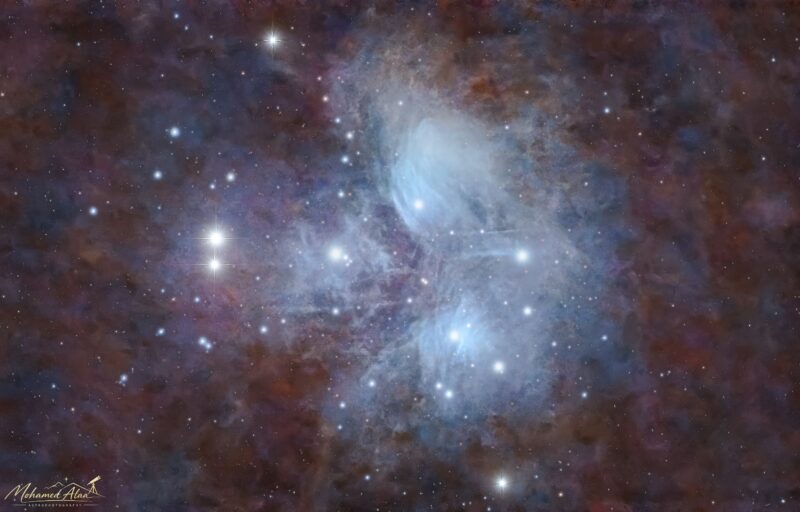
A runaway star in the Pleiades
Stars are born from clouds of gas in space. Sometimes many stars are formed from a single cloud. They become members of star clusters. The well-known and beautiful Pleiades cluster is thought to have formed from one huge cloud of gas. Astronomers use the term ‘runaway star’ to describe a star that has escaped from its cluster. This runaway star is called GD 50.
Object GD 50 may be such a runaway star. It’s a white dwarf star with a bit more mass than our sun, but smaller than the Earth. A dime as dense as GD 50 would weigh 2,600 pounds.
GD 50 is now visible in the direction of the constellation Eridanus. Astronomers at the University of Leicester in England discovered that it moves through space in the same direction and at the same speed as the Pleiades. It’s also about the same age. These astronomers conclude that GD 50 was born in the Pleiades, then was flung out, possibly after passing too close to another star.
The Pleiades or Seven Sisters
The Pleiades cluster is sometimes called the Seven Sisters, and legend has long told of a lost sister.
But that lost sister can’t be GD 50. White dwarfs were once much brighter stars, and at one time GD 50 outshone all the current Pleiades members. But the star last shone brightly 60 million years ago, long before people arose on Earth to see it.
Read more: Lost sisters of the Pleiades are scattered across the sky
Bottom Line: GD 50 is a runaway star that most likely was part of the Pleiades star cluster.
Like what you read?
Subscribe and receive daily news delivered to your inbox.
More from
Editors of EarthSky


Look for Mercury this week, farthest from morning sun

See the Summer Triangle in the northern autumn sky
Meteor shower guide 2026: Up next … the Leonids
When will the Blaze Star erupt? Will neutrinos give us a warning?