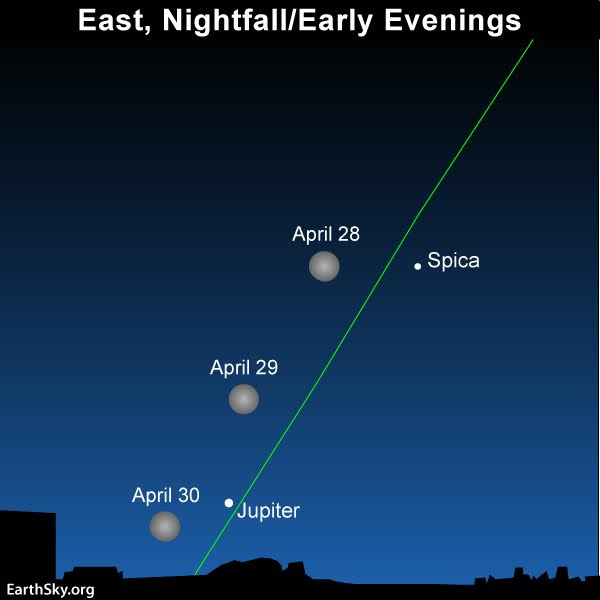
These next several evenings – April 28-30, 2018 – watch for a brilliant “star” close to the very bright moon. It’s no star at all, but the giant planet Jupiter, largest world in our solar system. The April 29 full moon will be close to Jupiter, and the April 30 moon even closer.
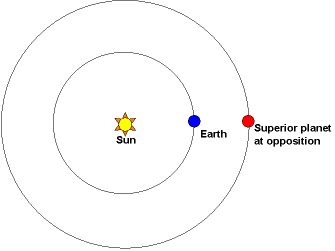
With or without the moon, you’ll find Jupiter climbing into the evening sky about an hour after sunset. This planet will soon reach its yearly opposition, when Earth will fly between Jupiter and the sun, gaining a lap on the planet for this year. Jupiter’s opposition will come on May 9, 2018.
At opposition, Jupiter rises in the east as the sun sets in the west. It’ll be out all night, from dusk until dawn. Since we’ll be generally closest to it, it’ll be the best time to observe Jupiter with a telescope, and even good-quality, steadily held binoculars should let you glimpse the ever-changing dance of Jupiter’s moons.
One last thing … it’s fun to stand outside in a fairly level spot, where you can see the horizons, and watch Jupiter and Venus in late April 2018. As Earth spins under the sky, Venus is now descending in the west as Jupiter ascends in the east. Around now, if you have an unobstructed view of the sky, you should easily see the sky’s two brightest planets – Venus in the west, and Jupiter in the east – as night falls.

Bottom line: Watch for Jupiter near the moon April 28 to 30, 2018.
Like what you read?
Subscribe and receive daily news delivered to your inbox.
More from
Deborah Byrd


Visible planets and night sky guide for October

Cassiopeia the Queen is overhead on autumn evenings
What star in the northeast flashes colorfully? It’s Capella!
Proxima Centauri is the closest star to our sun