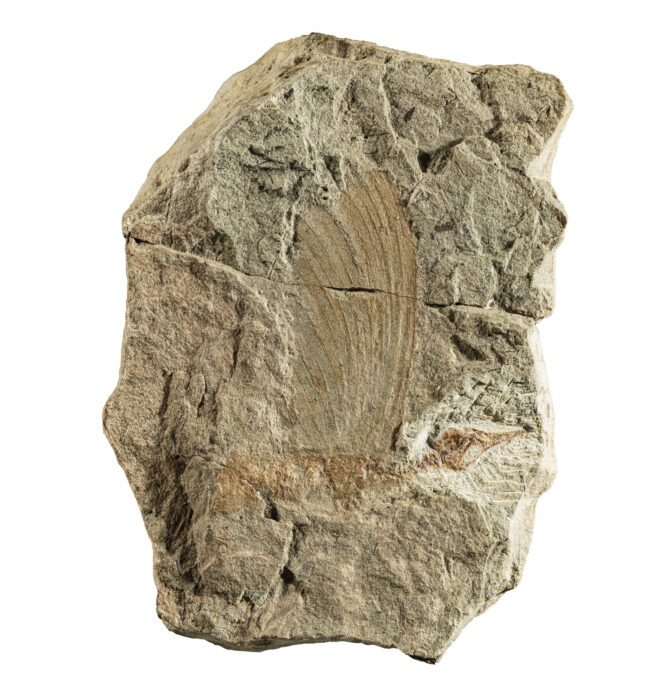
- The Mirasaura grauvogeli was a reptile that lived around 250 million years ago. The fossil of this creature shows a large crest.
- The soft tissue that made up this crest is a bit of a puzzle. It appears to be neither feathers, scales nor hair.
- The fossil provides the first direct evidence for complex skin appendages early during reptile evolution.
By Valentina Rossi, University College Cork and Maria McNamara, University College Cork
A mysterious fossil and the evolution of skin and feathers
A delicate, innocuous little fossil from the reptile known as Mirasaura grauvogeli – “Grauvogel’s wonder reptile” – is forcing a rethink about the evolution of skin and its appendages such as feathers and hair.
The newly discovered fossil is from the Middle Triassic Grès à Voltzia site in northeast France, making it some 247 million years old. It preserves evidence of some of the most astonishing soft-tissue features described to date in ancient reptiles. We are two of the authors of a new paper on these finds, published in Nature.
The fossil shows that the tree-dwelling Mirasaura had a large and startling crest along its back. The crest is formed by elongated appendages that are neither scales, feathers nor hair.
A reptile with a crest
Until now, scientists thought complex skin outgrowths such as feathers only evolved much later, in birds, dinosaurs and pterosaurs. This probably occurred through a single origin in the common ancestor of these animals. In all other types of reptile, the only skin outgrowths present are scales.
Mirasaura has overthrown this paradigm in sensational fashion. Compared with the size of its body, the long blades of its tall dorsal crest are enormous. Closer inspection reveals this crest comprised individual, overlapping appendages. Each had a narrow central ridge and a lobed outline, similar to the shaft and form of feathers.
However, the fossil structures seem to lack the fine branching architecture that characterizes most feathers in modern birds. What’s more, Mirasaura is not related to birds, dinosaurs or pterosaurs. Instead, it belongs to a very ancient group of reptiles, the drepanosauromorphs, which are known only from the Triassic.
The soft tissues of Mirasaura are preserved as a thin brown film, rich in fossil melanosomes. These are cell structures that contain the pigment melanin during life. Research by our team at University College Cork and others has revealed widespread preservation of fossilized melanosomes in ancient vertebrates. These pigment granules can actually be used to reconstruct melanin-based color patterns in extinct animals.
What the research showed
Our team’s research has shown that fossil melanosomes can also help reconstruct the soft tissue anatomy of fossil animals. That’s because melanosomes from different body tissues have different shapes and sizes. Our comprehensive examination of the fossilized soft tissues in Mirasaura, coupled with rigorous statistical analysis of the preserved melanosomes, reveals that their geometry is consistent with melanosomes in feathers. But it’s not consistent with melanosomes found in hair and in reptilian skin. This strongly suggests the Mirasaura skin appendages share common developmental features with feathers.
Were the Mirasaura structures feathers, then? The solid, continuous blade of soft tissues either side of the central shaft shows no evidence for branching, which is a defining characteristic of most feathers in birds, dinosaurs and pterosaurs. The water is muddied, however, by the simple unbranched structure of some peculiar feathers in birds. One example is the bristles of the turkey’s so-called beard. Similar unbranched filaments are known in many dinosaurs and pterosaurs. These are widely considered to represent simple feathers.
Certain dinosaur fossils even have flattened, strip-like feathers that lack branching but possess a central shaft. Some experts consider this to be an unusual – extinct – feather type. Whether the resemblance between these fossil structures and the Mirasaura skin outgrowths is superficial or belies closer evolutionary ties remains to be seen.

Fossil provides direct evidence of complex skin appendages
Intriguingly, research on the developing chick embryo shows that feathers can lose their branched structure when certain genes are manipulated. We are currently examining in greater detail the morphology and composition of the Mirasaura structures to help us interpret their anatomy more definitively.
Irrespective of what type of skin outgrowth they represent, our analyses of the anatomy of Mirasaura consistently position it, as well as other drepanosauromorph reptiles, at the base of the reptile tree. This supports data from developmental biology indicating that the genetic basis for the growth of complex skin appendages probably originated in the Carboniferous period, over 300 million years ago.
Mirasaura therefore provides the first direct evidence that complex skin appendages did appear early during reptile evolution. Thus, they are not unique to pterosaurs, birds and other dinosaurs.
We owe these new insights to painstaking conservation efforts, which serve as a reminder of the critical importance of natural history collections in conserving our natural heritage.
More about Mirasaura
Fossil collector Louis Grauvogel unearthed the earliest discoveries of Mirasaura remains in the 1930s. After decades in the Grauvogel family, these specimens were donated to the State Museum of Natural History Stuttgart in 2019, where careful preparation revealed their true significance.
Now, the Mirasaura specimens force us to accept that even before the age of dinosaurs, reptiles were evolving striking anatomical traits normally associated with much younger fossils. This adds an intriguing dimension to future research into the origins of feathers. And it prompts paleontologists to consider fossils from more diverse reptile groups … and from time periods before the appearance of dinosaurs and their direct ancestors.
Valentina Rossi, Postdoctoral researcher, Palaeontology, University College Cork and Maria McNamara, Professor, Palaeobiology, University College Cork
This article is republished from The Conversation under a Creative Commons license. Read the original article.
Bottom line: A fossil of an ancient reptile shows a distinct crest that is made neither of feathers, scales or hair. It’s forcing scientists to rethink the evolution of skin and feathers in reptiles.
Read more: How did dinosaurs become birds? This fossil offers insights

Like what you read?
Subscribe and receive daily news delivered to your inbox.
More from
EarthSky Voices


Why leaves change color in the autumn

How a helium leak in an exoplanet atmosphere hints at life
Would a Yellowstone supervolcano eruption end humanity now?
Neptune discovered on this date 180 years ago