Pegasus is a baseball diamond! Just in time for the World Series

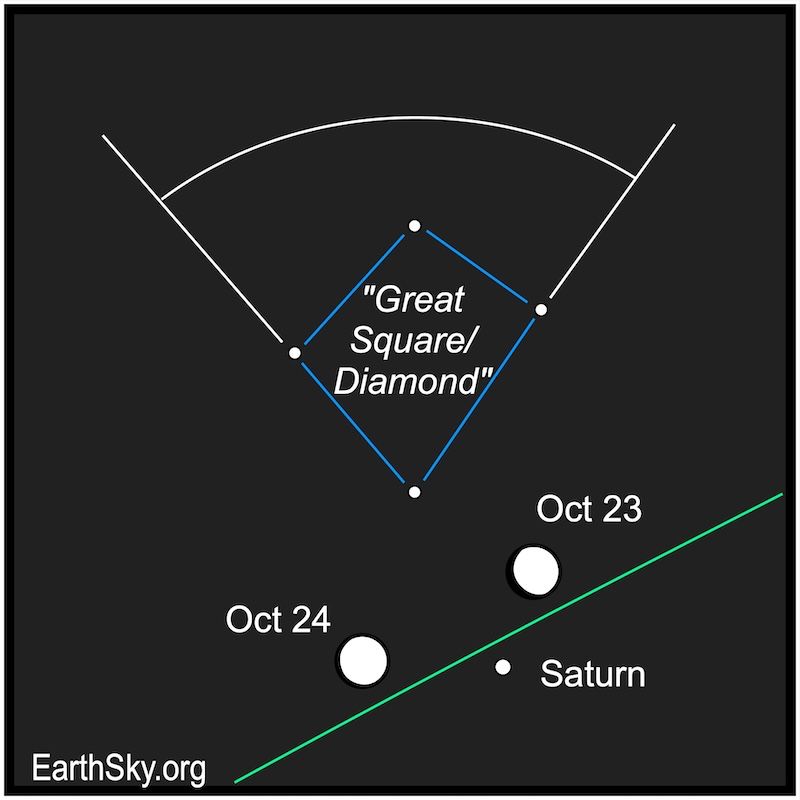
Almost out of nowhere, the summer skies have become the autumn skies. And, with that, here we are in the meat of baseball’s playoffs. One of the things I love most about this time of year is how, almost to celebrate baseball’s holy month, the skies bring us a mighty interstellar baseball diamond.
This weekend, after you’ve finished trying to find Saturn as it hides among the eastern sky’s stars, turn a bit to the left. As darkness falls, you’ll see a huge square of four stars rising into the eastern skies.
“Wait. That’s the Great Square of Pegasus. What does that have to do with baseball?”
Well … baseball’s played on a diamond, right? And what’s a diamond if not a square turned 45 degrees? As mid-October and the playoffs come along, the Great Square sits over the horizon with home plate at the bottom. Second base sits higher above, about halfway toward Vega and Deneb, which you might remember from such asterisms as the out-of-season Summer Triangle.
Over time, the diamond will turn and square itself out. But for now, there’s a game of astro-baseball (spaceball?) happening somewhere out there.
The stars of the Great Diamond
The points of this diamond are 2nd- and 3rd-magnitude stars a couple of hundred light-years away. Behind the plate is Algenib, an old star about five times the size of our sun. Then, heading around the horn, are Markab at first, and the red giant Scheat is at second.
At the hot corner is the beautiful Alpheratz, about 100 light-years away. Oh, Alpheratz. Even though its name comes from Arabic and means something like the horse’s navel, it’s actually not in Pegasus at all, but in Andromeda, right on the border. In fact, for many years, it was considered part of both constellations.
I really love that star. For me, there’s something about it that really makes me happy. Maybe it’s its muted, far-off, icy color, or maybe it’s that I use it to find the great Andromeda Galaxy in my binoculars. With a good view of that part of the sky, you can see a line of three stars extending from the Great Square Baseball Diamond off toward the northwest. That’s the rest of Andromeda the Chained Lady. And that constellation is home to the Andromeda Galaxy, or Messier 31, just a couple million light-years away.
Make the sky your own
Many years ago, long before I learned much about the constellations, I stood staring out the window. The Brewers were playing the Cardinals in the World Series on the TV behind me. I loved baseball, still do, but I was a Yankees fan, still am. So, when Robin Yount and Ozzie Smith weren’t batting, I was a little bored. I stared and noticed those stars and made my own asterism out of them. That’s one of the things I love most about watching the skies. We can all turn out the lights, look away from the news, and make it our own.
After all these years, it’s fun to sit here and think of myself in 1982. It’s fun to still see those stars and think of them as a baseball diamond. It’s fun to think of where I was then and where I am now, here, writing about it.
Maybe this weekend, grab a baseball-obsessed kid, head out, and show them the most gigantic baseball diamond in the universe, too.
Don’t miss the next unmissable night sky event. Sign up for EarthSky’s free newsletter for daily night sky updates.
Bottom line: Pegasus is a baseball diamond! And you can see it, too. The Great Square of Pegasus is tilted to look like a diamond in October, as if to celebrate the World Series.
Read more: Pegasus the Flying Horse, and the best sky story ever
Read more: Great Square of Pegasus gallops into the autumn sky
Like what you read?
Subscribe and receive daily news delivered to your inbox.
More from
Scott Levine


Will you see the Jupiter-Mercury conjunction on August 15?
What does opposition mean for an outer planet?