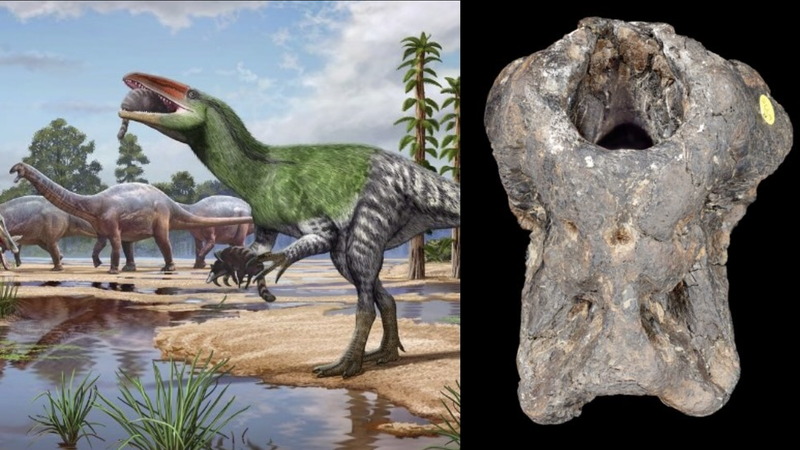
More than 100 years ago on the Isle of Wight, off the south coast of England, amateur paleontologist Reginald Walter Tooley found a dinosaur fossil. And, in 1924 — after Tooley’s death — the fossil came to the Natural History Museum in London. It was one of a batch of some 1,000 unstudied specimens. The fossil then sat in a drawer for a century. No one knew it would bring to light a new dinosaur species.
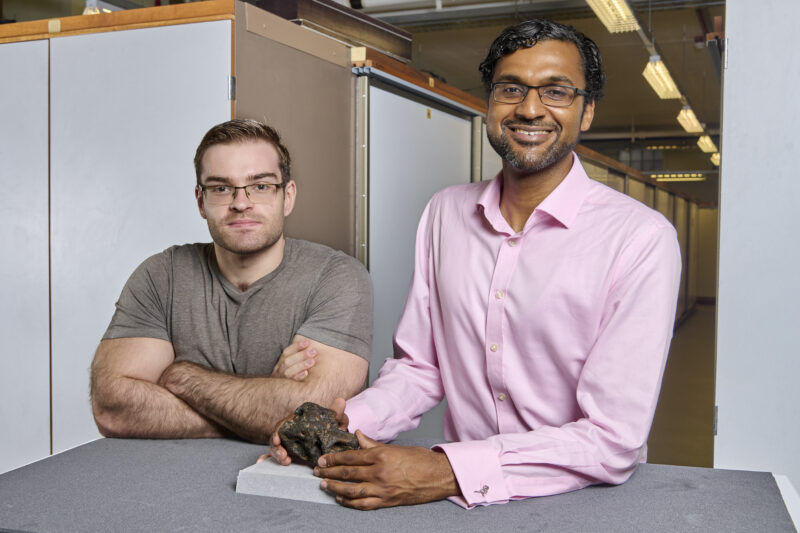
Fast forward 100 years. Two paleontologists — Cassius Morrison and his student Charlie Scherer of University College London Earth Sciences — pulled the long-overlooked specimen out of storage. They wondered if it could be reevaluated using modern diagnostic techniques.
The researchers used CT scanning to get a better understanding of the fossil. And they used 3D modeling to show what this dinosaur would have been like when it roamed what’s now the Isle of Wight some 120 million years ago.
They published their peer-reviewed research in the journal Royal Society Open Science on October 14, 2026. They said they’d named this newly recognized dinosaur species Invictibellatrix amberina.
Morrison commented:
It’s a real mystery that this fossil was overlooked for so long, sitting in a drawer for nearly 100 years. Lots of bones are found on the Isle of Wight. Who knows what else is waiting to be discovered.
What’s in a name?
The word amberina primarily honors the amber embedded within the plant debris beds of the Wessex Formation on the Isle of Wight, where the 120-million-year-old fossil was originally collected.
Invictibellatrix, meanwhle, translates from Latin as unconquered female warrior.
The researchers said this dinosaur would have been about as tall as a human. It stood on two legs, ate meat, and likely had feathers, they said. It would have used its arms and giant claws to attack smaller prey. such as smaller dinos, lizards and mammals.
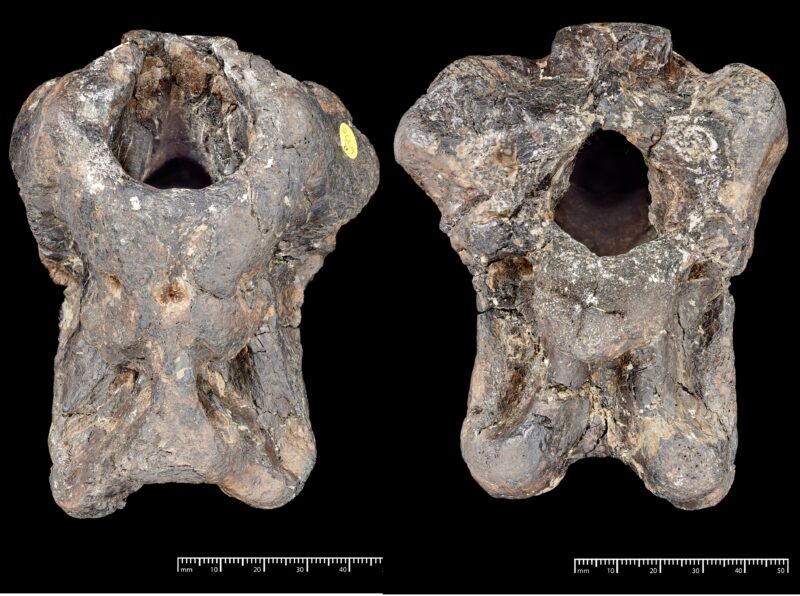
They found that the skull has an oval hole where the brain and spinal cord would have met. The hour-glass-shaped crest was also distinctive; this crest was what led to the classification as a new species.
It might have been gigantic, but wasn’t
The new dinosaur species belonged to a group of two-legged dinos called the megaraptorans. A species of megaraptoran had never been discovered to exist in Europe until now.
Megaraptorans could be gigantic, as big as a T-rex. But the new human-sized dinosaur is the smallest megaraptoran yet found. While it would have stood around the height of a human, at about 5 feet (1.5 meters), it would have been long from its head to its tail, spanning about 10-13 feet (3-4 meters). And those large, curved claws were likely around 4-8 inches (10-20 cm). These estimates are based on what we know of Invictibellatrix‘s closest relatives, the scientists said.
Cassius Morrison said:
It would have eaten small dinosaurs, lizards and mammals, occupying a similar role in the food chain to the hyena today.
And while humans didn’t yet exist while Invictibellatrix was on Earth, Morrison said:
It was not the apex predator of its time, but for humans this dinosaur would have been more dangerous than a T. rex. We would have been perfectly sized prey, about 1/3 of their body weight. They definitely would have chased us. A T. rex would not have bothered, as we would have been too small.
Where might the new dinosaur species have lived?
Invictibellatrix amberina is the first member of the megaraptoran family known to live in Europe. Researchers think megaraptorans originated in Asia. Later, they traveled through Europe. The larger carnivorous species became apex predators in areas of what is today Africa, South America and Antarctica. Scherer commented:
This new species is the first proof we have that megaraptorans were also present in Europe and that they reached Gondwana this way rather than island-hopping further south.
The larger megaraptorans came later and lived farther south. Researchers think the smaller megaraptorans who lived farther north died out earlier.
Bottom line: Researchers have identified a new dinosaur species from a fossil found on Isle of Wight in the U.K. The carnivorous dino would have stood about as tall as a human.
Like what you read?
Subscribe and receive daily news delivered to your inbox.
More from
Kelly Kizer Whitt


The MMX mission launches to Mars’ moons on Monday

Visible planets and night sky guide for October
No more leap seconds! Timekeeping is officially changing
Space is getting crowded. Here’s the latest satellite report