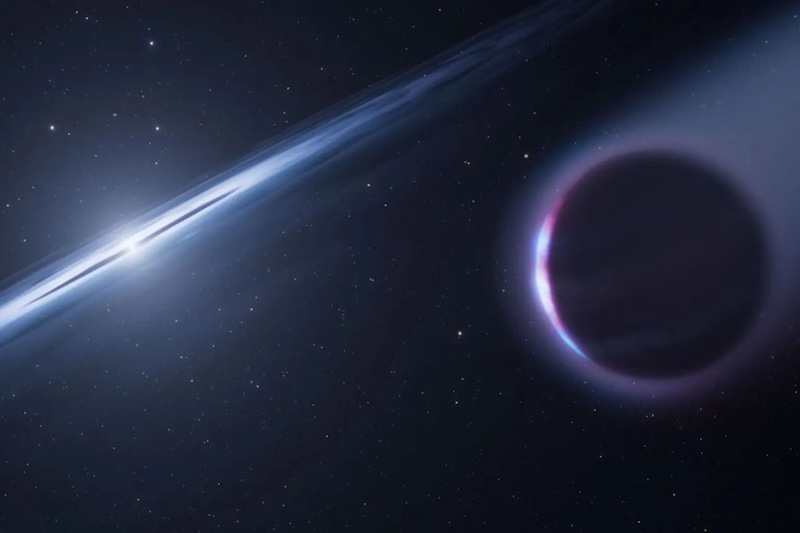
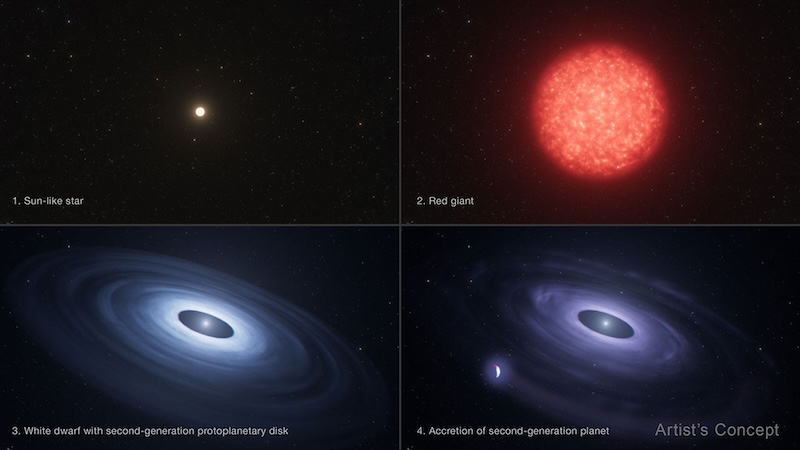
- Planets form in the disks of dust and gas around newborn stars. These are called 1st-generation planets. But there are 2nd-generation planets too. A 2nd-generation planet can form in the material cast off from dead white dwarf stars.
- Astronomers might have found a 2nd-generation planet around the white dwarf HS 0209+0832. It is in archives from the Hubble Space Telescope.
- A “cold case” mystery about the white dwarf might now be solved thanks to the discovery.
Science news, night sky events and beautiful photos, all in one place. Click here to subscribe to our free daily newsletter.
Astronomers detect possible 2nd-generation planet
Planets typically form from the huge disks of dust and gas around newborn stars. These are what scientists call 1st-generation planets. But our universe evolves. So it should also contain 2nd-generation planets. A 2nd-generation planet is one that formed in material cast off from a dead star.
Now, for the first time, astronomers have detected a possible 2nd-generation planet that formed around a white dwarf. That is, the dense core left over by a dying star. They detected this planet in the data archive of the Hubble Space Telescope.
The potential discovery might solve an old “cold case” mystery about this white dwarf, which is named HS 0209+0832. Scientists have known for some time that this white dwarf has an unusually high amount of the element niobium in its atmosphere. And they’ve wondered … why? This phoenix-like planet rising from the dead star’s ashes might be the answer.
The researchers published their peer-reviewed paper in Nature Astronomy on October 5, 2026.
1st chapter of a long tale
We tend to think that after a star dies — probably along with its planets — that that’s it. But it’s not necessarily the end of the story. Astronomer Jamie Williams is the lead author of the new study at the University of Warwick in the U.K. He said:
Rather than the white dwarf stage being a kind of epilogue to the story of a star and its planets, this research points to the systems we are familiar with only being the first chapter of a potentially much longer tale, with some new characters showing up. That’s a really exciting prospect to pursue.
He added:
The 2nd-generation planets are worlds that form out of the material a star casts off as it dies. They’re incredibly rare, and finding one around a white dwarf was completely unexpected. It’s a bit like finding a planet that has risen from the ashes of the very star it once orbited.
Unknown chemical signatures
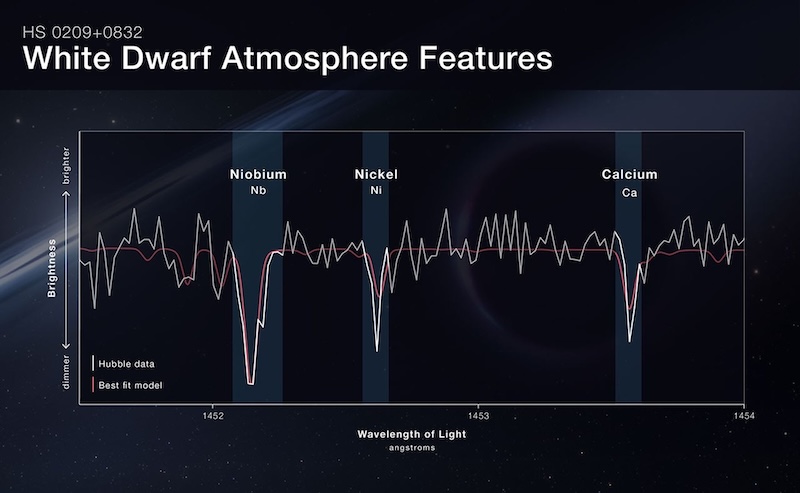
Ever since Hubble first observed HS 0209+0832 in 1999, a mystery has shrouded the white dwarf. Hubble detected about 100 chemical signatures that couldn’t be identified.
At the time, they remained unknown. But now, the researchers have used an updated chemical database. They found that the element niobium could explain many of these detections. And there was a lot of it. Williams said:
What Hubble is showing us in this white dwarf system is something we haven’t seen before: a high abundance of the element niobium, the signature of which I was unfamiliar with when I first found it in the archival data.
Niobium points to a 2nd-generation planet
The amount of niobium is also a clue. It suggested the presence of a planet that formed after the original star had died and became a white dwarf: a 2nd-generation planet. Co-author Nicholas Stone, a theoretical astrophysicist at the University of Wisconsin – Madison, said:
Niobium and other elements heavier than iron are astronomically special because, unlike many common elements, they are not formed in the cores of stars by thermonuclear fusion. Instead, these heavy elements can only be synthesized in the exotic conditions that briefly emerge inside dying stars. The presence of niobium is a signpost of these ‘death’ throes, and the expulsion of the dying star’s innards into space.
This pattern of elements is a telltale sign of the ‘s-process,’ a nuclear reaction that builds heavy elements inside dying stars during their bloated red giant phase. It’s a chemical signature no ordinary, ‘1st-generation’ planet should carry, which told us that this new planet was something different.
This is the first time that scientists have detected niobium in the atmosphere of a white dwarf, as co-author Boris Gaensicke, also at the University of Warwick, noted:
When Jamie asked me about niobium in relation to this study I was truly gobsmacked, as that element had not been reported in any other white dwarf analyzed to date. Once we realized it was there, everything fell into place.
What kind of planet is it?
The researchers estimate the planet itself to be about the size of Jupiter, therefore a gas giant. But it is quickly losing its atmosphere. Why is that?
The researchers say it is because the white dwarf is still very hot and bombarding the planet with intense radiation. Not surprising, since the planet orbits only 3.7 million miles (6 million kilometers) from the white dwarf. That’s a lot closer than Mercury is from the sun, at 36 million miles (58 million kilometers).
In fact, the planet might have a comet-like tail of material. This material would then fall back onto the white dwarf. That’s why the niobium is in the atmosphere of the white dwarf. And notably, Mercury also has a tail, of sodium.
Even though the white dwarf planet is losing its atmosphere, it will likely survive for a long time yet, as Williams noted:
If the 2nd-generation planet is there, I think it is likely to survive. Eventually the white dwarf will cool and then maintain a consistent temperature, with the planet in its stable habitable zone for millions of years.

A companion star?
The researchers also think that the white dwarf might have had a companion star. Williams said:
Forming the protoplanetary disc in this situation is not easy and helps explain why these planets are so rare. A single, isolated star dies and sheds mass in a roughly symmetrical way. To form a disc of material necessary to birth a planet, HS 0209+0832 likely required a companion star that pulled the ejected material back into orbit, rather than letting it escape.
Data about the 2nd-generation planet from other missions
Two other missions also provided additional data that support the existence of the 2nd-generation planet. These are NASA’s now-retired FUSE (Far Ultraviolet Spectroscopic Explorer) and NASA’s TESS (Transiting Exoplanet Survey Satellite).
FUSE corroborated the findings of large amounts of niobium in the white dwarf system. And TESS observed the system for four straight months. It detected periodic variations in brightness of the white dwarf. These variations are evidence for a planet that orbits at only 3.7 million miles (6 million kilometers) from the white dwarf.
The HS 0209+0832 system will provide valuable data about white dwarfs and any planets that still exist around them. As Gaensicke said:
I think this research is an important example of the fact that scientific discovery is not a straight path. It often needs that magical moment when people discuss big questions on their minds and realize that together they can find unexpected answers.
Bottom line: Astronomers might have found a new 2nd-generation planet orbiting a white dwarf star. It could also help answer a “cold case” mystery about the white dwarf.
Source: Discovery of a 2nd-generation planet candidate accreting onto a white dwarf
Read more: Speedy white dwarf planets are more likely to be habitable
Like what you read?
Subscribe and receive daily news delivered to your inbox.
More from
Paul Scott Anderson


Weirdest cloud on Mars formed via ‘exotic physics’

Did formaldehyde on ancient Mars help kickstart life?
Black holes could have planets, new simulations suggest
Is this an alien radio signal from a super-Earth exoplanet?