Science news, night sky events and beautiful photos, all in one place. Click here to subscribe to our free daily newsletter.
- We know that Mars once had lots of water on its surface. And a new study says there might have been formaldehyde in some of that water.
- Atmospheric formaldehyde was likely brought down to the surface through rainfall, the researchers in Japan suggests.
- In water, formaldehyde can kickstart the chemical reactions to produce the sugars and organic molecules needed for life.
Follow the ancient rains on Mars
Did life once exist on Mars? Various clues in recent years have moved the answer toward “quite likely.” But we still don’t know for sure. Now there’s another possible clue: formaldehyde.
Scientists said on October 1, 2026, that atmospheric formaldehyde could have mixed with rainwater billions of years ago. And in water, formaldehyde can help start chemical reactions that produce sugars, amino acids and other complex organic molecules needed to start life.
The researchers — from Tohoku University, the Earth-Life Science Institute and the Institute of Science Tokyo in Japan — wanted to know where this formaldehyde would have actually been present on Mars’ surface. The new study makes some interesting findings.
The intriguing new peer-reviewed results were published in The Planetary Science Journal on September 30, 2026.
Formaldehyde on ancient Mars
We know that Mars once had plentiful water on its surface, including rain, rivers, lakes and a probable ocean. And some studies have shown that the early atmosphere on Mars likely produced formaldehyde, a pungent, colorless gas.
Why is that important? When formaldehyde is mixed in water, something very interesting happens. Chemical reactions create sugars, amino acids and other complex organic molecules. These are the molecules needed to help give a kickstart to life.
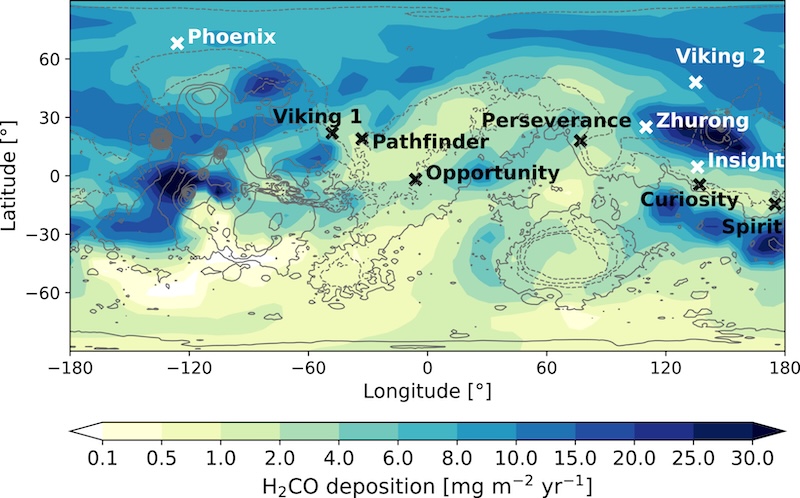
Where was the formaldehyde?
If there was formaldehyde on Mars long ago, where exactly was it? The researchers created a global map showing where the gas would most likely have been located on the surface.
They simulated the warmer conditions of the time, about 3.8 to 3.6 billion years ago. With this model, the researchers studied how temperature, water vapor, pressure and ultraviolet (UV) light affected the formation of formaldehyde.
The results indicated that water vapor was of particular importance. First, UV light broke down the water molecules. This released reactive hydrogen , which was needed to form the formaldehyde.
Then, rains brought the formaldehyde down to the surface. Based on this, the researchers concluded that areas with more water had more formaldehyde. So basically, the water cycle determined which areas would have more formaldehyde.
Lead author Shungo Koyama at the Institute of Science Tokyo and Tohoku University said:
By comparing our map with findings from rovers, we can begin to test whether places that received more H2CO were also more favorable for early life-related chemistry. If future observations confirm this relationship, our map could help identify promising targets for future Mars missions.

Mountainous regions get the most formaldehyde
As it turned out, mountainous regions received the most rainfall and had the most formaldehyde. In fact, regions like Tharsis and Elysium had 10 times more formaldehyde than the global average. Both areas have huge towering volcanoes.
To note, this estimate is for how much formaldehyde Mars had way back then, not now.
Did formaldehyde help start life on Earth?
Back in 2011, another study published in Proceedings of the National Academy of Sciences showed that formaldehyde might have also helped start life on Earth.
Scientists think that billions of years ago, a Mars-sized object slammed into the Earth, blasting out debris that formed the moon. The collision, most experts say, caused huge numbers of organic molecules to flee our planet. But sticky formaldehyde molecules held onto a fair chunk of Earth’s carbon that we might have otherwise lost. We might owe our existence to that ancient formaldehyde.
Bottom line: Formaldehyde in the ancient rains on Mars might have provided crucial chemical reactions needed for life to begin on the red planet billions of years ago.
Read more: Formaldehyde might have helped start life on Earth
Read more: New study says rain on ancient Mars fed rivers and lakes
Like what you read?
Subscribe and receive daily news delivered to your inbox.
More from
Paul Scott Anderson


Black holes could have planets, new simulations suggest

Is this an alien radio signal from a super-Earth exoplanet?
Life on Enceladus? 2 new studies boost chances
Water systems on early Mars were complex and hot