



High school teacher finds 1st-ever adult T. rex trackway
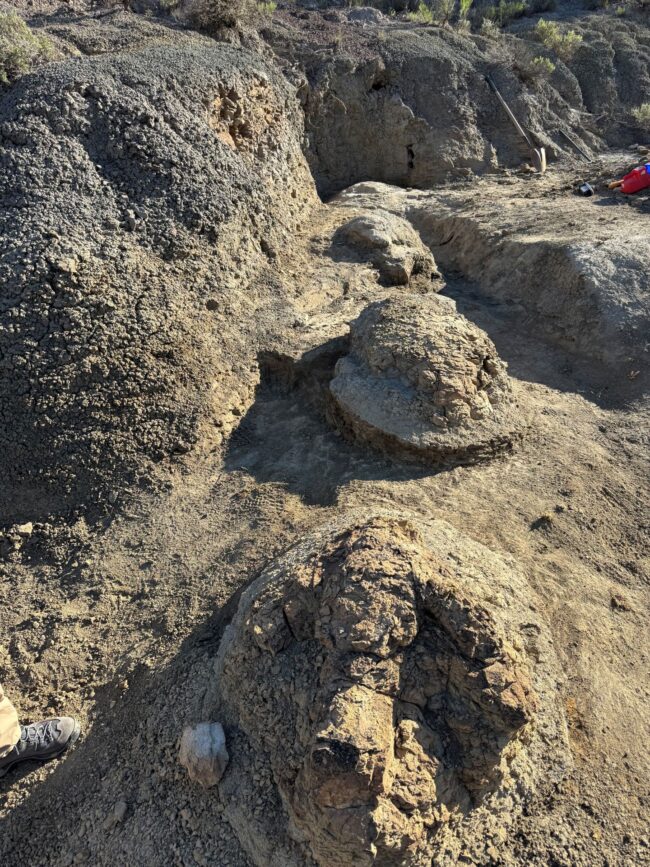
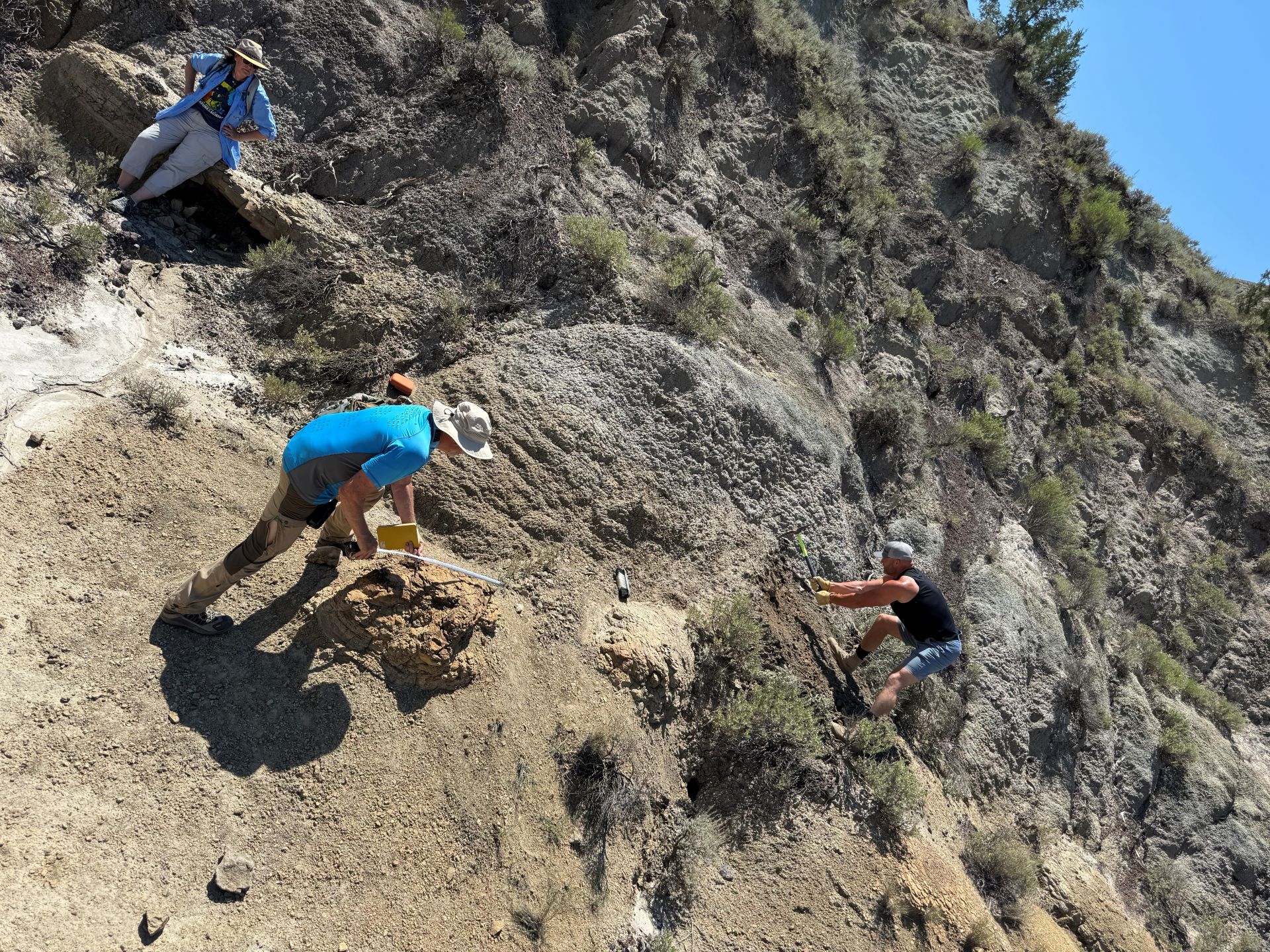
A Colorado high school science teacher, Kent Hups, was volunteering on a dig in North Dakota with the Denver Museum of Nature & Science when he made a remarkable discovery. He spotted a Tyrannosaurus rex footprint, and then soon discovered three more, forming a trackway. It’s the first known discovery of an adult T. rex trackway. The footprints are preserved in sandstone at the Hell Creek Formation and are about 66.5 million years old.
The Denver Museum of Nature & Science said on September 9, 2026, the trackway extends for 23 feet (7 meters). These T. rex footprints allow researchers a glimpse of the ferocious predator in motion.
Hups, who became a co-author of the paper, said:
As a teacher, I’m always telling my students that science starts with curiosity, passion and careful observation. I never imagined that could lead me to a discovery like this.
The researchers published their peer-reviewed study of the T. rex trackway in the Journal of Vertebrate Paleontology on September 8, 2026.
A closer look at the T. rex trackway
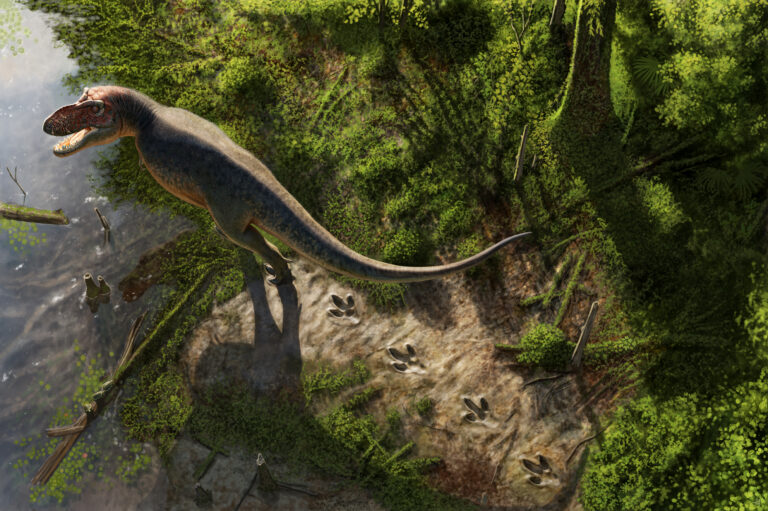
The T. rex trackway consists of four large footprints. Each footprint is roughly 3 feet (1 meter) long. The footprints include two from the left foot and two from the right. The researchers were able to estimate that the T. rex was walking at a speed of about 3.5 to 4.5 miles per hour (5.6 to 7.2 kilometers per hour). That’s about the pace of a brisk human walk.
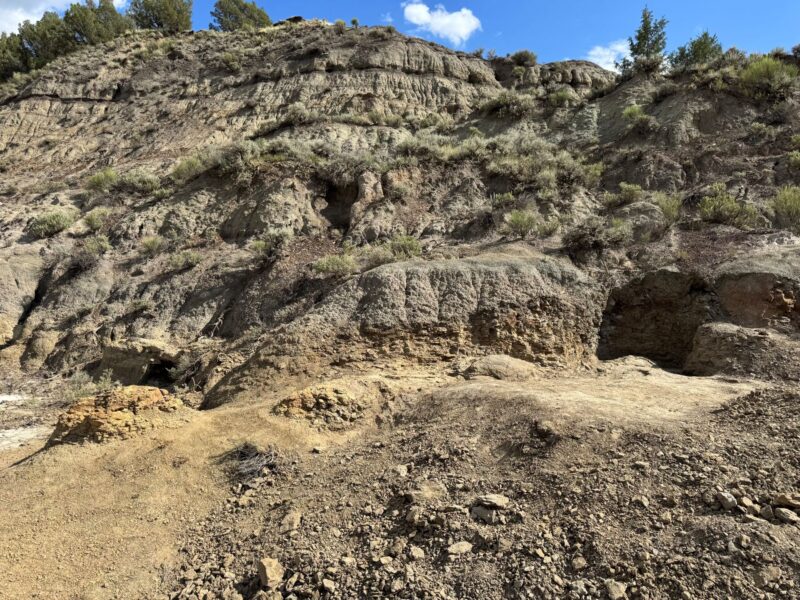
The tracks are part of the Hell Creek Formation. This is a famous fossil-rich site that preserves rocks and fossils from the final part of the Cretaceous.
Why are the footprints raised?
Normally when we think of footprints, we think of depressions in the ground. And that’s how these started out, too. The dinosaur stepped into a soft mud and made an indent in the ground. Later, the footprint pooled with water and then sand or mud washed into the depression, filling it.
Eventually, that sediment hardened. And over millions of years, the filled-in footprint becomes rock. With even more time, softer rock that was around the surrounding footprints erodes away. In this case, what’s left behind is the harder sediment that had filled in the footprints. So what you see today is essentially an inverted footprint: a natural cast of the original track.
Ancient footprints are also preserved in other ways. Sometimes it’s the ground the dino stepped on that remains harder than subsequent layers. In those cases, you do have a preserved indentation of a footprint, such as in Ouray, Colorado.
Watch more: Hike along these dinosaur tracks in Colorado
Get a better perspective of the T. rex trackway in this video. Video via Peter Falkingham/ Denver Museum of Nature & Science.
How do scientists know it was a T. rex?
There are several clues pointing to the trackway belonging to a T. rex. First is that the footprints themselves are huge. Also, the narrow shape of the toes suggests they are from a T. rex. Plus, the area around the trackway is rich in T. rex fossils.
In fact, scientists have found individual footprints in this area before that they have attributed to adult T. rexes. But this is the first sequence of footprints — a trackway — that they believe is from a T. rex.
Co-author Tyler Lyson of the Denver Museum of Nature & Science said:
Bones tell us an enormous amount about these animals, but footprints capture a moment of behavior. With a trackway, we can actually follow an animal as it moved across the landscape. That is incredibly rare for T. rexes.
Scientists scanned the tracks in 3D
The researchers have used high-resolution 3D surface scanning to document the footprints and the entire trackway. Eventually, they plan to excavate the tracks themselves to display in the Denver Museum of Nature & Science.
The scans were able to produce such a detailed digital model of the tracks that the lead author never even saw them in person. Peter Falkingham is a professor of paleobiology at Liverpool John Moores University and a dinosaur track expert. He said:
The technology we’re able to apply in the digital age means my colleagues could scan the tracks in the field and then send the 3D information over to me to visualize on my computer and in VR, enabling me to take as close a look as they did in person.
You will soon be able to see the tracks for yourself if you visit the Denver Museum of Nature & Science.
Bottom line: A high school teacher discovered four footprints that make up the first-ever known T. rex trackway. He discovered it at Hell Creek Formation in North Dakota.
Via Denver Museum of Nature & Science
Read more: Rare juvenile T. rex discovered by young fossil hunters
Like what you read?
Subscribe and receive daily news delivered to your inbox.
More from
Kelly Kizer Whitt


Huge new Webb image is chock-full of space delights

Wildfires near the South Pole burned 90 million years ago
JUICE mission to fly by Earth in late September
Mercury is shrinking up to 30% more than expected


