



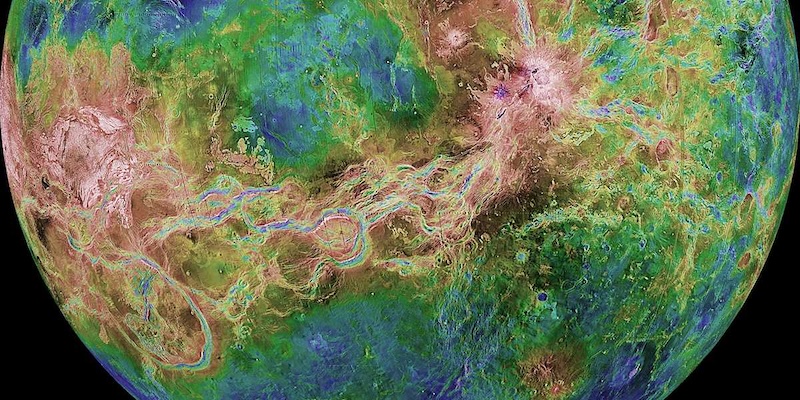
- Is Venus dead geologically? Or is it still active? New evidence from ETH Zurich suggests that Venus is still active.
- Recent analysis of huge rift valleys show that they formed more recently than previously thought.
- This means that they could still be active today. This is in addition to other evidence for currently active volcanoes on Venus.
Is Venus dead?
Scientists once thought Venus was geologically dead. But growing evidence of active volcanoes suggests the planet might still be rumbling beneath its thick haze and clouds. On July 24, 2026, researchers at ETH Zurich in Switzerland said the planet’s huge rift valleys might have been active more recently than thought … and perhaps still are active.
Rift valleys are low areas that form when Earth’s tectonic plates pull apart. This creates a sunken floor called a graben with steep walls on the sides. One example on Earth is the East African Rift.
The researchers published their peer-reviewed findings in Nature Geoscience on July 24, 2026.
Article: Rifts on Venus are still, or were recently, active and may have undergone faster extension than usually assumed, potentially because of mantle plume activityhttps://t.co/gSkCUQ2RLB
— Nature Geoscience (@NatureGeosci) July 24, 2026
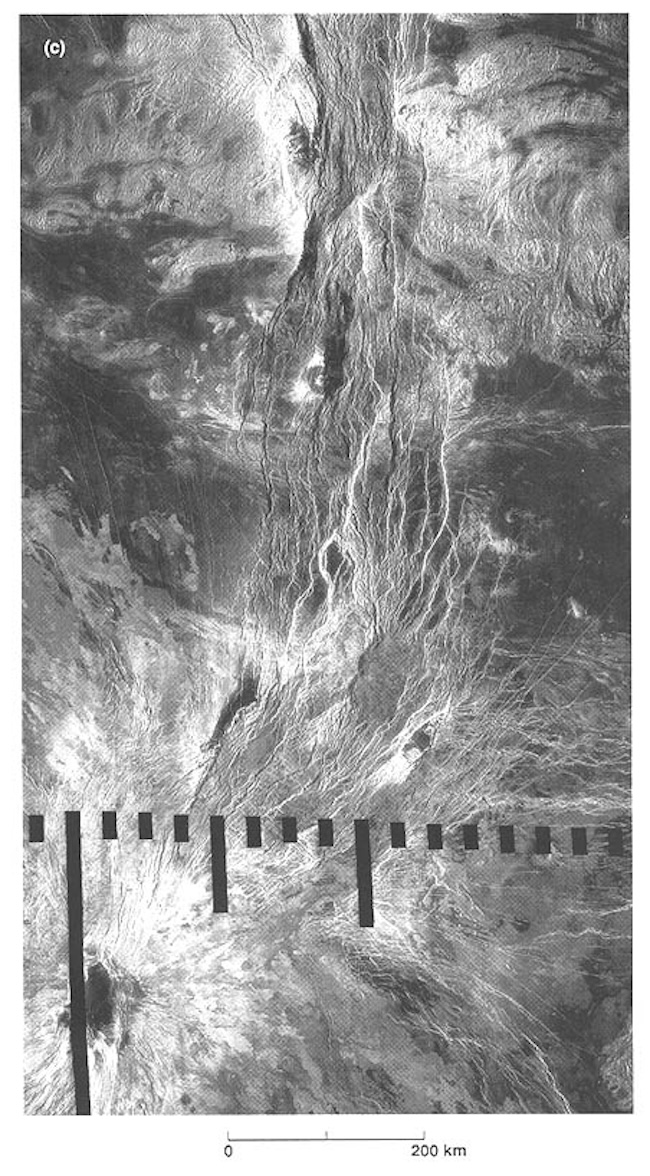
New 3D models of rift valleys on Venus
Xi Yang, the paper’s lead author, conducted the research as part of his master’s studies under Taras Gerya, professor of geodynamics at ETH Zurich.
The research team created a new computer model to simulate rift valleys on Venus. The high-resolution 3D simulations are the first of their kind. They can simulate known rift valleys on Venus in great detail. Earlier models were simpler and were mostly 2D.
The simulations revealed broad ridges called rift flanks. They form along the edges of rift valleys. This happens when the rift valleys are still relatively young geologically and are still moving or have stopped moving only recently. The analysis also suggests that the rifts widen faster than scientists previously thought, at a rate of about 3–10 centimeters (1–4 inches) per year.
The results are further evidence that Venus is still tectonically active beneath the surface. The study did not directly measure the valleys moving. Instead, the researchers inferred recent activity from their shapes. Gerya said:
The results help us to better assess the tectonic activity on Venus.
The study found that the rift flanks eventually flatten after movement ends. The older the rift system, the flatter and narrower its flanks become. Crustal relaxation causes the flanks to subside. On Earth, though, erosion is usually responsible.


Active volcanoes and lava tubes on Venus
There has also been growing evidence in recent years that Venus’ volcanoes are still active. Much of this evidence has come from re-analysis of old data from NASA’s Magellan mission.
In addition, scientists have found evidence for lava tubes on Venus. One lava tube announced earlier this year is wider and taller than any on Earth.
Scientists will now be able to use the data from the study to pinpoint the likely most active regions on Venus. And future missions, such as the European Space Agency’s EnVision (2031), NASA’s VERITAS (2031) and DAVINCI (early 2030s), ISRO’s Venus Orbiter Mission (2028) and Rocket Lab/MIT’s Venus Life Finder (TBD), could then focus on these areas.
Taken together, these discoveries show that Venus has been a geologically very active planet, and still is. What else will we learn from future missions?
Bottom line: A new study of huge rift valleys on Venus shows that they are likely younger than previously thought and might still be geologically active today.
Source: Recent active rifting on Venus revealed by wide rift flank uplifts
Read more:
Active tectonics on Venus? Old data reveal new clues
Like what you read?
Subscribe and receive daily news delivered to your inbox.
More from
Paul Scott Anderson


Lucy mission to Trojan asteroids: 5 years of discoveries

Surprising colors of white dwarf stars revealed for 1st time
Caves on the moon are target of new NASA mission
2nd-generation planet: Was this world born around a dead star?



