



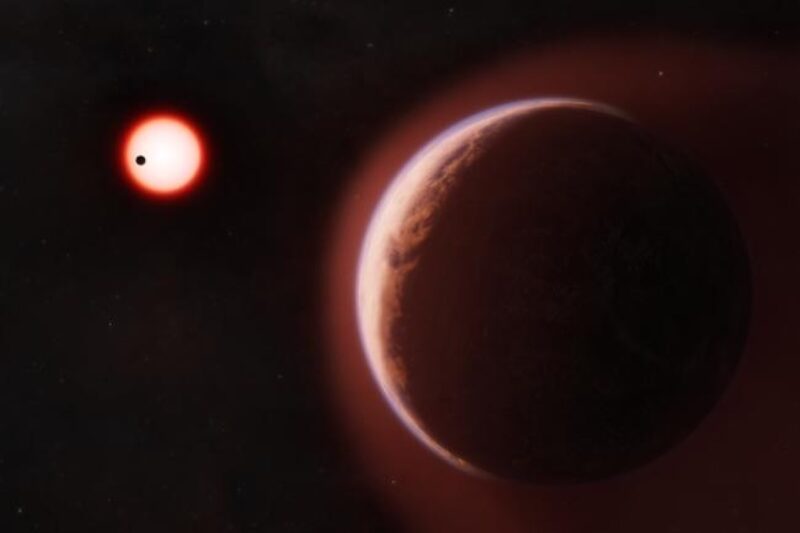
- LHS 1140 b is a super-Earth exoplanet 48 light-years away. It orbits in the habitable zone of its red dwarf star.
- Scientists have just found evidence that this world has an atmosphere. The evidence comes from helium leaking from the planet into space.
- The researchers estimate the atmosphere is over 3 billion years old. More observations are needed to know the atmosphere’s composition.
1st detection of atmosphere on rocky exoplanet
For the first time, astronomers have found strong evidence for an atmosphere on a rocky exoplanet in the habitable zone of its star.
The planet, LHS 1140 b, is a super-Earth planet about 48 light-years from us. LHS 1140 b orbits a red dwarf star within the so-called habitable zone. Being in this zone doesn’t necessarily make a planet fit for life. The habitable zone is simply the region around a star where temperatures would allow water to remain liquid, which is crucial for life as we know it.
The researchers, led by the Center for Astrophysics | Harvard & Smithsonian in Cambridge, Massachusetts, said on July 16, 2026, that they detected helium escaping from LHS 1140 b. And this kind of helium escape also happens in the atmospheres of Earth and other planets.
LHS 1140 b is 1.73 times the radius of Earth and 5.6 times Earth’s mass. The researchers say that’s consistent with an Earth-like bulk along with a lower-density part, such as an atmosphere or a high abundance of water.
The planet has an estimated equilibrium temperature of 116 degrees Fahrenheit (47 degrees Celsius).
The researchers published their exciting peer-reviewed results in Science on July 16, 2026.
A major milestone
The discovery is a major milestone in the study of rocky exoplanets. That’s because an atmosphere is essential for life as we understand it. Lead author Collin Cherubim at Harvard University said:
An atmosphere is essential for a planet to support life as we know it. This is the first time anyone has found an atmosphere on a rocky planet in the habitable zone of another star.
Co-author Robin Wordsworth added:
20 years ago we wondered whether other terrestrial-type planets even existed. Then we learned they’re common, and found some in the habitable zone. The next question was whether any of them had managed to keep an atmosphere. Now we know at least one has.
Cherubim and his colleagues were testing their theoretical model of LHS 1140 b. The model predicted that the planet would have an atmosphere, with helium escaping from the upper atmosphere into space. The researchers used the Warm Infrared Echelle (WINERED) Spectrograph on the Magellan Clay Telescope at Las Campanas Observatory in Chile for their observations of LHS 1140 b.
And, in fact, they observed both known planets of the star LHS 1140. Both LHS 1140 b and LHS 1140 c transited their star on the same night. The researchers saw no evidence of an atmosphere on LHS 1140 c, which is smaller and more heavily irradiated by its star. But LHS 1140 b was a different story.
Escaping helium points to an atmosphere
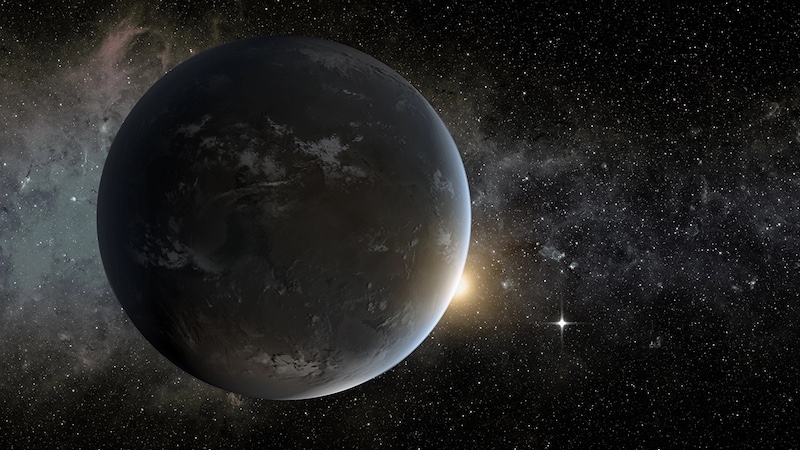
The researchers found helium escaping from LHS 1140 b. This kind of helium escape has been seen before on some planets, including Earth. Helium, a very light gas, will move to the top of an atmosphere, where it will start leaking into space. And the data was solid. David Charbonneau, head of the Harvard Department of Astronomy and astronomer in the Center for Astrophysics | Harvard & Smithsonian, said:
Collin analyzed the planets we knew about and predicted that this one would have a helium atmosphere. Then he organized telescope time, got the data and the detection was statistically rock solid.
The X-ray data from Magellan Clay explained the rate at which the planet lost its helium. This is due to X-ray radiation from the host star. Therefore, the X-ray data proved the rocky object must be replenishing its supply of helium. If it wasn’t, there would be no helium remaining in the planet’s atmosphere.
Notably, the researchers detected the helium escape in 2024 but not in 2025. This indicates that the atmospheric escape process is variable. It also means the atmosphere likely no longer contains any primordial hydrogen in its atmosphere. That’s good, since it hints that the atmosphere is more complex and evolved, like on rocky planets in our solar system, including Earth. Other gases and water would be below the top helium layer.
An ancient atmosphere
The researchers say that the atmosphere has likely survived for more than 3 billion years.
Astronomers had found that some other rocky exoplanets don’t have atmospheres. This was cause for a bit of pessimism among scientists. As Jason Dittmann at the University of Florida noted:
We were getting to the point in the field where maybe all of these planets don’t have an atmosphere, and we need to look at ones around sun-like stars instead of smaller stars. And then finally here is actually one with an atmosphere, and it happens to be the one that I had spent so many hours working on.
LHS 1140b is one of the current selected targets under the Rocky Worlds Director’s Discretionary Time (DDT) Program. Rocky Worlds DDT is a joint program for the James Webb Space Telescope and the Hubble Space Telescope that is dedicated to finding evidence of atmospheres on rocky exoplanets orbiting dwarf stars.
We still don’t know what the rest of the atmosphere, below the upper helium layer, is composed of. That will require additional observations to figure out. As Cherubim noted:
This has been a model validation, and hopefully it’s just the first of many more observations to come.

Bottom line: Scientists have found an atmosphere on rocky exoplanet LHS 1140 b. The super-Earth planet, 48 light-years away, is in the habitable zone of its red dwarf star.
Source: Helium escaping from the atmosphere of a nearby rocky exoplanet orbiting in a habitable zone
Via Center for Astrophysics | Harvard & Smithsonian
Read more: New habitable exoplanets model narrows down search for life
Read more: Habitable exoplanets could exist around nearby stars
Like what you read?
Subscribe and receive daily news delivered to your inbox.
More from
Paul Scott Anderson


Lucy mission to Trojan asteroids: 5 years of discoveries

Surprising colors of white dwarf stars revealed for 1st time
Caves on the moon are target of new NASA mission
2nd-generation planet: Was this world born around a dead star?



