




2 asteroid flybys yield new closeup images
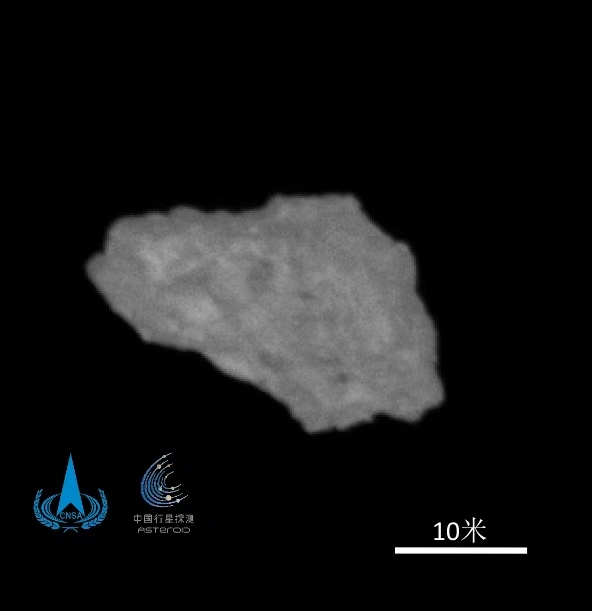
Space agencies from both China and Japan have just shared images from flybys of two different asteroids in our solar system. On July 2, 2026, China’s Tianwen-2 probe flew past asteroid Kamo’oalewa from a distance of just 12.5 miles (20 km). Then on July 5, 2026, Japan’s Hayabusa2 flew past asteroid Torifune from a mere 6 miles (10 km) distant.
Both space agencies caught images of the asteroids. Kamo’oalewa might be a chunk of the moon ejected in a giant impact. And Torifune revealed itself to be two rubble piles joined together, or what astronomers call a contact binary.
Flyby of asteroid Kamo’oalewa
On July 6, 2026, the China National Space Administration said:
The Tianwen-2 probe has arrived at its target asteroid and begun scientific exploration.
Tianwen-2’s target is the asteroid Kamo’oalewa, which is a near-Earth asteroid. The asteroid has a strange orbit that keeps it in unison with Earth. This resonant orbit makes it a quasi-satellite of Earth. A 2024 study showed Kamo’oalewa might have once been a part of the moon that blasted away during an impact that formed the lunar crater Giordano Bruno.
China’s mission to the asteroid began back on May 29, 2025, with the launch of Tianwen-2. After a journey of what the space agency called about 400 days and 621 million miles (1 billion kilometers), Tianwen-2 will now:
… conduct more detailed scientific explorations to obtain information on the asteroid’s shape, material composition and internal structure, providing support for preparations for sampling.
Flyby of asteroid Torifune
Hayabusa2’s journey to Torifune has taken much longer. The mission launched to space in December 2014. At that time, its target was the asteroid Ryugu. In 2020, Hayabusa2 rendezvoused with Ryugu and took samples that it sent back to Earth. Analysis of the samples show they are rich in primitive organic material.
After Ryugu, the Japan Aerospace Exploration Agency (JAXA) sent the Hayabusa2 probe on an extended mission to Torifune. The probe arrived at 18:30 Japan Standard Time on July 5, 2026. Hayabusa2 made several observations during its flyby. JAXA is still acquiring this data, so expect more revelations about the asteroid to come!
But Hayabusa2’s extended mission is not over. After a couple of swings past Earth, the space probe is headed for the tiny asteroid 1998 KY26. The asteroid is just 36 feet (11 meters) in diameter. Hayabusa2 should arrive at the asteroid in 2031.
Bottom line: Japanese and Chinese space agencies both completed asteroid flybys in early July 2026. See the closeup images here.
Via China National Space Administration
Like what you read?
Subscribe and receive daily news delivered to your inbox.
More from
Kelly Kizer Whitt


Why does anything exist? New theory emerges

Visible planets and night sky guide for October
Euclid was mapping the universe. Then it found a comet
Auriga the Charioteer and bright Capella on October evenings



