



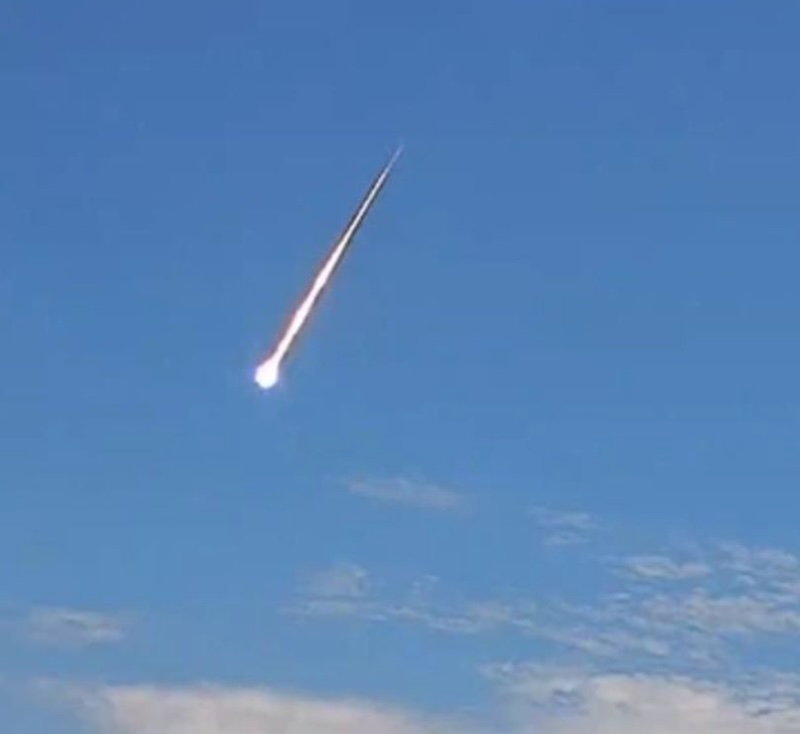
Flash and boom over Massachusetts
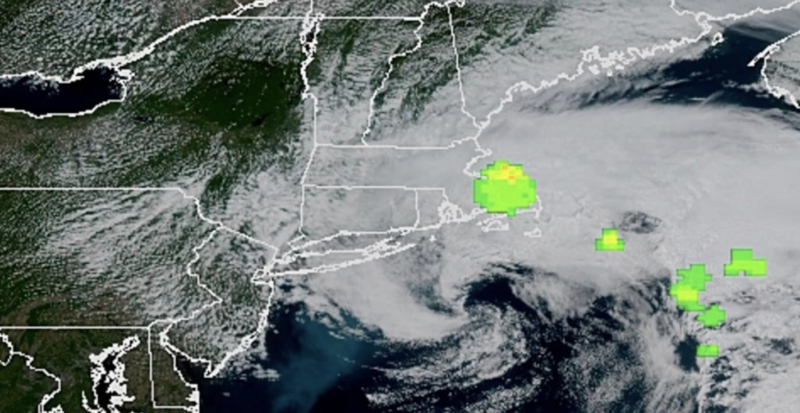
Many in the U.S. East – particularly around Massachusetts – reported a bright daytime meteor streaking across the sky at around 2:07 p.m. EDT (18:07 UTC) yesterday afternoon (May 30, 2026). And eyewitnesses also reported hearing a big double BOOM. The reports came in to the American Meteor Society’s report a fireball page. Meanwhile, NOAA’s GOES-19 satellite recorded a flash over that part of the North American continent. NASA also chimed in on X, calling the event a “meteor,” and suggesting:
The meteor appears to have fragmented at an altitude of 40 miles (64 km) over northeast Massachusetts and southeast New Hampshire. The energy released at breakup is estimated to be equivalent to about 300 tons of TNT, which accounts for the loud noise.
Experts later suggested the object was traveling at a speed of 75,000 mph (121,000 kph).
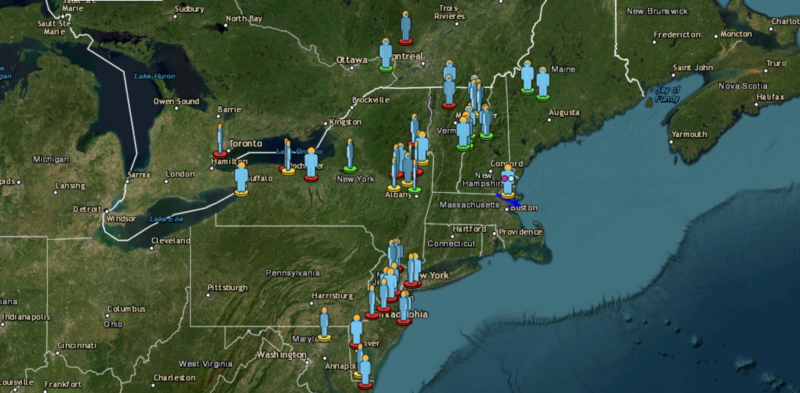
Eyewitness reports
Eyewitnesses noted on the AMS events page that the meteor looked like a shooting star in the daytime sky.
A witness in Hudson Falls, New York, explicitly reported that the fireball was:
… very easily visible in full sunlight.
Another in Stowe, Vermont, stated that:
… the ‘falling fire’ stood out clearly against the bright sky.
While many caught a glimpse of it, an even greater number of people on the ground reported hearing a massive double boom and feeling buildings shake around 2:07 p.m. EDT (18:07 UTC).
How often does this happen?
Exact statistics on daytime meteors – over Earth as a whole – are hard to come by. The vast majority would go unnoticed in the bright sunlight. But scientists and meteor organizations still have a clear estimate of how often they should happen.
According to data from the American Meteor Society (AMS) and planetary scientists:
- A lot of space debris strikes Earth’s atmopshere daily. Astronomers estimate that roughly 100 to 150 tons of space debris hits Earth’s atmosphere every single day. Most of this is dust or tiny pebbles. But larger chunks capable of producing a bright “fireball” (objects ranging from the size of a softball to a small car) hit the atmosphere about 500,000 times per year. As a further example, in 2014, the Nuclear Test Ban Treaty Organization reported 26 atom-bomb-scale impacts to our atmosphere over a 14-year period. This organization operates a network of sensors, monitoring Earth continually for the infrasound signature of nuclear detonations.
- Still, daytime reports are rare. Bright sunlight can mask even bright incoming fireballs. Plus, most fall over the ocean or over other uninhabited areas (deserts, ice caps, forests). Finally, most people don’t simply don’t look up much.
- Estimated global visibility. According to the American Meteor Society, a daytime fireball bright enough to easily break through full sunlight and be noticed by casual observers on the ground only happens over any given localized, populated area once every few years.
Bottom line: Many reports a fiery streak in the daytime sky and a boom, probably a meteor, over the U.S. East.
Like what you read?
Subscribe and receive daily news delivered to your inbox.
More from
Deborah Byrd


Great Square of Pegasus gallops into the autumn sky

2026 September equinox: All you need to know
Why is planet Venus so bright in Earth’s sky?
Zodiacal light: Start watching for it now


