



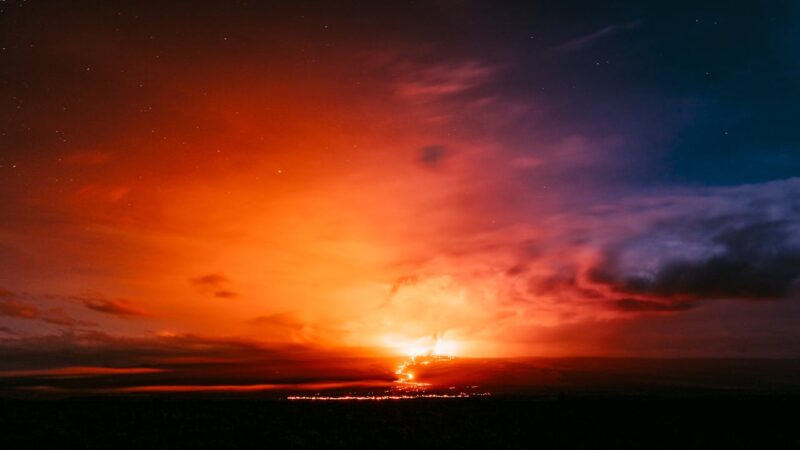
The biggest US supervolcanoes you’ve never heard of
When you hear the word supervolcano, you might think of Yellowstone National Park. Some 2 million years ago, the Yellowstone volcano erupted so violently that it covered more than 5,790 square miles (15,000 square kilometers) with ash. Its deposits covered 21 states and parts of Canada.
But there were two other eruptions of supervolcanoes within the United States that were even larger. One was La Garita in Colorado 27.8 million years ago. And the other was at Wah Wah Springs in Utah and Nevada 30 million years ago.
Why haven’t you heard of them?
Despite their enormous size, these supervolcanoes are not widely known outside scientific circles. That’s partly because they’re so old. Erosion has softened their features, and later geological activity has reshaped the land.
Yet both these ancient eruptions – in present-day Colorado and spanning the Utah-Nevada state line – rank among the largest known volcanic events in Earth’s history.
In contrast, Yellowstone is geologically young and still active. Its geysers and hot springs still showcase the land’s volcanic nature. Plus, there’s a chance that Yellowstone will erupt again someday, though another supereruption is far from guaranteed. And it could be tens of thousands of years in the future.
Wah Wah Springs is the largest known US eruption
The Wah Wah Springs Caldera eruption occurred about 30 million years ago. It erupted after the age of the dinosaurs but before the rise of humans. But the rhinos, camels, tortoises and palm trees that lived there at the time are still preserved in the sediments.
Wah Wah Springs is one of the largest volcanic eruptions scientists have ever discovered. And they only did so in 2013.
Scientists from Brigham Young University said that the volcano erupted over the course of a week, releasing some 201 trillion cubic feet (5,700 cubic kilometers) of ash and magma. To put that into perspective, it was about 5,000 times larger than the 1980 eruption of Mount St. Helens.
Ash from Wah Wah Springs blanketed vast regions of what is now the western United States. Some of the debris from this eruption still exists in layers up to 13,000 feet (4 km) thick in southern Utah.
Watch Brigham Young University scientists describe the Wah Wah Springs Caldera supervolcano.
La Garita still shows its scars in Colorado
Another colossal eruption occurred at the La Garita Caldera in southern Colorado some 28 million years ago. It was a time of intense volcanic activity across what we now call the San Juan volcanic field. La Garita belched out around 176 trillion cubic feet (5,000 cubic kilometers) of material that spread across tens of thousands of square miles.
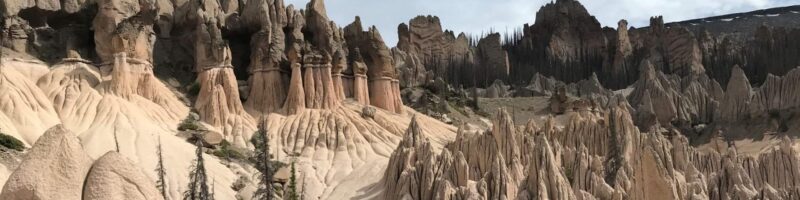
You can still see the results of this supervolcano in the Wheeler Geologic Area near Creede, Colorado. Erosion of the volcanic ash has created needlelike formations. Geologists have named the deposits left behind by this eruption the Fish Canyon Tuff.
Today, it’s still possible to make out the caldera – or the collapsed basin of the volcano – in satellite images of Colorado. The area is directly west of Great Sand Dunes National Park.
What makes a supervolcano?
Scientists use the term supervolcano for eruptions that eject more than 240 cubic miles (1,000 cubic kilometers) of material. Both Wah Wah Springs and La Garita far exceed that threshold. Fortunately, both these supervolcanoes are now extinct. Yellowstone is still an active volcanic landscape.
Supervolcanic eruptions don’t look like the cone-shaped volcanoes we often imagine. Instead, they involve massive underground magma chambers. When pressure builds to a breaking point, the ground above collapses, forming a caldera. This huge depression can span dozens of miles.
The eruption itself can last for days or weeks. And it sends towering columns of ash into the atmosphere, triggering flows of superheated gas and rock called pyroclastic flows. Supereruptions, though rare, have global consequences. Ash clouds can block sunlight, alter climate and disrupt ecosystems worldwide. The eruption of Mount Tambora in 1815, just shy of a supereruption, created The Year Without a Summer.
A different kind of landscape
As you can see, tens of millions of years ago, the American West was home to massive volcanic fields. The eruptions from the Wah Wah Springs and La Garita supervolcanoes created a layered terrain. And erosion and tectonic forces wore down these volcanoes and layers of tuff, leaving us with the landscapes we see today.
Bottom line: Two of the biggest US supervolcanoes erupted millions of years ago, and you’ve probably never heard of them: Wah Wah Springs and La Garita.
Read more: Juno spots most extreme volcanic activity on Io to date
Read more: The most recent volcanoes on Mars were surprisingly active
Like what you read?
Subscribe and receive daily news delivered to your inbox.
More from
Kelly Kizer Whitt


Visible planets and night sky guide for October

World Space Week is October 4 to 10. Find events here
What are the world’s loudest birds? Here are 2 contenders
And the Fat Bear Week winner is … Backpack!



