Venus superior conjunction on January 6
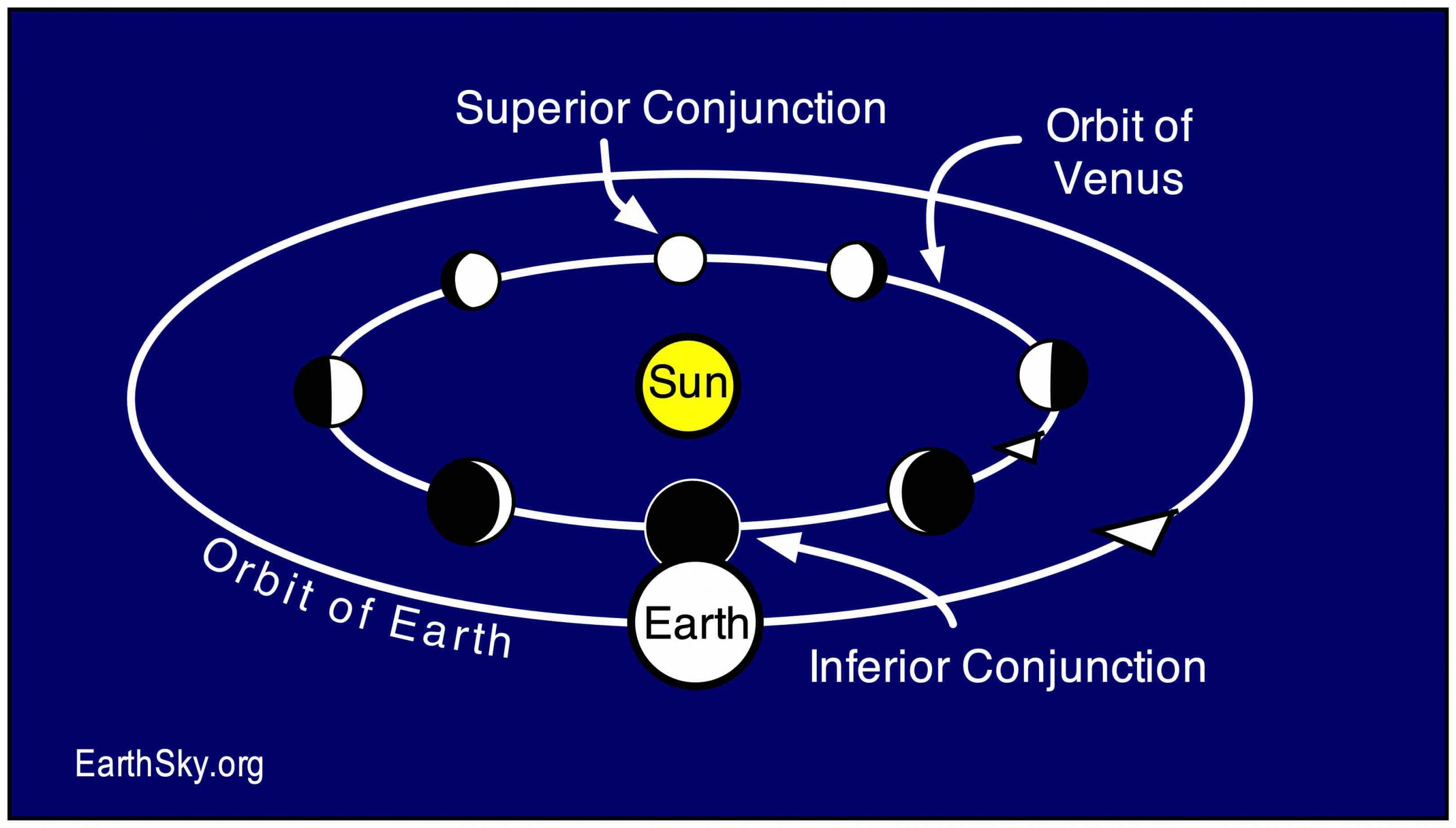
Venus orbits the sun one step closer than Earth. So it stays near the sun in our sky, as the morning “star” or evening “star.” When it’s up, you can spot Venus easily. It’s the brightest planet we see, far outshining all other stars and planets. And it’ll even more readily catch your eye when near a crescent moon. But where is Venus now? On January 6, the Earth, sun and Venus are most aligned in space for this year. And Venus is now generally on the opposite side of the sun as viewed from Earth. Venus will reach its superior conjunction – when it is almost – but not quite – behind the sun as seen from Earth – at 17 UTC (1 p.m. CST) on January 6, 2026.
Before early January 2026, Venus spent over eight months as a dazzling morning “star.” It reached greatest elongation – its greatest apparent distance from the sun in our sky – on June 1, 2025. It hung low in the east before sunrise for many months, before slipping away in the morning sunlight in late November 2025. Since then, it’s been too close to the sun to see. But it’ll return to the evening sky, probably around mid-February for Northern Hemisphere observers (some weeks later for Southern Hemisphere observers), for a lengthy evening apparition.
And here’s something fun! At this 2026 superior conjunction, the sun is nearly between us and Venus. Venus is passing almost directly behind the sun as seen from Earth. Keep reading …
At 2026 superior conjunction, Venus close to sun in sky
Venus’ orbit is tilted about 3.4 degrees to Earth’s orbit. Because of that tilt, at most superior conjunctions, Venus typically goes slightly north or south of the sun in our sky.
But, during the superior conjunction of Venus in early 2026, the planet will pass very close to the sun in our sky. It won’t go directly behind the sun as seen from Earth. That happens only rarely. But it will pass just outside one sun-diameter from the sun’s center.

At superior conjunction, Venus will pass only about 0.7 degree (about 42 arc-minutes) from the sun’s center in our sky. Meanwhile, the disk of the sun is 32 arc-minutes wide. So Venus will be just beyond the sun’s rim, or edge. And Venus is still outside the occulting disk of the sun-observing SOHO spacecraft’s LASCO C2 instrument (see image at top). So the sun will not occult or pass in front of Venus in 2026.
Does Venus ever take dead aim and pass directly behind the sun? An alignment that is truly dead-center as seen from Earth’s viewpoint might be expected on timescales of many thousands of years. But, because it doesn’t happen on any human-meaningful interval, we don’t have a date for when it will happen next.
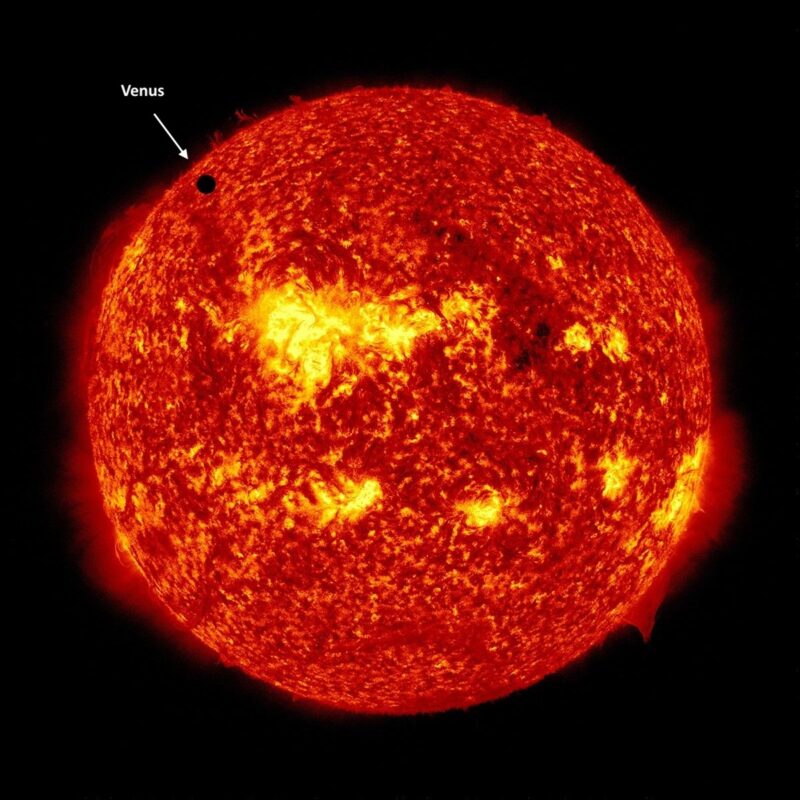
We can tell you that the disk of Venus is small in contrast to the sun’s disk. And sometimes Venus does pass in front of the sun (at inferior conjunction) as seen from Earth. The last time it happened was earlier in this century. Venus transits always come in pairs, which happen eight years apart, and which are separated from each other by 105 or 121 years. Here’s the last set of pairs:
- June 8, 2004
- June 5–6, 2012
The next Venus transit will be on December 10–11, 2117.
How often does Venus reach superior conjunction?
Venus comes to a superior conjunction every 584 days. At every superior conjunction, Venus moves from our morning sky to our evening sky (it moves from our evening sky to our morning sky at every inferior conjunction). Its next superior conjunction will be in August 11, 2027.
Earthly observers can’t see Venus in January 2026. It’s too close to the sun’s glare to see from Earth. But – for Northern Hemisphere observers – Venus will emerge into the evening sky around mid-February. If you have a clear western sky, you might see Venus as it’s joined briefly by the planet Mercury around February 18. Southern Hemisphere observers will have to wait some weeks longer to see Venus. When it does emerge – for all of us – Venus appear as a bright light in the western evening twilight: the glittering evening “star.”
When will you see Venus in the evening? If you’re in the Northern Hemisphere, you might see it as early as mid-February. Certainly – for Northern Hemisphere observers, assuming you have a clear western horizon – you’ll see it by early March. It’ll be harder to spot from Earth’s Southern Hemisphere than for us in the north. Southern Hemisphere observers might not see Venus until April.
For all of us, Venus will ascend in the evening twilight – rapidly for the Northern Hemisphere, gradually for the Southern Hemisphere – for some months after it appears. Overall, at this evening apparition, it’ll spend about eight months as a brilliant light in the evening sky.
It’ll disappear again, passing back into the sun’s glare (between Earth and the sun this time) in October 2026.
So is Mars in retrograde?
As you saw in the top image, Venus is approaching the sun from the right side. And in the next graphic on this page, you see that – from our point of view – the planets travel counterclockwise around the sun. So why is Mars appearing to enter from the left side in the top image, moving toward the sun? Is it some form of retrograde motion? Nope.
The SOHO spacecraft’s LASCO C2 instrument is stabilized so that the sun stays in the center of the frame. But from our point of view in the sky, these objects are all moving against the background stars. And these three objects are currently all moving in the same direction. But, in the image at the top of this post, the sun and Venus are moving more quickly in front of the stars, from our earthly perspective. So they are overtaking more-distant Mars.
But with the video keeping the sun centered in the frame, it looks as if only Mars and Venus are moving in our sky … and in opposite directions!
Bottom line: Venus reaches superior conjunction at 17 UTC (1 p.m. CST) on January 6, 2026. At that time, we on Earth are almost – but not quite – on a straight line with Venus and the sun, with the sun almost between us and this neighboring planet.
Like what you read?
Subscribe and receive daily news delivered to your inbox.
More from
Editors of EarthSky


Venus brightest in the evening sky this week

See Venus in the daytime: Here are 3 tips
Crepuscular rays are sunrays in twilight skies
What is retrograde motion? And why is the moon moving backwards?