



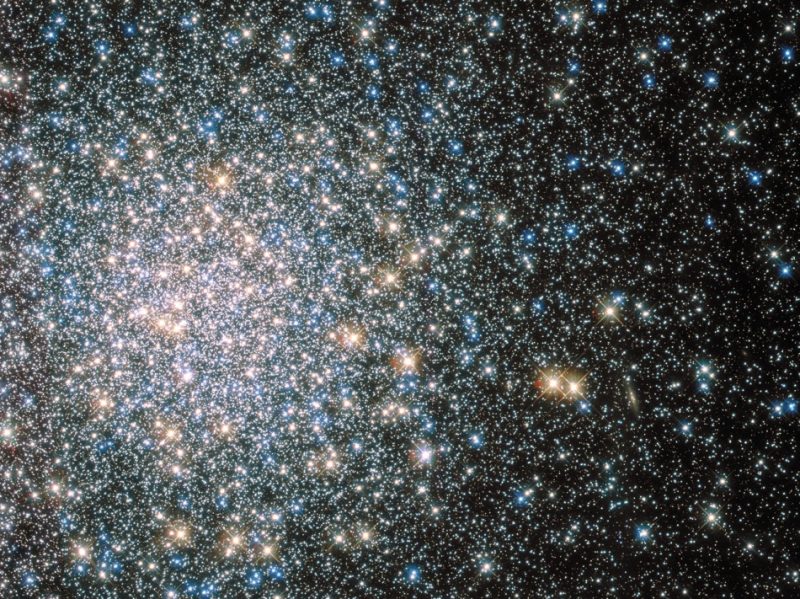
- Globular clusters are huge, symmetrical groups of stars packed closely together in space. They contain the most ancient stars in our Milky Way.
- They look like round fuzzy balls when seen through telescopes.
- Stars in the Milky Way’s globular clusters probably formed first, as our galaxy was starting to form.
A globular cluster contains ancient stars
Globular clusters are tightly packed, symmetrical collections of as many as 10 million stars. These behemoths can reach 300 light-years in diameter. They orbit mostly in the vast stellar halos surrounding most spiral galaxies, like the Milky Way. And they contain some of the very oldest stars in a galaxy.
In fact, the origin of globular clusters might be closely related to the birth of galaxies. One theory goes that each spiral galaxy was once a shapeless cloud of gas and dust, before its very first stars then collected into globular clusters. These clusters would then have stayed put in the halo around the galaxy’s center, while the rest of the spinning galaxy flattened out and formed spiral arms. This scenario would explain why we now see globular clusters orbiting in the Milky Way’s outskirts, and why they contain our galaxy’s most ancient stars.
But no one is precisely sure how globular clusters formed … or what role, if any, they played in the development of galaxies.
We do know that globular clusters are the oldest, largest and most massive type of star cluster. Their age is determined by their almost complete lack of what astronomers call metals, which are the heavier elements forged in star interiors. That’s important because the early universe, before the first stars and galaxies were born, contained only the two lightest elements: hydrogen and helium.
The difference between a globular cluster and an open cluster
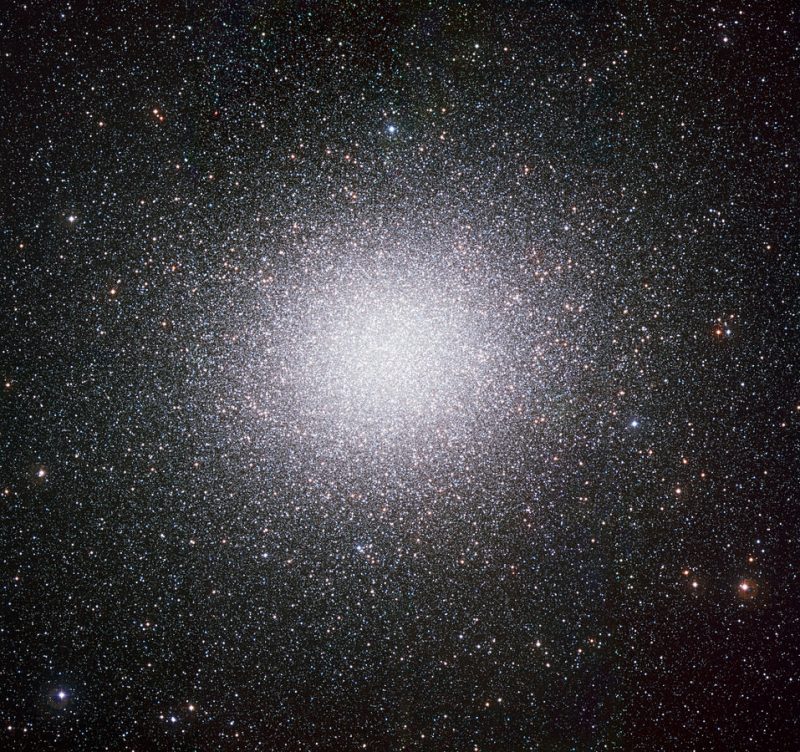
Globular clusters are symmetrical in shape, and are densest toward their centers. On the other hand, open star clusters – such as the Pleiades – are irregular in shape and loosely grouped together.
Globular clusters orbit in the halo of our galaxy. Their positions center around the galaxy’s core and expand above and below the galactic disk. Open star clusters tend to orbit within the disk. That is, their stars are scattered throughout the disk of our galaxy, and the same is presumably true in other galaxies.
Globular star clusters contain hundreds of thousands of stars. Some globular clusters, like Omega Centauri, contain millions of stars. Open star clusters contain only hundreds of stars.

The Milky Way has over 150 globular clusters
Our own Milky Way has over 150 confirmed globular clusters, with perhaps more that galactic dust is hiding from us. The Andromeda Galaxy (M31), our neighboring spiral galaxy, appears to have around 300 globular clusters.
Some elliptical galaxies – those that appear smooth and oval-shaped – have globular clusters. For instance, the giant elliptical galaxy M87 has over 15,000 globular clusters. If M87 sounds familiar, that might be because it’s also home to the supermassive black hole that the Event Horizon Telescope famously imaged in 2019.
The orbits of globular clusters are highly eccentric (stretched out into an oval) and inclined (at an angle) to the galactic plane. And they take about a few hundred million years to complete a single orbit, since they are way out in the outskirts of a galaxy.
A tight ball of stars
A globular cluster looks like a fuzzy ball in a telescope. And you’ll see individual stars at the periphery merging into a solid ball of light towards the center. This ball only appears solid because the stars are so close together that they can’t be resolved individually through a telescope.
At the center of a globular cluster, stars may reach a density of between 100 and 1,000 stars per cubic parsec. That’s in contrast to the density of stars near our sun, estimated at about 0.14 star per cubic parsec. Your night sky would be full of stars if you lived on a planet orbiting a star in a globular cluster!
Globulars contain ancient stars
The stars in globular clusters are the galaxy’s most ancient inhabitants. They comprise a group that astronomers call Population II stars.
Their estimated ages are between 11 and 13 billion years old, making them almost as old as the galaxy itself. Not surprisingly, many of these ancient stars have evolved into huge, bloated red giant stars. So will our sun in a few billion years.
The stars in globular clusters are extremely metal-poor, astronomically speaking. Which is to say, they only contain tiny amounts of elements heavier than helium (astronomers refer to all elements heavier than helium as “metals”). The heavier elements made inside stars end up in interstellar space via supernova explosions. So, these old stars – born before many of these supernovae had occurred – are expected to lack metals. In other words, Population II stars consist almost exclusively of hydrogen and helium, the materials present in the early universe.
However, globular clusters can have heavier metals, like those in stars that formed more recently. In particular, excesses of sodium, carbon, oxygen and aluminum, with heavier metals such as strontium, yttrium, barium and europium are present in some clusters. These anomalies remain a mystery, but astronomers do have a few theories to explain it. For instance, they point to the early presence of supermassive stars going supernova in the early universe.
Messier 13 is the best globular cluster in the Northern Hemisphere
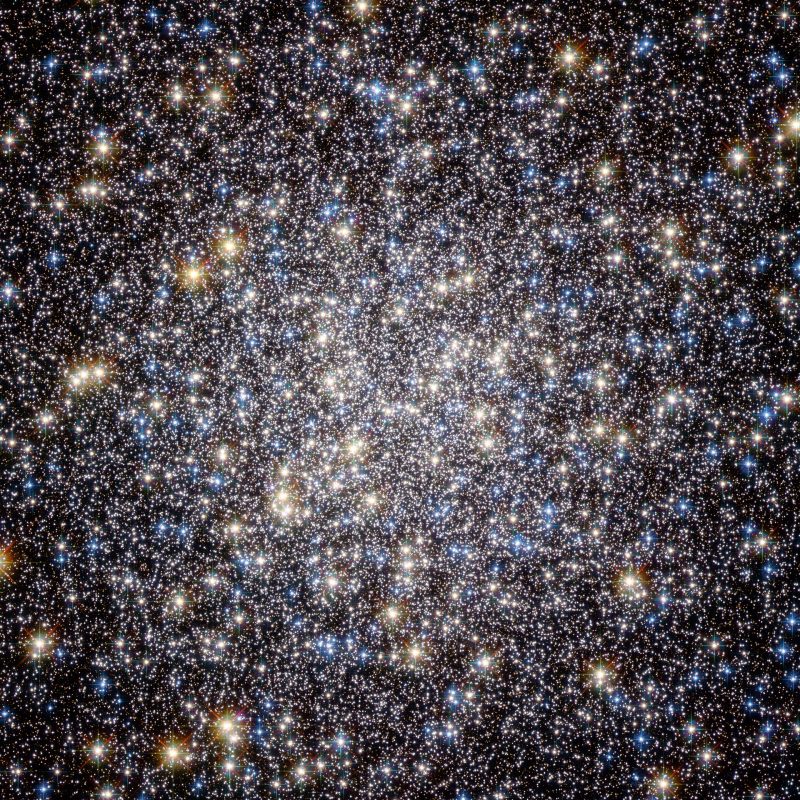
The most famous globular cluster in the Northern Hemisphere is M13 in the constellation Hercules, which Edmond Halley discovered in 1714. Another name for M13 is the Great Globular Cluster. Charles Messier later added it into his famous Messier catalog in 1764.
In amateur telescopes, it is a small fuzzy patch of light. At the center of this cluster, some 22,000 light-years from Earth, stars orbit so closely that occasionally they collide. Their deaths lead to the creation of new stars known as blue stragglers. This stellar population is the only type of newer stars in globular clusters.
Some other great globular clusters
Other globular clusters of note are M22 in Sagittarius – one of the brightest in the sky – M5 in Serpens and M12 in Ophiuchus. Many of the night sky’s biggest and brightest globular clusters are best viewed on spring nights and often feature in so-called Messier Marathons.
Furthermore, there are two fabulous globular clusters in the Southern Hemisphere. Omega Centauri, also known as NGC 5139, is visible with the unaided eye to observers at low northern latitudes and in the Southern Hemisphere. Omega Centauri contains approximately 10 million stars and is about 16,000 light-years away. The other is 47 Tucanae, noted for having a small, very bright and dense core. In fact, it is one of the most massive globular clusters in the galaxy, containing millions of stars.
Read more: Evidence for intermediate-mass black hole in Omega Centauri
Even the smallest telescopes reveal globular clusters as a wonderful sight. However, a large telescope resolves individual stars toward their centers.
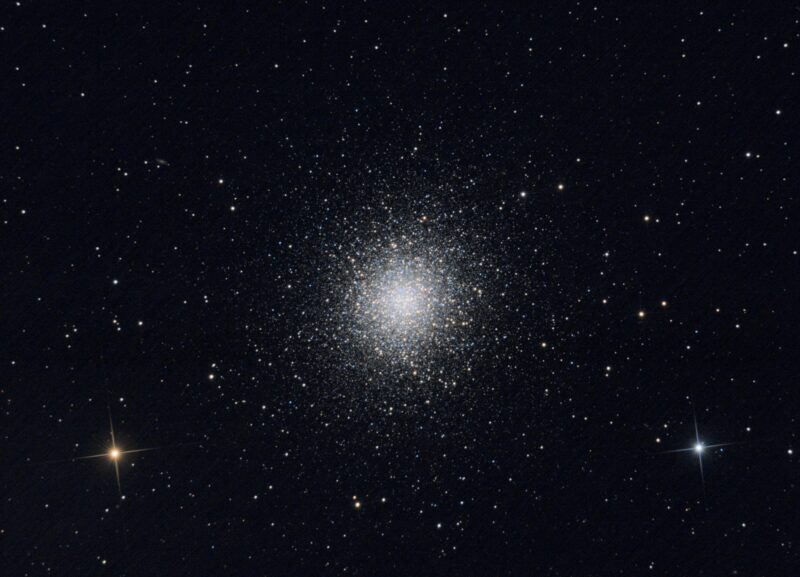
Bottom line: Globular clusters are spherical collections of stars, orbiting mostly in the halo of spiral galaxies. Our Milky Way galaxy has over 150 globular clusters containing some of our galaxy’s oldest stars.
Another kind of cluster: What’s an open cluster?
Read more: Messier objects are fuzzy patches in the night sky
Like what you read?
Subscribe and receive daily news delivered to your inbox.
More from
Andy Briggs


What is the Milky Way? It’s our home galaxy

What’s a galaxy? All you need to know about galaxies
What’s a constellation? What’s an asterism?
What’s a red dwarf? Only the most abundant Milky Way star



