- The Big Dipper is a prominent pattern made from seven bright stars.
- It’s part of the constellation Ursa Major the Great Bear.
- Use the two end stars in the bowl of the Big Dipper to find Polaris, the North Star.
The Big Dipper
The Big Dipper is a famous and favorite group of seven bright stars. It’s supposed to be easy to find. So what if you can’t find it? In the northern autumn months, the Big Dipper rides low in the northern sky during the evening hours. For some parts of the U.S. and similar latitudes, some or all of it is below the horizon in the evening this time of year. The best time to see it now is to look north shortly before dawn!
The Big Dipper forms a highly recognizable asterism – or star pattern – that resembles an old-fashioned water dipper. The Dipper has a bowl made of four stars, and a handle made of three stars. It is part of the constellation Ursa Major the Great Bear.
The northern sky is like a large celestial clock, with Polaris – aka the North Star – at its center. In other words, the entire northern sky wheels in a great circle throughout the night (although it’s wheeling in a counter-clockwise direction). But Polaris stays still (or nearly so). That’s because Earth’s northern axis nearly points to it. And so Polaris is the famous North Star, used by sea navigators and scouts to find the direction north. Want to find it? You can use the famous Big Dipper asterism to locate Polaris.
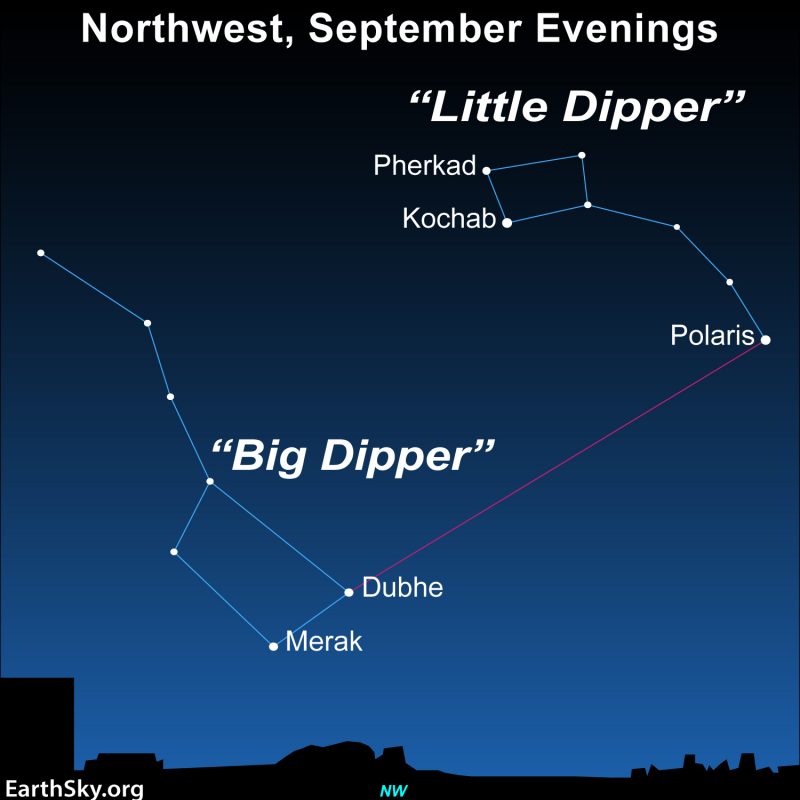
Use the Big Dipper to find Polaris
Notice that a line from the two outermost stars in the bowl of the Big Dipper points to Polaris. Thus, those two stars – Dubhe and Merek – are sometimes called “the Pointers.” And notice that Polaris marks the tip of the handle of the Little Dipper.
However, go look soon, because, in September, the Big Dipper is headed for its least noticeable time of year. The reason is that the Big Dipper swings full circle – 360 degrees – around Polaris in about 23 hours and 56 minutes. So in 24 hours, the Big Dipper actually swings more than a full circle, or 361 degrees. Does that make a difference? Yes! It means that – if you look at the same time each autumn evening – the Big Dipper will appear just a little bit lower in the northwestern evening sky.
In other words, the Dipper is descending in the northwestern evening sky, from one night to the next. And that means that, a month from now at mid-evening (say around mid-October), the Big Dipper will be noticeably lower in the northwest. For some months in autumn and winter, parts or even all of the Big Dipper is beneath the horizon in the evening, as seen from the southernmost latitudes in the United States. That might be why, if you’re just learning the sky, you sometimes can’t find the Big Dipper when you look for it.

The Big Dipper is circumpolar from mid-northern latitudes
On the other hand, the Big Dipper is circumpolar, or always above the northern horizon, from more northerly latitudes. You’ll find it in your sky throughout the year as seen from the northern U.S., Canada and similar latitudes.
Watch the Big and Little Dippers circle around Polaris tonight!

The Dipper throughout time
The constant motion from night to night of these stars circling Polaris is a bit like a bear circling its prey, looking for a way to attack. Several ancient cultures from the Greeks and Romans to the Mi’kmaq Indians likened these stars to a bear.
In Greek mythology, the Big Dipper asterism represents the hindquarters and tail of the constellation Ursa Major the Great Bear. The Mi’kmaq saw the three stars of the Big Dipper handle as hunters chasing the bear.
Bottom line: On northern autumn evenings, the famous Big Dipper lies low on – or even below – the northern horizon. You can use it to find Polaris, the North Star.
The Big and Little Dippers: How to find them
EarthSky astronomy kits are perfect for beginners. Order today from the EarthSky store
Enjoying EarthSky so far? Sign up for our free daily newsletter today!
Like what you read?
Subscribe and receive daily news delivered to your inbox.
More from
Larry Sessions


Alpha Centauri, the star system closest to our sun

Coma Berenices galaxy cluster, best in April and May
Coma Berenices: See how Leo the Lion lost his tail
5 moon myths that still fool people today