



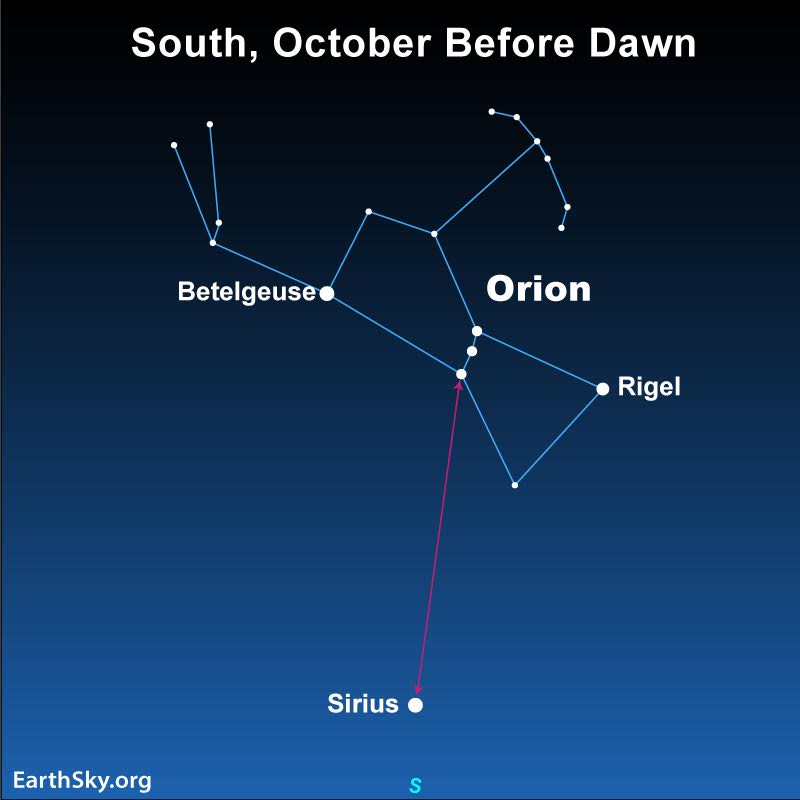
Watch for the brightest star, Sirius
Bright Jupiter outshines all the stars in the morning sky right now, but our brightest star is there too.
At this time of the year we always get questions about another bright object in the dawn sky. Andy wrote:
Early this morning, looking south, I saw a beautiful star, bright and multicolored … Can you identify it for me?
And Paula wrote:
This morning two of us got up early. We found a pulsing star straight down the sky below Orion’s Belt. It was pulsing the colors of green, yellow, blue and red like a strobe light. I will search for it every morning as it was so enchanting.
So if you’re up before daybreak, take a moment to look for Sirius, which is the sky’s brightest star. It’s so brilliant that you can even see it from a light-polluted city. And you can see it if you stay up late, too! It’s rising in the middle of the night now, as seen from around the globe, and is high in the sky – at its best – by dawn.
Want a specific view from your location on the globe? Visit Stellarium and enter your location.
What is that bright twinkling star?
This star is enchanting, so much so that – every year, beginning in Northern Hemisphere autumn – we get many, many questions about a multicolored star twinkling in the southeastern to southern sky after midnight. This star typically turns out to be Sirius, which is in the constellation Canis Major the Greater Dog and is sometimes called the Dog Star.
Why does Sirius twinkle so much?
Sirius appears to flash different colors when it’s low in the sky. Really, all the stars are flashing different colors, because light is composed of all the colors of a rainbow, and the journey through our atmosphere breaks starlight into its component colors via refraction.
But you don’t notice the colors of the other stars much, because they’re not as bright as Sirius. Sirius is the brightest star visible from anywhere on Earth.
Since our atmosphere is causing the light to break into its colors, and since Sirius is often seen low in the sky now (where you are peering at it through a thicker layer of atmosphere than when it’s overhead), the flashing colors of Sirius are very obvious. When Sirius is higher in the sky – which it is close to dawn in the month of October and November – or in the evening sky in January and February – you’ll find that Sirius shines with a steadier, whiter light.
So, on these October and November mornings, watch as Sirius winks at you in the wee hours before dawn!

Bottom line: We get many questions about a bright, colorful, twinkling star on these October mornings. It’s the brightest star, Sirius, in the constellation Canis Major. You’ll know it’s Sirius, because Orion’s Belt always points to it.
Like what you read?
Subscribe and receive daily news delivered to your inbox.
More from
Deborah Byrd


Visible planets and night sky guide for October

What star in the northeast flashes colorfully? It’s Capella!
Proxima Centauri is the closest star to our sun
NASA’s Perseverance rover on Mars sets off-world driving record



