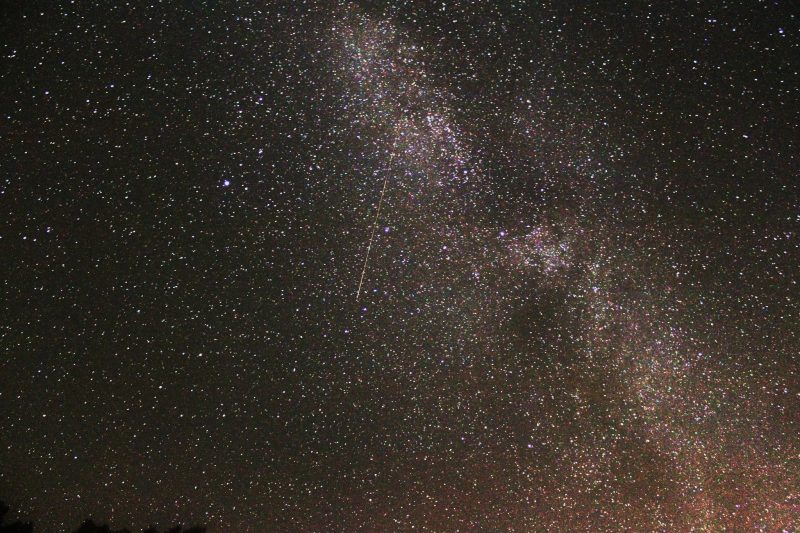
Planning to watch the Draconid meteor shower this year, and want to identify the radiant point? Here are two ways to do it. Follow the links below.
You don’t have to identify the radiant point to watch the Draconids.
Use the Big Dipper to locate the Draconids’ radiant.
Use the Summer Triangle to locate the Draconids’ radiant.
Read more: When to watch the Draconid meteor shower this year
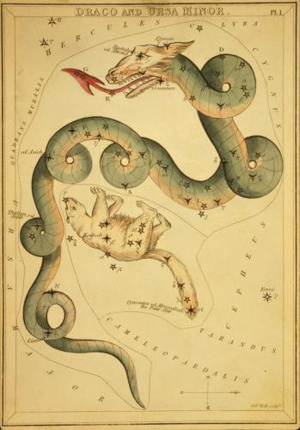
You don’t have to identify the radiant point to watch the Draconids or any meteor shower. Assuming the radiant is above your horizon, the meteors will streak all over the sky.
Why is a radiant point important then? If you trace the paths of the Draconid meteors backward, they appear to radiate from the Dragon’s fiery mouth. For most meteor showers, the whereabouts of the radiant point is important because the radiant needs to be above the horizon, in order for you to see the most meteors. For the Draconids, assuming you live at a northerly latitude, that requirement is less important. Why? Because, for northerly latitudes, the radiant point of the Draconid shower – in the northern constellation Draco – is above the horizon all night.
Still, people always ask about – and want to know about – meteor shower radiant points.
Identifying a meteor shower radiant point is fun, and the Draconids’ radiant is particularly fun. The Dragon’s two brightest stars – Eltanin and Rastaban – are near the radiant point for the Draconids.
These stars represent the Dragon’s eyes. Find them tonight!
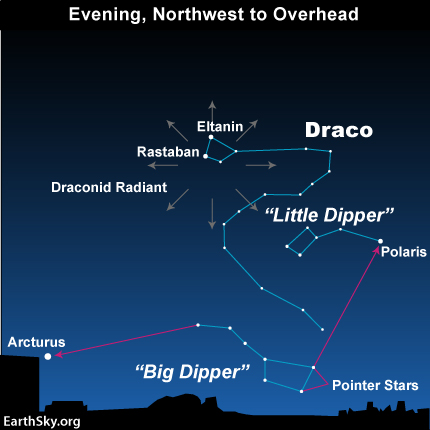
Use the Big Dipper to locate the Draconids’ radiant. Our sky chart – above – shows the northwestern quadrant of the sky and covers a lot more area than most of our charts do. The Big Dipper sits low in the northwest, especially as seen from the southern United States and comparable latitudes. From those latitudes, obstructions on the horizon may hide the Big Dipper from view. From farther south – say, the Southern Hemisphere – you won’t see the Dipper at all in the evening at this time of year.
However, if you can spot it low in the sky, use the Big Dipper to star-hop to the star Polaris. Polaris marks the end star in the handle of the Little Dipper.
Got all these stars? Then you should also be able to spot Eltanin and Rastaban, high up in the northwestern sky at nightfall and early evening in early October.
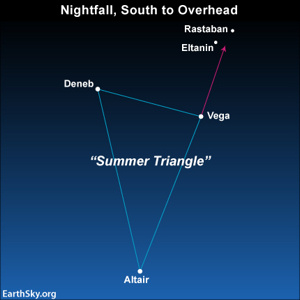
Use the Summer Triangle to locate the Draconids’ radiant. The Summer Triangle asterism shines high in the south to overhead at nightfall. It is composed of three bright stars in separate constellations: Vega, Deneb and Altair.
If you know how to recognize the Summer Triangle, draw an imaginary line from the star Altair through the star Vega to locate the medium-bright stars Eltanin and Rastaban. They mark the approximate radiant of the Draconid meteor shower.
Bottom line: Here’s how to locate the radiant point of the Draconid meteor shower.
Like what you read?
Subscribe and receive daily news delivered to your inbox.
More from
Bruce McClure


Cassiopeia and Perseus on October evenings

Meet Aquarius the Water Bearer and its stars
Check out the Double Cluster in Perseus on October evenings
Find the Andromeda Galaxy using Cassiopeia