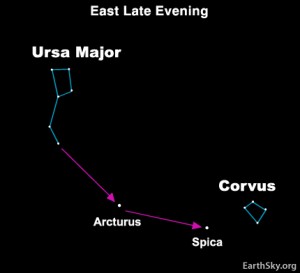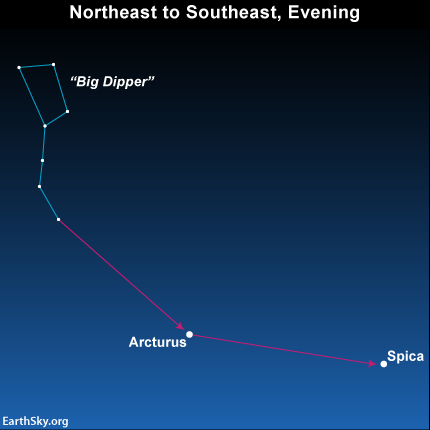
The best time in all of 2012 to see the planet Saturn is here. Earth will pass between Saturn and the sun this weekend – April 15, 2012. Want to spot Saturn? Let the Big Dipper introduce you to it. You can always use a star-hopping trick to find the star Spica in any year, and Saturn is right next to Spica in 2012. The phrase is: follow the arc to Arcturus and drive a spike to Spica.

Follow the arc to Arcturus and drive a spike to Spica. In 2012, the planet Saturn is right next to Spica.

The little square star pattern near Spica is another constellation, Corvus the Crow.
We’ve shrunk the scale of today’s charts in order to take a wide sweep of sky from northeast to southeast. So when you look in the sky for these stars, know you’ll be looking at a broad expanse of sky – generally eastward in the evening. Why eastward in the evening? When Earth goes between the sun and Saturn tomorrow, Saturn will be generally opposite the sun in our sky – ascending in the east as the sun is sinking below the western horizon.
Follow the arc to Arcturus, and drive a spike to Spica. Find the Big Dipper in the northeast in the evening sky, and follow the curve in the Big Dipper’s handle to the star Arcturus in the constellation Bootes: follow the arc to Arcturus. Now extend the curve in the handle into the southeastern sky: drive a spike to Spica. Saturn will be right next to Spica. The planet will shine with a golden color, and, if you contrast it to the star, you will find it doesn’t twinkle as stars do.
Want to learn more about the star Arcturus? Click here
Spica in the constellation Virgo looks like one star, but this single point of light is really a multiple star system – with at least two member stars and possibly more – located an estimated distance of 262 light-years away. Spica’s constellation, Virgo, is so large and rambling and difficult to see that we haven’t marked it. But you can look for a little squarish figure to the upper right of Spica on the chart at right. This square star pattern is the constellation Corvus the Crow.
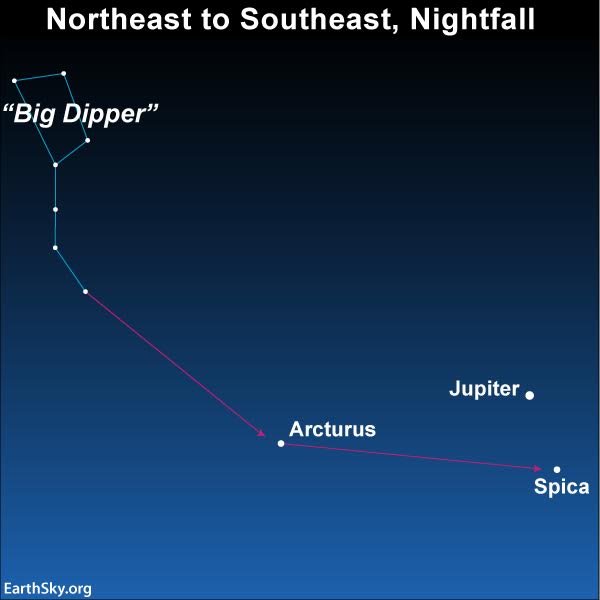
Spica is a whirling double star
As Earth travels around the sun, all the stars rise four minutes earlier each day. Thus these stars – and the planet Saturn – will be rising earlier and appearing higher in the sky earlier in the evening in the coming months.
Use the Big Dipper to arc to Arcturus and spike Spica – and Saturn – on these springtime 2012 evenings!

Any information on a meteor tonight, we have just seen a huge shooting “blue” star come streaming to earth tonight
Hello Mary. If you go to the American Meteor Society web site you will find the info you are looking for. They also have a site to report the meteor. This is very beneficial because they have camera’s set up to monitor these occurrence and would appreciate your help. Cheers DQ
Thank you for this site. It’s very helpful for amateur stargazers.
I always thought that the phrase used to help locate the star Spica, ‘arc to Arcturus, spike to Spica’ implied just that, driving a spike or nail straight. I recently researched Virgo in the National Audubon Society’ Field Guide to the Night Sky’. Virgo is described as the goddess of agriculture, fertility and earth amongst others. She is generally portrayed holding a Spica, latin for ‘ear of wheat’. Spica, is one of the oldest star names in use (and the origin of ‘spike’ the English name for an ‘ear of grain’). interesting how the same word can mean different things over time.
viewing Saturn and Spica so close together is a ‘golden’ opportunity to answer the often repeated question “is that a planet or a star?” the warm, gold colored flat light of Saturn is very different from the icy blue shimmering light of Spica. The difference between reflected (planet) and projected (star) light can easily be seen even without binoculars.
Thanks for your feedback Tom. I love this website! I’ve been using it for the past 2 months to teach my 6 year old what we view in the night sky.
Hi guys, great website! Having a great time with the family as a result.
Would like to ask, has anyone else noticed activity around the “big dipper” constellation tonight? My family and I have been paying attention to this area as a result of this website and trying to find Saturn and we have noticed 4 moving objects through this constellation. All 4 sightings were near the “handle” of the plough – if looking at the picture, 2 were moving west through it, the other 2 were at the same time moving in opposite directions, one west throught it and the other east away from it.
If nobody has seen this activity can anyone advise on what they might be? From the naked eye they all seemed to move at the same sort of speed and be the same size/distance away.
Thanks in advance!
Hi Paul, does what you’re seeing look like steadily-moving stars? High up? No sound? If so, it is probably Earth-orbiting satellites. If you look up at night – especially around sunset or sunrise, and especially if you’re looking in a dark sky -you can see many Earth-orbiting satellites crossing the sky.
All the best and happy gazing!
Deborah
That is exactly what they looked like!
I would never have thought that they could be seen by the naked eye.
Thank you so much, keep up the great work
Thanks Tom that was very interesting. I do love this site… I learn so much, more than in school. Thanks to all who come here to learn.
Wonderful view of Saturn in the Western skies of Seattle…so huge!!! It is 11:35 PM.
please help, i am an utter plonker with a telescope i can only find thing that someone has shown me before. i am desperate to find saturn i live on the greek island of rhodes i subscribe to sky at night mag and still cant understand