Auriga has a flashy star and 3 star clusters
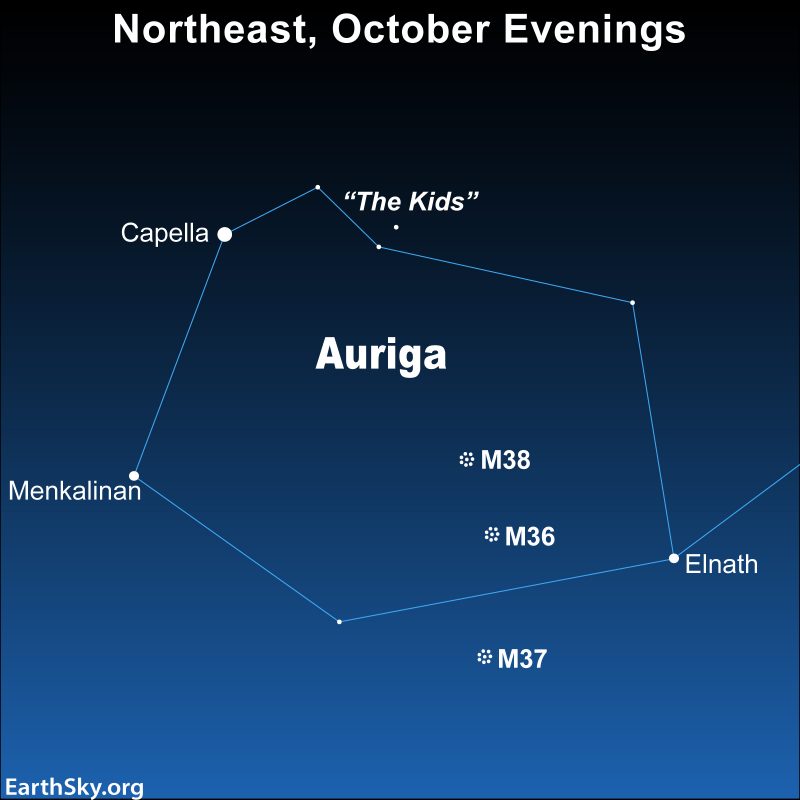
Auriga the Charioteer is a great constellation for Northern Hemisphere observers to spot in autumn, because a bright, often-flashing star advertises its presence. Capella, the brightest star in Auriga, flashes red, blue and green when it’s close to the horizon and seen through a thick layer of Earth’s atmosphere.
Capella is known as the Goat Star. And close to Capella is a pair of stars known as The Kids, the baby goats that the Charioteer carries. And Auriga houses three star clusters that are easy to hunt down with binoculars.
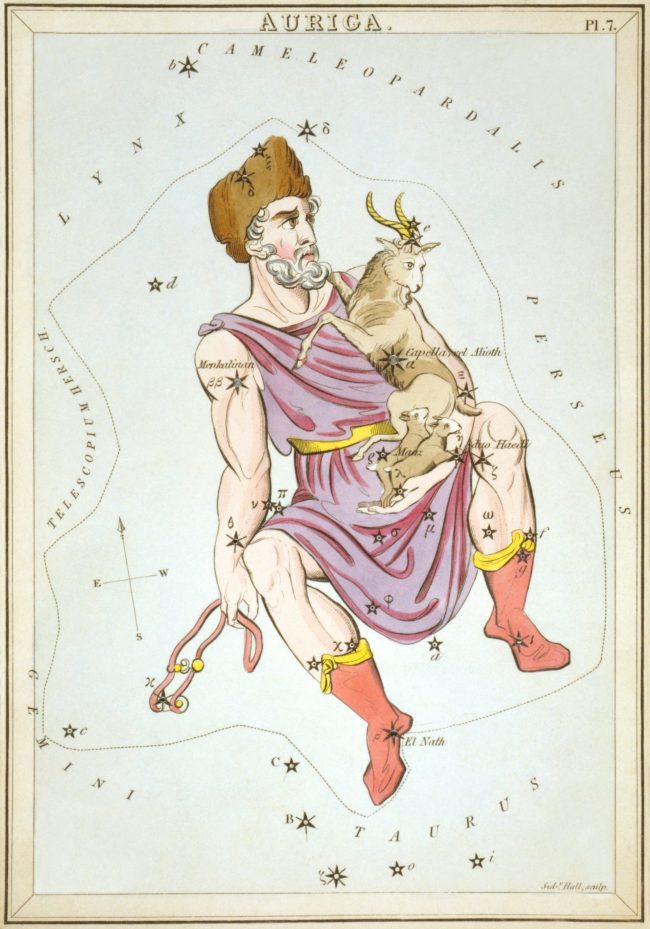
Auriga is a far-northern constellation. It’s close enough to the North Star that people in the northern U.S. and Canada — and similar latitudes — see it as circumpolar. In other words, they can see all or part of the constellation on any night of the year.
But some times of the year are better than others. If you want to see the entirety of Auriga, start looking for the constellation and flickering Capella in Northern Hemisphere autumn. Soon you’ll be familiar with its gems and ready to go deeper by the time it moves higher and into better viewing position by winter.
Auriga the Charioteer’s brightest star, Capella
Auriga’s brightest star, Alpha Aurigae, is a twinkling beauty named Capella. It’s a golden star, somewhat similar to our sun. In fact, if you could get some distance away from our solar system — light-years away — you might see our sun much as we see Capella.
Capella is located at one corner of the constellation Auriga, marking the Charioteer’s left shoulder. It also marks one of the corners of the Winter Circle.
Capella garners a lot of attention on autumn evenings in the Northern Hemisphere because we see it near the horizon through a thick layer of Earth’s atmosphere. The wavering atmosphere causes the light from the star to jump around, flashing bright colors of red, green and blue, making it look like an emergency vehicle parked in space.
On winter evenings, Capella moves overhead and its flashiness is dampened as we look at it through a thinner layer of atmosphere.
Capella shines at a magnitude of 0.08 and is the 6th brightest star in the sky. It’s so bright because it’s nearby. Capella lies just 43 light-years away.
In fact, Capella is actually a pair of binary stars, both of which are yellow giant stars with small red dwarf companions.
Capella is also the closest 1st magnitude star to Polaris, the star currently marking our north celestial pole.
The asterism of The Kids
If you’re unsure whether you’ve identified Capella, you can always look nearby for a small triangle of stars. This triangle is an asterism, or named configuration of stars. While Capella is the Goat Star, this little triangle asterism represents The Kids.
Other stars in Auriga the Charioteer
Menkalinan, the second brightest star in Auriga, marks the Charioteer’s right shoulder. This star is also fairly nearby, at a distance of 85 light-years.
Notice the star Elnath at the southern tip of Auriga. This star used to belong both to Auriga, where it was known as the heel of the Charioteer, and to the constellation Taurus the Bull, where it represented the tip of the Bull’s northern horn. In the last century, though, the International Astronomical Union decreed that this star shall belong only to Taurus!
Star clusters in Auriga the Charioteer
In a dark sky, using binoculars, you can spot some easy-to-see star clusters within Auriga: M36, M37 and M38. These Messier objects fall nearly in a line, with M36 in the middle. The open star clusters have distinct personalities when viewed with magnification.
M36 bears the nickname the Pinwheel cluster and looks reminiscent of the Pleiades. M37 is the brightest and largest of the three clusters and lies opposite the Milky Way‘s galactic center, still in the plane of our galaxy but looking out to its fringes. Lastly, M38 has the nickname the Starfish cluster. Others think this cluster looks like an X or the Greek letter Pi. What do you see?

Bottom line: Auriga the Charioteer is a north circumpolar constellation, best viewed on autumn and winter evenings. Its star Capella is the 6th brightest star in the sky.
Like what you read?
Subscribe and receive daily news delivered to your inbox.
More from
Kelly Kizer Whitt


Euclid was mapping the universe. Then it found a comet

Visible planets and night sky guide for October
It’s official! Chiricahua is now the 64th US national park