
Here is something special and very rare.
On Friday evening (March 11, 2016), a few minutes before sunset, a thin band of Kelvin Helmholtz clouds developed above a cumulonimbus anvil and became iridescent for just three minutes before dispersing.
The first three photographs on this page, in which the iridescence is bright, were taken with a Panasonic Lumix DMC-TZ60 in intelligent auto mode and x60 zoom magnification.
The distant view – at the bottom of the page – was taken a short while before. The Kelvin Helmholtz cloud band had not yet become colorful.
To see Kelvin-Helmholtz clouds is rare, for them to become iridescent is much rarer and for a swallow to fly past during the fraction of a second when a photograph is taken defies all odds and is almost miraculous!
Read more about Kelvin Helmholtz clouds, and see more photos
Read more about cloud iridescence

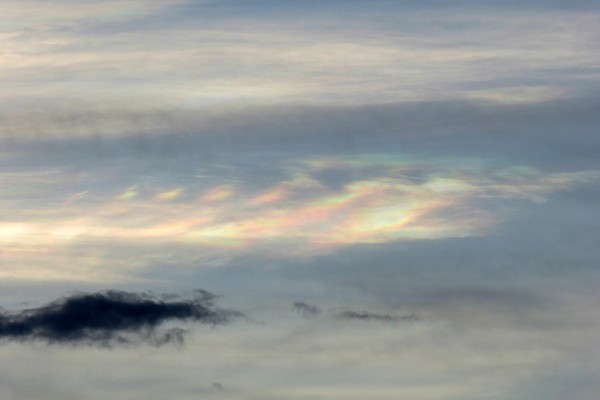

Bottom line: Iridescent Kelvin Helmholtz clouds – clouds that look like ocean waves – on March 11, 2016 over Mutare, Zimbabwe.
Like what you read?
Subscribe and receive daily news delivered to your inbox.
More from
Peter Lowenstein


Here’s how much smaller the sun looks at aphelion

The young moon returns
Golden virga at sunset
Old moon and Mercury, past 2 mornings