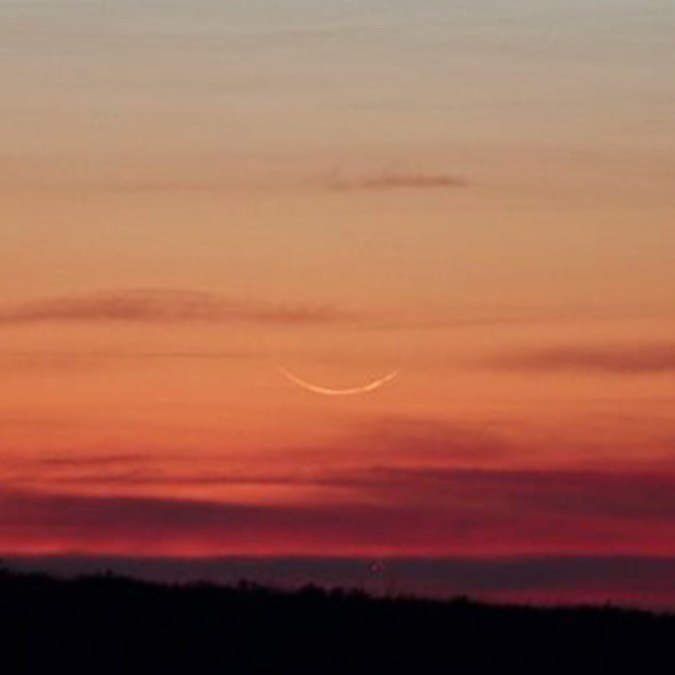
New moon – when the moon passed between the Earth and sun, causing the April 20 hybrid eclipse – was early this morning. And after every new moon comes a young moon, a slim crescent in the west after sunset. Occasionally – when the moment of new moon happens around midnight by your local clock – you have a chance to see a very young moon, one less than 24 hours old. That’s the case, for some of us, tonight (April 20, 2023).
Seeing such a young moon is a rare delight. At such times, the moon is still close to the sun along our line of sight. In other words, it’s close to the sunset. And its lighted portion is turned almost entirely away from us. It’s a fragile illuminated crescent moon, maybe the thinnest crescent moon you’ve ever seen.
Will you see a very young moon on April 20, 2023? It depends on where you are on Earth’s globe, and on your sky conditions. If you do catch it – and have a photo – please submit it to EarthSky Community Photos.
Young moon on April 20, 2023?
On April 20, new moon happens at 4:12 UTC (12:12 a.m. EDT). This particular new moon passed in front of the sun, creating an unusual hybrid solar eclipse, early in the day on April 20.
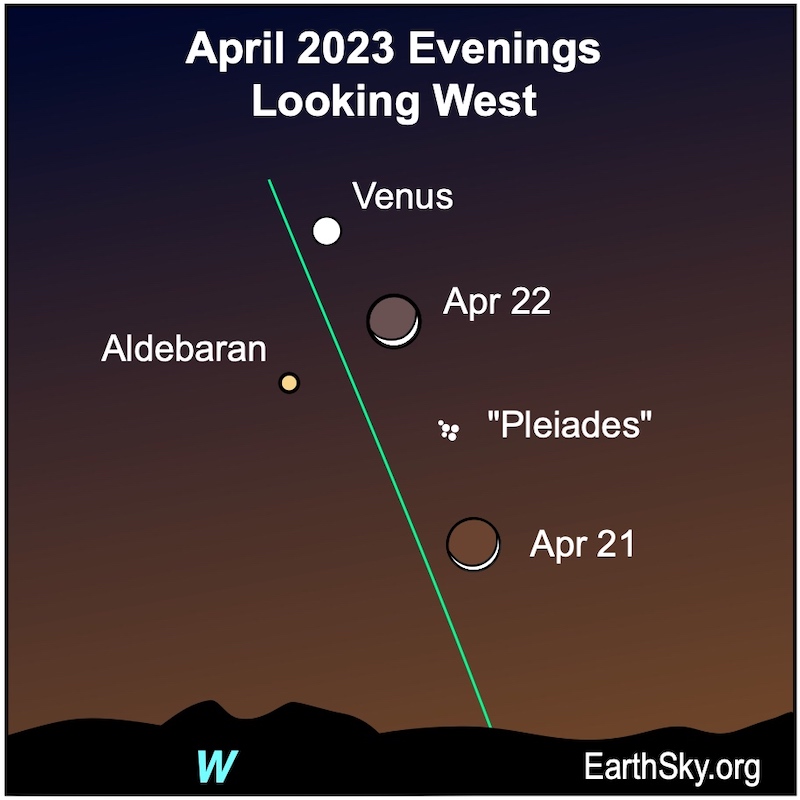
This evening (the evening of April 20) – fresh from the eclipse – the young moon, less than a day old, will pop into view in the west after sunset for people who are in North America – and who are in the Eastern, Central, Mountain and Pacific time zones.
Why so specific? There are two things to consider. First, the angle of the ecliptic, or path of the sun, moon and planets. Second … timing.
Angle of the ecliptic. Here’s why it needs to be Northern Hemisphere, not Southern Hemisphere, to see tonight’s young moon. At this time of year, in the Northern Hemisphere, the ecliptic is making a steep angle to the evening horizon. That steep angle carries the moon high above the sunset. Meanwhile, from the Southern Hemisphere, the ecliptic makes a narrow angle with the evening horizon in April. And that narrow angle carries the moon to one side of the sunset, keeping it closer to the horizon. A young moon closer to the horizon is tough to see, because it’s buried in the twilight glare.
Timing. Now consider, for example, London on April 20. London time is just an hour ahead of UTC. So … new moon falls at +4 UTC, or ~5 a.m. London time (“~” means “approximately”). And that means that – on April 20 – the moon around sunset will be just under 15 hours old (5 a.m. to 8 p.m. = 15 hours), as seen from London. And it’s probably not possible to see a 15-hour-old moon with the unaided eye (though some have claimed to have seen it!).
But – by the time of sunset on April 20 as seen from New York City – the moon will have gotten farther from the sun in our sky. It’ll be a slightly older moon, setting longer after sunset. New York City is four hours behind UTC, when daylight time is in effect. So new moon falls at 12:12 a.m. EDT in NYC on April 20. And sunset in NYC on April 20 falls ~7:30 p.m. EDT. And that means that – on April 20 – the moon around sunset will be ~19 hours hours old (12:12 a.m. to 7:30 p.m. = ~19 hours), as seen from NYC … old enough to catch in the west after sunset!
And so on across the various time zones of the continental U.S. Those in the Central time zone will see a young moon ~20 hours old. Those in Mountain time will see a moon ~21 hours old. Those in Pacific time will see a moon ~22 hours old. All see-able, and all less than a day old!
So will you see it? Maybe. You’ll need to look toward an unobstructed horizon, shortly after sunset. Clouds, trees or tall buildings could hide the moon from view. Here’s a tip. As soon as the sun is safely over the horizon, start scanning the western horizon for a sliver of the moon. Use binoculars to scan, if you have them. If you can’t find the crescent moon, look for a surprisingly bright point of light deep in the bright evening twilight. That’ll be Mercury, which is several degrees away from the thin crescent moon on April 20, and might help you spot it.
Trying is always fun. And, if you do see it, the moon on April 20 will be so, so beautiful.
And, just remember, the April 20 young moon will soon follow the sun below the western horizon.
For a more precise view from your location try Stellarium-web.org.
Check here for precise times of the sunset and when the moon sets at your location.
What’s the youngest moon it’s possible to see?
Definitely, it’s rare to see a moon within about 24 hours of the new phase. But it turns out, if you use optical aid, you can see the moon all the way until the moment of new moon. However, always avoid looking directly at the sun!!
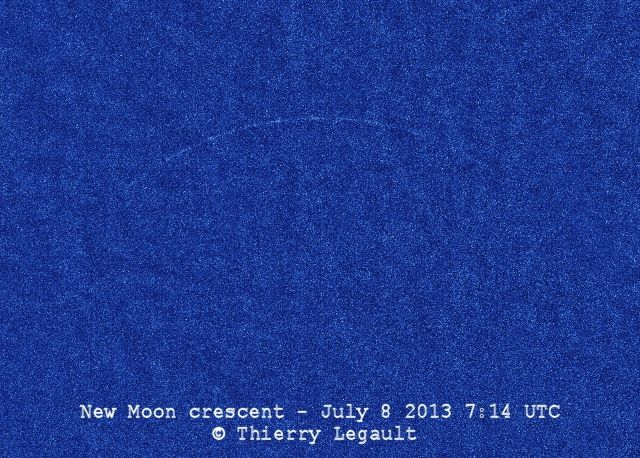
On July 8, 2013, a new record was set for the youngest moon ever photographed (see photos below). Thierry Legault – shooting from in Elancourt, France – captured the July 2013 moon at the precise instant it was new. Or most nearly between the Earth and sun for this lunar orbit. Legault’s image (below) shows the thinnest of lunar crescents, in full daylight, at 7:14 UTC on July 8, 2013. Legault said on his website:
It is the youngest possible crescent, the age of the moon at this instant being exactly zero. Celestial north is up in the image, as well as the sun. The irregularities and discontinuities are caused by the relief at the edge of the lunar disk (mountains, craters).
Can you see a young moon with your eye alone?
How young a moon you can expect to see with your eye depends on the time of year and on sky conditions. It’s possible to see the youngest moons – the thinnest crescents, nearest the sunset – around the spring equinox. And so you know, the youngest moons will be more of a slight curve rather than a full crescent.
And cameras can catch more than the eye alone.
For example, when Legault captured the image above, the sun and moon were separated only 4.4 degrees – about 9 solar diameters – on the sky’s dome. It is extremely difficult, and risky, to try to capture the moon at such a time because there’s always a risk of unintentionally glimpsing the sun and thereby damaging your eyesight. So don’t try it, unless you know what you are doing!
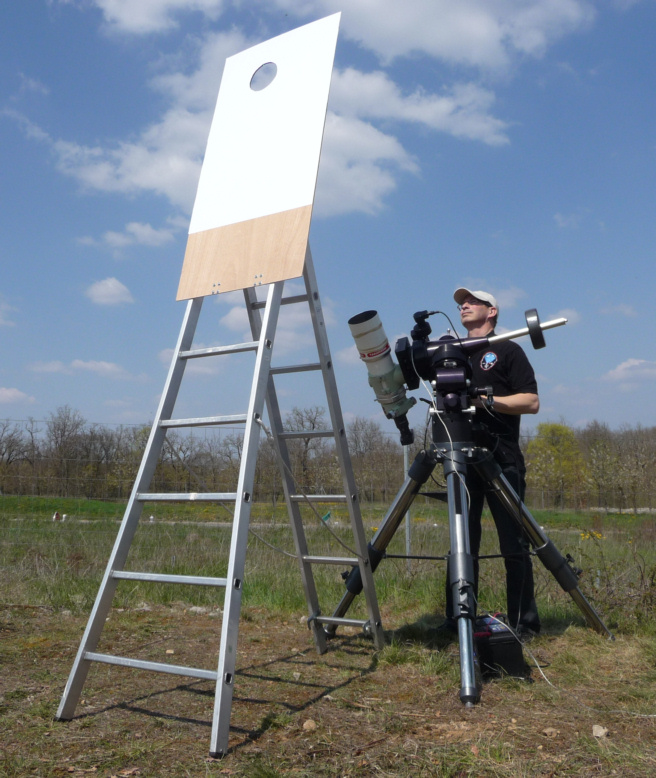
Thierry Legault used a special photographic setup to capture this youngest possible moon. He wrote:
In order to reduce the glare, the images have been taken in close infrared and a pierced screen, placed just in front of the telescope, prevents the sunlight from entering directly in the telescope.
The record for seeing a very young moon
A longstanding, though somewhat doubtful, record for youngest moon seen with the eye is by two British housemaids. They said they saw the moon 14 3/4 hours after new moon in the year 1916.
Stephen James O’Meara achieved a more reliable record in May 1990. When he saw the young crescent with the unaided eye 15 hours and 32 minutes after new moon.
The record for youngest moon spotted with the eye using an optical aid passed to Mohsen Mirsaeed in 2002, who saw the moon 11 hours and 40 minutes after new moon. Wow!
But Legault’s photograph at the instant of new moon? That record can only be duplicated, not surpassed.
Tips for observing very young moons
Young moons are located some distance east of the sun on the sky’s dome (because the moon always moves eastward in orbit). Young moons appear to our eye as exceedingly slim crescents. And likely illuminated by earthshine, seen low in the western sky for a brief interval after sunset.
No matter where you are, remember to wait until the sun has completely set before scanning the horizon with optical aid! You’ll also need a flat, clear horizon to the west. Start looking shortly after the sun disappears. So, when bright twilight still fills the western sky look for the infant moon that’s barely illuminated!
And, of course, optical aid enhances your young moon possibilities even more.
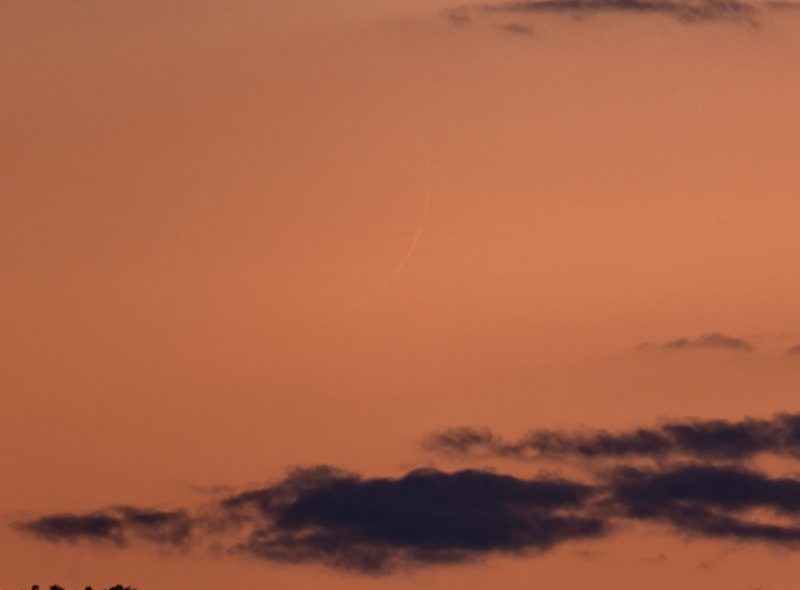
Bottom line: Occasionally you get the chance to look for a very young moon, less than 24 hours old. On April 20, 2023, if you are in North America where the timing – an angle of the ecliptic – is right, and you live anywhere in the Eastern, Central, Mountain and Pacific time zones, look for the young moon just after sunset.
Click here to check out Thierry Legault’s book on astrophotography.
Like what you read?
Subscribe and receive daily news delivered to your inbox.
More from
Deborah Byrd


NASA’s Perseverance rover on Mars sets off-world driving record

Visible planets and night sky guide for October
Hera mission hits the brakes to arrive at asteroid
Flashing star in autumn? Here are 3 candidates