



NASA has released this graphic showing the orbits of all known Potentially Hazardous Asteroids (PHAs), that is, asteroids that are considered hazardous because they are fairly large (at least 460 feet or 140 meters in size), and because they follow orbits that pass close to Earth’s orbit (within 4.7 million miles or 7.5 million kilometers).
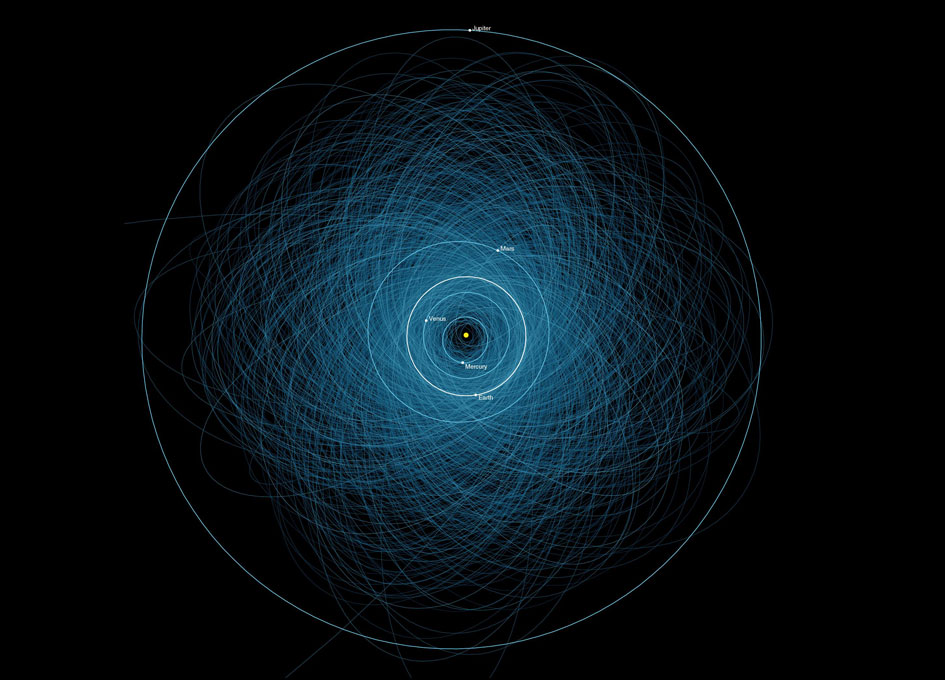
Astronomers have categorized more 1,400 PHAs as of early 2013.
Being classified as a PHA does not, of course, mean that an asteroid will impact the Earth. NASA is quick to point out:
None of these PHAs is a worrisome threat over the next hundred years.
Prefer to see this graphic in list form? Click here.
Astronomers with NASA and other organizations do track these asteroids, continually refining what we know about their orbits so that more precise predictions can be made about their future close approaches and impact probabilities.
Like what you read?
Subscribe and receive daily news delivered to your inbox.
More from
Deborah Byrd


Visible planets and night sky guide for October

Hera mission hits the brakes to arrive at asteroid
Flashing star in autumn? Here are 3 candidates
Stargazing tips! 10 great tips for beginning astronomers



