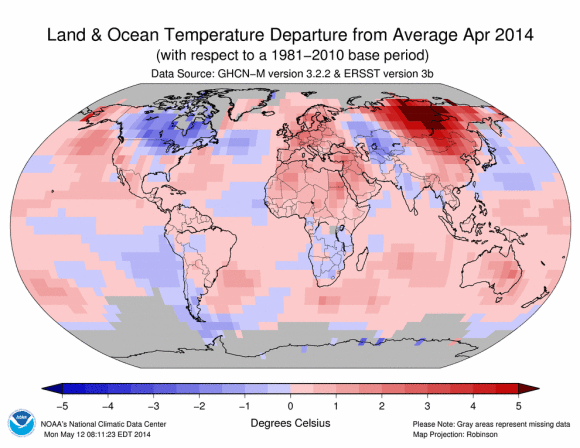
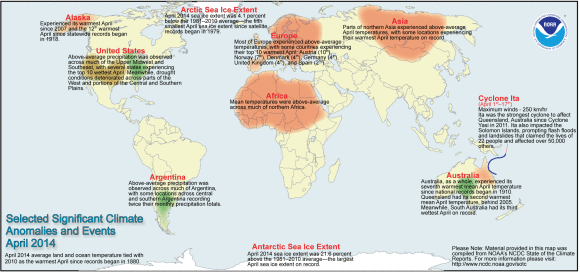
Globally, April 2014 was either tied with April 2010 for being the warmest April on record … or it was the second-warmest April on record. That difference is between experts at the National Oceanic and Atmospheric Administration (NOAA) and at NASA. Either way, it’s a reminder that our local weather is not the whole story.
According to NOAA, April 2014 was tied with April of 2010 as being the warmest April on record globally for land and ocean surface combined. NOAA also said that – globally – the January 2014 to April 2014 period was the 6th warmest Jan-Apr period on record.
And NOAA provided data about the recent U.S. cold months, saying the United States experienced its coldest start to the year (Jan-Apr) since 1993. For the U.S., the January 2014 to April 2014 period was the 46th coldest Jan-Apr period on record.
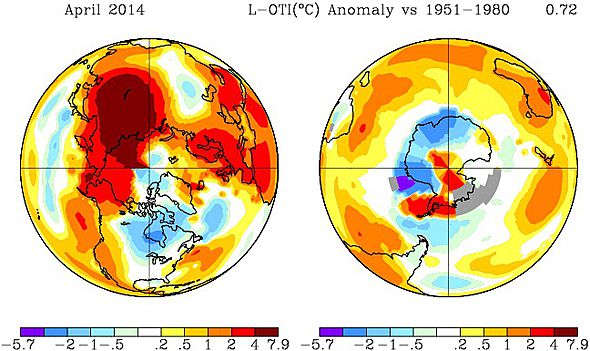
Meanwhile, NASA’s GISS reported that – globally – April 2014 was the second-warmest April on record, considering land and ocean combined, behind April 2010. April 2014 averaged 0.73 degrees C. or 1.31 degrees F. above the 1951-1980 average. That’s in contrast to April 2010, which was was 0.80 degrees C. above the average, NASA said.
Bottom line: Globally, April 2014 was tied with April 2010 for being the warmest April on record, or it was the second-warmest April on record.
Like what you read?
Subscribe and receive daily news delivered to your inbox.
More from
Deborah Byrd


Cassiopeia and Perseus on October evenings

Visible planets and night sky guide for October
Orionid meteor shower 2026: All you need to know
See brightest star, Sirius, in your morning sky