



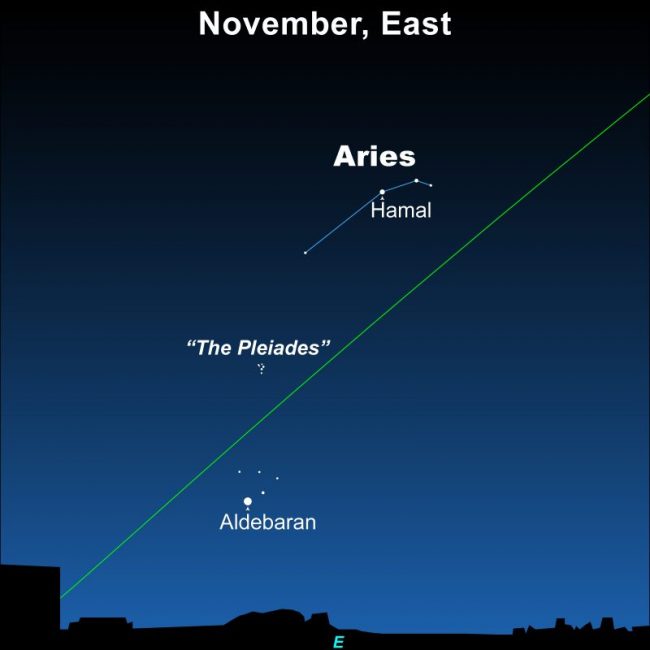
Hamal in November
Hamal – also known as Alpha Arietis – shines as the brightest star in the constellation Aries the Ram. This star and two others – Sheratan and Mesarthim – make up the Head of the Ram. Aries is small. But the compact pattern of these three stars makes Aries relatively easy to find.
As seen from mid-northern latitudes, Hamal lights up the eastern sky on November evenings, will shine high in the southern sky by January evenings, and will sit low in the west by March evenings. This star is easily visible from Earth’s Southern Hemisphere, too. Try Stellarium to find Hamal’s height in your sky from your exact location on the globe.
As seen from the whole Earth, Hamal disappears from the night sky around April. It returns to the eastern sky before sunrise by about June, to begin another cycle of visibility.
Aries finder chart
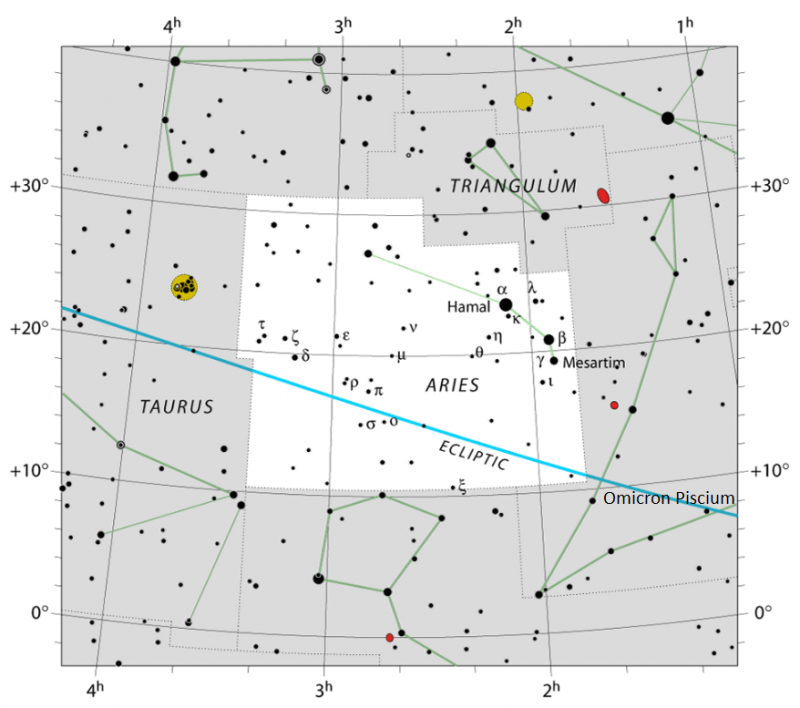
Hamal was an equinox star
It’s fun to spot Hamal and its brother stars in the night sky. As an ancient equinox star, Hamal also has a profound significance in the history of astronomy.
In our modern era, if you could see the stars in daytime, you’d see the sun and Hamal in conjunction – lined up with one another, due north and south in right ascension – on or near April 24.
But, long ago, they were in conjunction exactly at the March equinox.
Nowadays, April 24 – the date of Hamal’s conjunction with the sun – is a little more than a month after the March equinox, which always takes place around March 20. This is the Northern Hemisphere’s spring equinox, and it’s a time of renewal throughout the northern half of Earth. So, of course, this time of year had significance to our ancestors, who were very much aware of their connection to the land and sky.
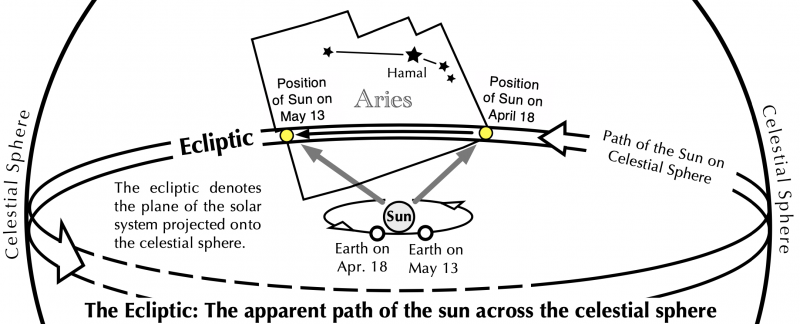
Precession of the equinoxes
If you could backtrack some 2,500 years, you’d find the annual conjunction of the sun and Hamal happening on the March equinox. In fact, if you could backtrack 2,200 years, we’d also find the March equinox sun in conjunction with another star in Aries, Sheratan.
So you see that the location of the sun at the March equinox sun drifts in front of the stars. It moves westward in front of the backdrop constellations by about one degree (two sun diameters) every 72 years. This drifting is due to a well-known motion of Earth called precession, or sometimes the precession of the equinoxes.
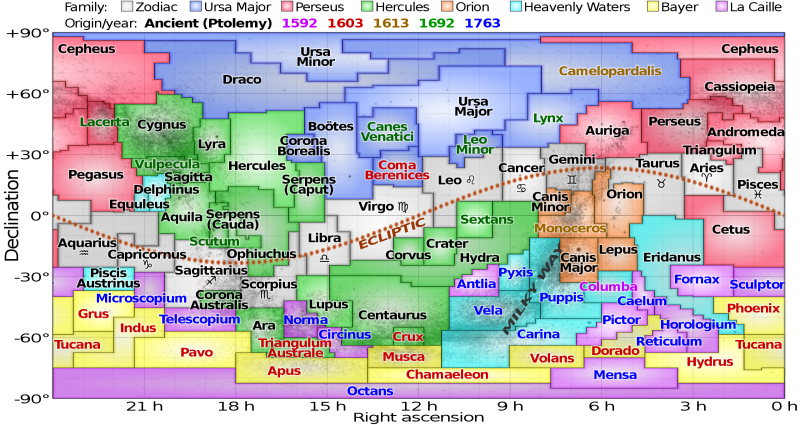
The March equinox sun shone in front of the constellation Aries from about 2,000 to 100 BCE. At present, the sun shines in front of the constellation Pisces on the March equinox.

First point of Aries
Even though the sun is no longer in front of Aries at the time of the March equinox, many people pay homage to the Ram and still refer to the March equinox point as the First Point of Aries.
This point on the celestial sphere – now in Pisces, due to precession – is one of the two points on the celestial sphere at which the celestial equator crosses the ecliptic. The other point – not as well known – is called the First Point of Libra (although it is now in Virgo), located exactly 180 degrees from it.
The First Point of Aries is considered to be the celestial “prime meridian” from which right ascension (like longitude in earthly coordinate systems) is calculated.
Bottom line: The star Hamal is the brightest star in Aries the Ram. Thousands of years ago, the sun was in conjunction – or aligned north and south – with this star at the time of the March equinox.
Enjoying EarthSky? Sign up for our free daily newsletter today!
Like what you read?
Subscribe and receive daily news delivered to your inbox.
More from
Editors of EarthSky


July birthstone: The rare and precious ruby

Asteroid Day to be observed worldwide on June 30
Draco the Dragon and Thuban, a former pole star
June solstice 2026: All you need to know


