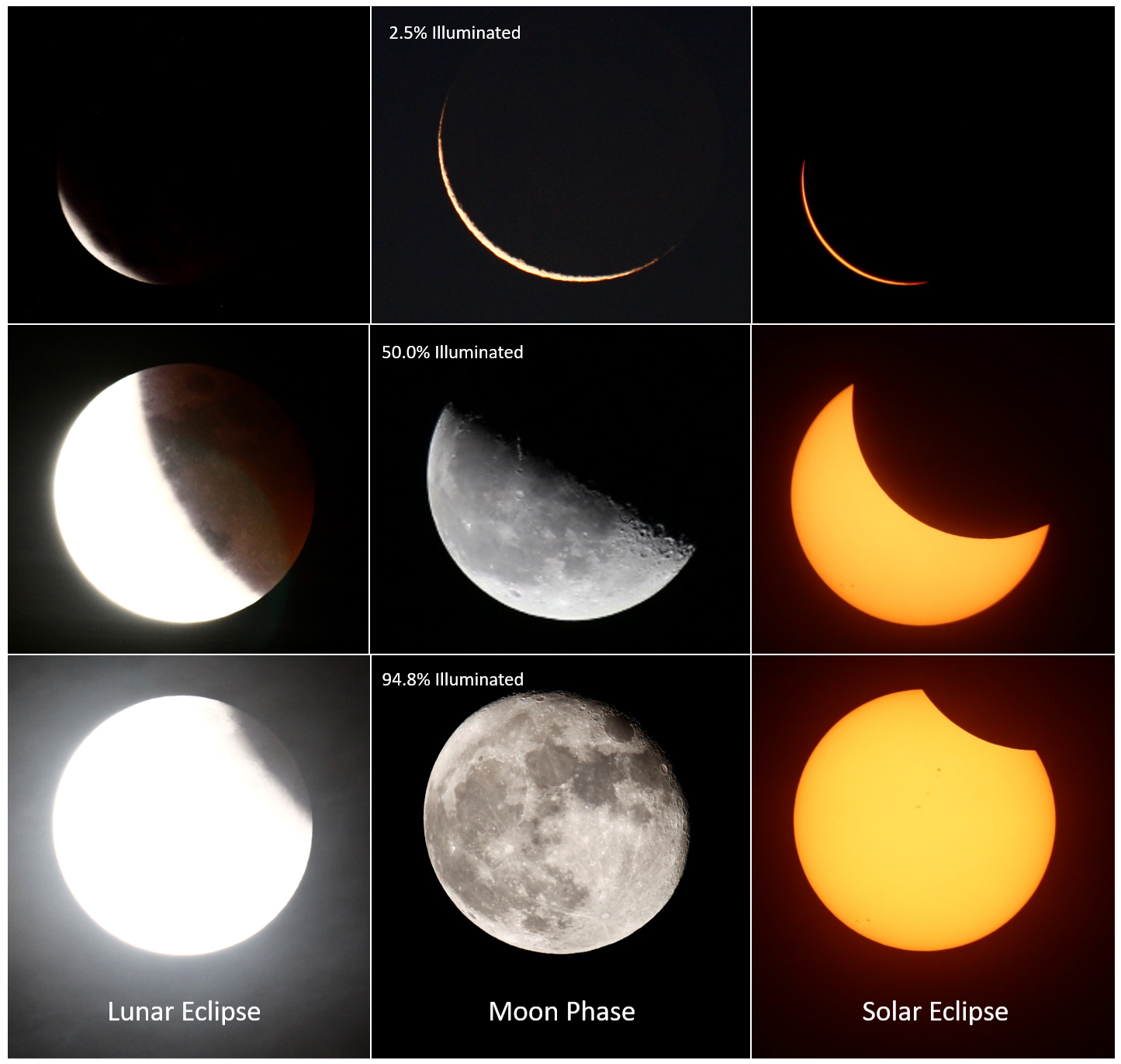
Taipei, TaiWan and Riverton, Wyoming, America
11:37 am
Canon EOS 600D + 600mm len
Canon EOS 6D + 600mm len
In order to compare the bright and dark areas, two of the moon photos have been flipped left and right.
When we observe solar and lunar eclipses, the shape of the sun and moon will change with the magnitude of eclipse. When the magnitude of eclipse is very large, the sun and the moon will become very thin, but the shape is different from the very thin crescent moon. This is because they have different reasons for forming bright and dark regions. The shape when the magnitude of eclipse is close to half is also different from the first quarter moon or the last quarter moon. Of course, when the magnitude of eclipse is small, the shape of the sun and moon is also different from the gibbous moon. If you look closely at the solar eclipse and the lunar eclipse, the shape of the sun and the moon are also different. The dark area of the solar eclipse is because the sun is blocked by the moon, so the edge is a small arc. The lunar eclipse is because the moon enters the shadow of the earth, so the edge is a larger arc.
Like what you read?
Subscribe and receive daily news delivered to your inbox.
More from
David Callejas


Sometimes Island on Lake Travis
Sunset on Lake Travis
Ready, set, explore Earth from home
Two planets destined to die as their star expands