



Wow! There’s so much to say about the June 2025 full moon! All June full moons ride low, but this will be the lowest full moon in decades. That’s because we’re in the midst of a Major Lunar Standstill. Plus, this full moon, which carries the name Strawberry Moon, will be near a beloved bright star, red Antares, Heart of the Scorpion in the constellation Scorpius. And there’s more! Watch for this full moon on the night of June 10-11! And join EarthSky’s Deborah Byrd at 12:15 p.m. CDT (17:15 UTC) on Friday, June 6, for details.
What when where
When to watch in 2025: Overnight on June 10-11.
Where to look: Look for the bright, round moon rising low in the east after sunset on June 10. It will reach its highest point in the sky after midnight on June 11. And it’ll lie low in the west shortly before sunrise.
Crest of the full moon will fall at 7:44 UTC on June 11, 2025. That’s 2:44 a.m. CDT on June 11. So if you live in the Americas, your fullest moon will hang low in the west opposite the sunrise on June 11.
Lowest full moon in decades
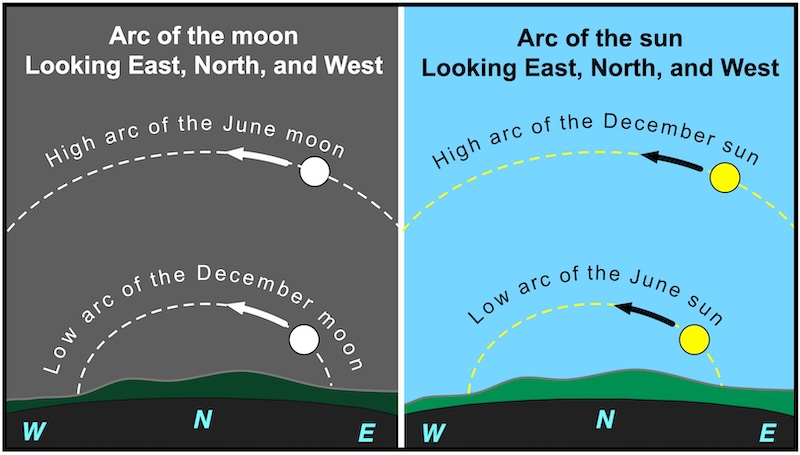
All full moons have their own special characteristics. And it’s a characteristic of the June full moon to ride low in the sky, as seen from the Northern Hemisphere. In a way, the June full moon mimics the low-riding December sun. And notice that when the sun rides high (as it does in this month, the month of the summer solstice for us in the Northern Hemisphere), the moon rides low. That’s true every year. But something special is happening in 2025.
That is, we’re near what’s called a Major Lunar Standstill. It’s all about the inclination of the moon’s orbit, which undergoes an 18.6-year cycle. The cycle happens because the moon’s orbit is being slowly dragged around – mostly due to the pull of the sun – every 18.6 years. This year’s Major Lunar Standstill culminated in January 2025. And we’re still close enough to it that the Standstill is affecting the path of this June full moon. As Dave Dickinson wrote for UniverseToday.com:
The cycle is a product of the unique orbit of our moon. Fun fact: the unique orbit of the moon is tilted 5.15 degrees not in respect to our rotational axis … but versus the ecliptic, the plane of the path of the Earth around the sun.
This means that the moon can range anywhere from 28.65 degrees declination south to north in the sky. That’s 23.5 degrees (the tilt of the Earth’s axis) plus 5.15 degrees (the inclination of the orbit of the moon versus the ecliptic).
So the moon can ride high or low in our sky, depending on various factors, including the time of year (all June full moons ride low as seen from this hemisphere) and on how close we are to a Major or Minor Lunar Standstill.
2006 was the last Major Lunar Standstill before this one. This one happened early in 2025. After this year, the apparent path of the moon in our sky will begin to shallow out again.
But, for now, we can expect an exceptionally low-riding full moon on the night of June 10-11. It’ll be lots of fun to see!
And if you’re interested in more details on Lunar Standstills, be sure to check out the wonderful video below, Patterns of the Moon, by the Archeoastronomy Database:
June full moon mimics December sun
The June full moon always rides low, as seen from the Northern Hemisphere. That’s because a full moon stays more or less opposite the sun. Its nighttime path mimics the sun’s daytime arc of the sun from six months ago, and six months hence.
This June 10-11, 2025, full moon will occur close to the solstice on June 20-21. So the June moon will follow nearly the same path across the sky as the December sun. The December solstice is the Northern Hemisphere’s winter solstice. So the moon’s trek on the nights around the June full moon will resemble the low path of the winter solstice sun.

Arc of the June full moon in the Southern Hemisphere
What about from the Southern Hemisphere? From there, the full moon’s arc across the sky climbs higher with each successive month after December. So it reaches its highest point on the full moon closest to the June solstice, which occurs sometime from June 7 through July 7. So in 2025, the June 10 full moon falls 11 days before the solstice, and the July 10 full moon falls 19 days after the solstice.
June full moon is the Strawberry Moon
All full moons have names. Some Native Americans used the name Strawberry Moon for the June full moon. And that name is still the most commonly used in North America. The name Strawberry Moon highlights the time of year when many species of berries ripen, particularly sweet strawberries. But in Europe, popular names for the June full moon include Honey Moon and Mead Moon. That makes sense because the June full moon always rides so low. And when we look at sky objects nearer to the horizon, we’re looking at them through more atmosphere than when they’re overhead. The extra thickness of air causes the golden color of the June full moon.
June full moon is in Ophiuchus in 2025
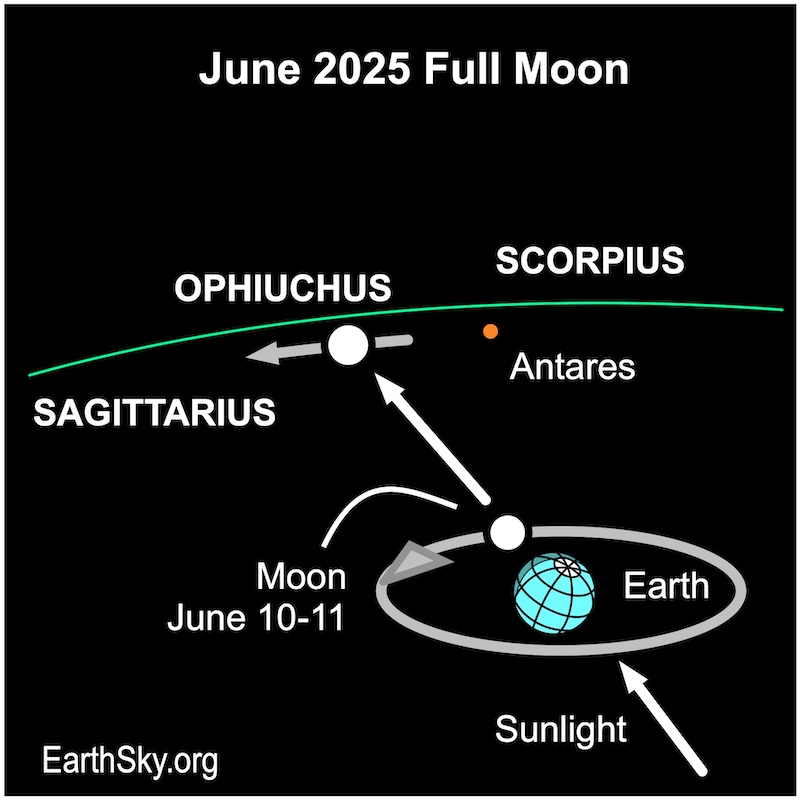
The June full moon can lie in front of one of three constellations of the zodiac. First, it can be in the constellation Sagittarius the Archer. Second, in Scorpius the Scorpion. Or third, in the constellation Ophiuchus the Serpent Bearer.
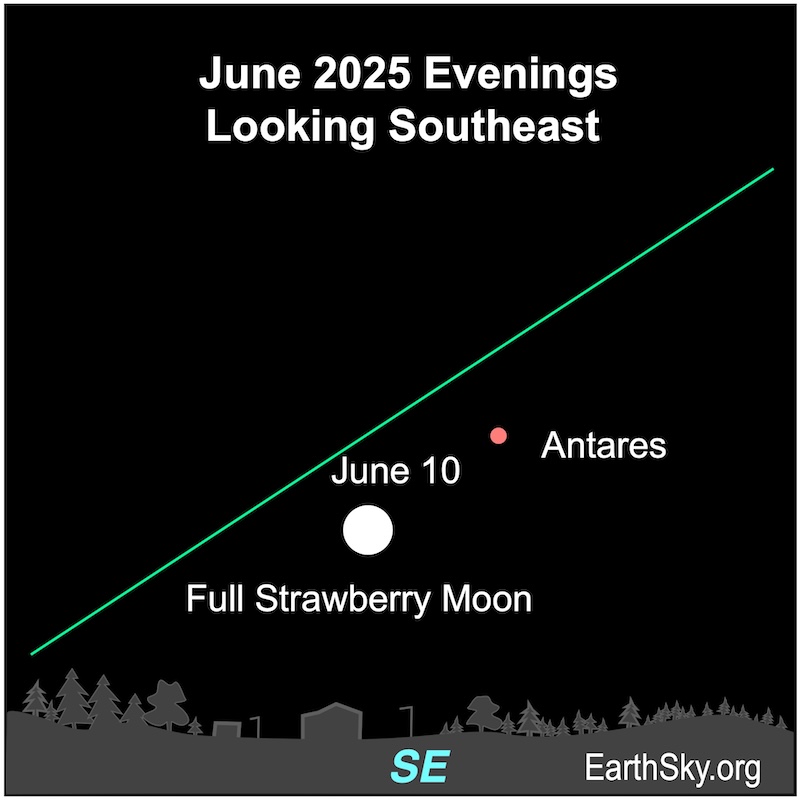
As seen from the Americas, the full moon will rise on the night of June 10 located in the bottom of Ophiuchus. Also, the full moon will lie near the center of our Milky Way galaxy. The galactic center is in the neighboring constellation Sagittarius.
June full moon is near Antares
You’ll notice a bright star near the moon. It’s red Antares, the brightest star of Scorpius, known as the Scorpion’s Heart. The constellation Ophiuchus lies right next to the constellation Scorpius.
Thank you, Alan Dyer!
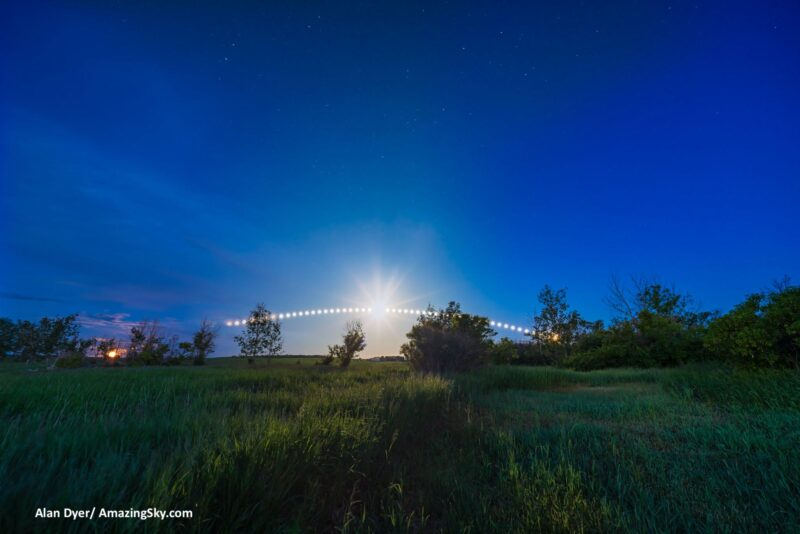
Astrophotographer Alan Dyer gave us permission to post the beautiful photo below showing the low path of the June full moon. Read more about this image at Alan’s Flickr page.
Bottom line: The June full moon – the Strawberry Moon – will occur on the overnight of June 10, 2025, and it will lie in the constellation Ophiuchus.
Like what you read?
Subscribe and receive daily news delivered to your inbox.
More from
John Jardine Goss


August full moon on August 8-9 is the Sturgeon Moon

July full moon – the Buck Moon – is today
May’s full moon is called the Flower Moon
April full moon is the Pink Moon and a micromoon


