



When and where to look in 2026: Look for the bright, round full moon climbing up in the eastern sky as the evening twilight darkens on April 1. The moon will glow high in the south near midnight. And it’ll drop low in the west before sunrise on April 2. Also, the moon will appear full and round in the evenings before and after the full moon.
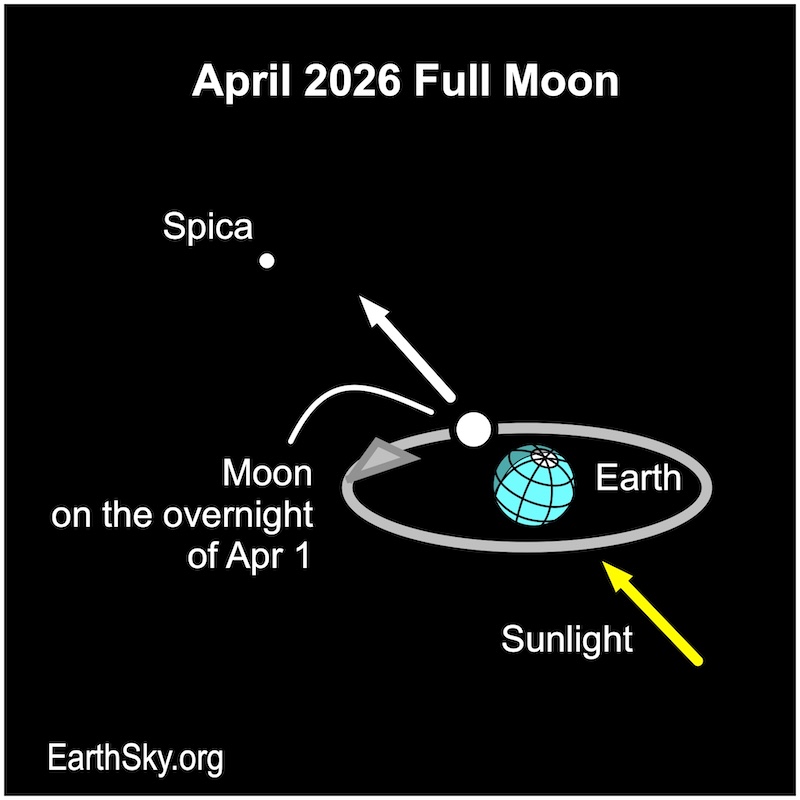
Crest of the full moon falls at 2:12 UTC on April 2, 2026. That’s 9:12 p.m. CDT on April 1 in central North America. As it rises, the April 1 full moon will be close to the star Spica in the constellation Virgo the Maiden.
Join EarthSky’s Marcy Curran for a preview of April’s full Pink Moon near Spica overnight on April 1, 2026. The moon will also be near the Spring Triangle. Don’t miss them!
Fun fact about full moons
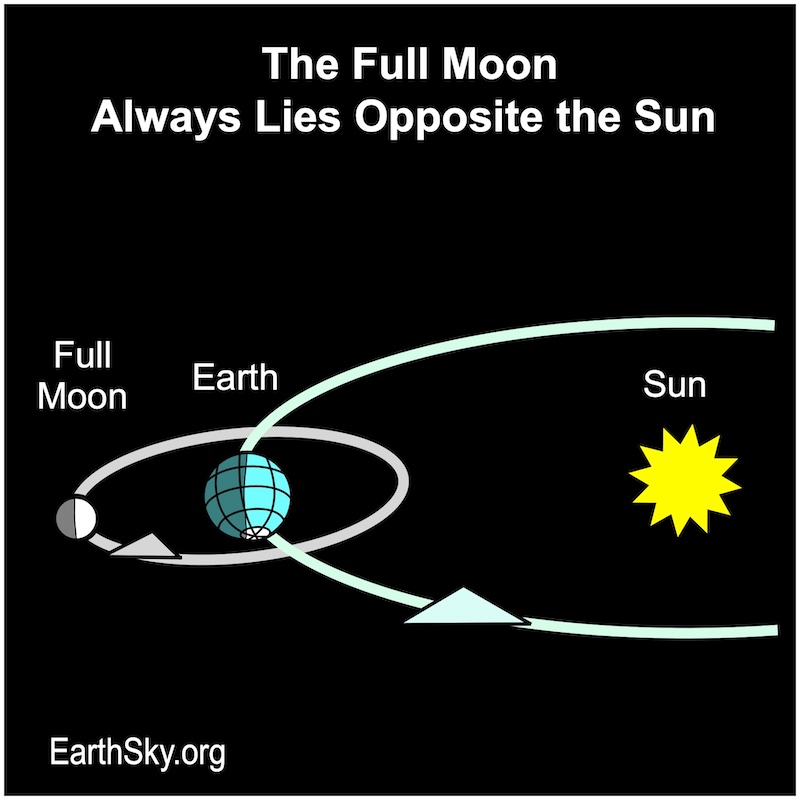
At full moon, the sun, Earth, and moon are aligned in space, with Earth in the middle. And the moon’s day side – its fully lighted hemisphere – directly faces us. That is why the moon appears full. In other words, a full moon always lies on the opposite side of the sky from the sun.
So on the night of full moon, the moon and sun in our sky behave as if they’re on two ends of a seesaw: the sun goes down, and the moon comes up. Around midnight, when the sun is below your feet, you’ll find the moon at its highest in the sky. Finally, all full moons set along the western horizon close to the time of sunrise.
April’s full moon is the Pink Moon
This is a beautiful time of year, especially when the full moon rises! April’s full moon has the nickname of the Pink Moon. That’s because of all the blooming flowers and trees, such as the pink creeping phlox.
The moment of full moon – when the moon reaches that point in its orbit directly opposite the sun in the sky – is April 2 at 2:12 UTC (9:12 p.m. CDT on April 1). However, a full moon is considered any 12 hours before or after the crest.
Read more: Full moon names by month and by season.
As it rises in the east, the Pink Moon will glow brightly above Spica, the brightest star in the constellation Virgo. In the hour just after midnight, the moon – and Spica – will arc above the southern horizon. Then the moon and Spica will set in the west just as the sun rises in the east on April 2.
April full moon shines in Virgo
The April full moon can lie in front of one of two constellations of the zodiac. In most years, as it will this year, it lands in Virgo the Maiden. But if the full moon occurs in the final few days of the month, it can fall in the neighboring constellation, Libra the Scales. But that doesn’t happen often, and won’t happen again until 2037.
Spotting Spica
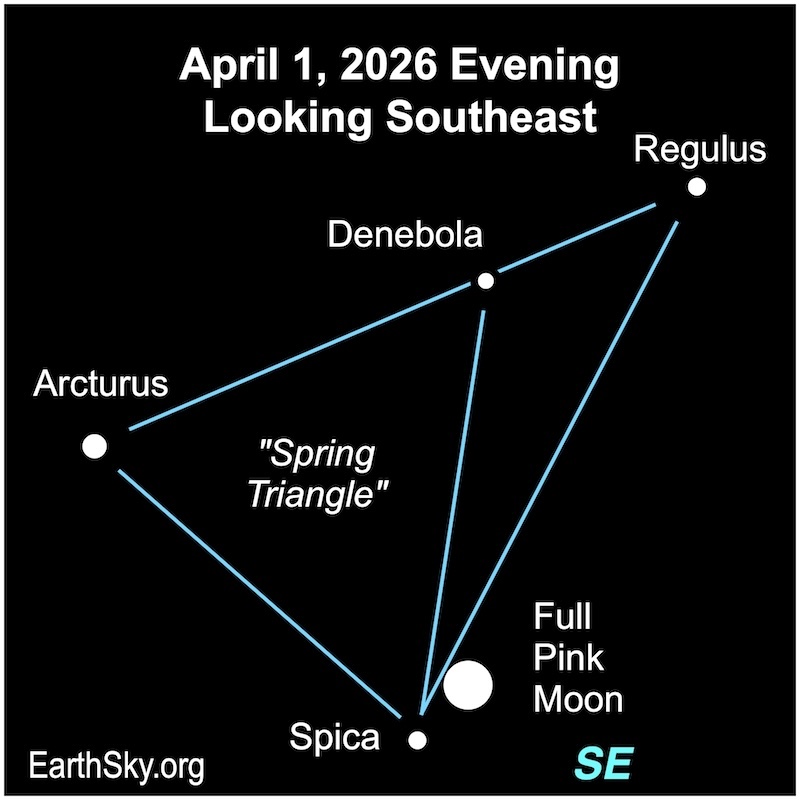
With the full moon being so very bright, can you see Spica? If not, try blocking the moon behind a foreground object such as your finger or a utility pole.
Spica is an important star for learning the night sky because it is the southern member of the Spring Triangle. This asterism also includes Arcturus and Regulus. Arcturus is easily found because it is the second brightest star seen from mid-northern latitudes. Regulus is the brightest star in Leo. Spica, Arcturus and Regulus form an attractive isosceles triangle.
Many stargazers, however, consider Arcturus, Spica, and the moderately bright Denebola (the easternmost star in Leo) as comprising the Spring Triangle. They create an easily recognizable equilateral triangle.
Bottom line: The April 2026 full Pink Moon is on the overnight of April 1. It will lie near the star Spica in the constellation Virgo the Maiden. At full moon, the moon rises in the east around sunset. It climbs highest in the sky around midnight. And it sets in the west around sunrise.
Like what you read?
Subscribe and receive daily news delivered to your inbox.
More from
John Jardine Goss


May 1 full moon is a Flower Moon and micromoon

Watch for the February full moon – or Snow Moon – on February 1
January full moon: Super Wolf Moon near Jupiter and perihelion
August full moon on August 8-9 is the Sturgeon Moon


