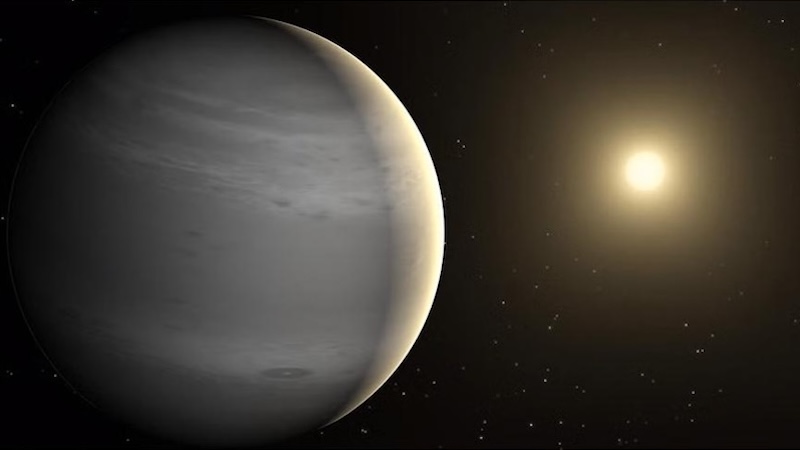
- TOI-199b is a Saturn-sized exoplanet 330 light-years from Earth.
- Unlike most gas giants, its temperature isn’t far from Earth’s.
- New Webb observations revealed this world’s atmosphere contains methane.
Saturn-sized exoplanet with Earth-like temperatures
Astronomers have used the James Webb Space Telescope to study an unusually warm, Saturn-sized exoplanet. The planet, TOI-199b, is about 330 light-years from Earth. It’s temperate, meaning its temperature is similar to Earth’s. It’s warmer than the gas giants Jupiter and Saturn, but much cooler than hot Jupiters that orbit very close to their stars.
This study marked the first close look at the atmosphere of a temperate gas giant. The researchers revealed on May 20, 2026, that the planet’s atmosphere contains methane. The observations also show hints of ammonia and carbon dioxide.
They used transmission spectroscopy to analyze the planet’s atmosphere. That technique can be used when the planet transits directly between its star and the telescope on Earth.
The researchers published the peer-reviewed paper in The Astronomical Journal on May 20, 2026.
Atmosphere of a temperate Saturn-sized exoplanet
Most of the giant exoplanets astronomers know of so far are hot Jupiters. They are scorching hot since they orbit so close to their stars. But there are some that are more temperate. This is the first close look at the atmosphere of a temperate gas giant planet. As leader of the science team, Renyu Hu, associate professor of astronomy and astrophysics in the PennState Eberly College of Science, explained:
One of the main advantages of studies of planets beyond our solar system, known as exoplanets, is the ability to study many different types of planets – especially ones that we don’t see in the solar system – to learn about how planetary systems form and evolve. Since the first exoplanet was discovered in 1992 by a team that included Aleksander Wolszczan at Penn State, astronomers have found thousands of exoplanets. But only a few giant, temperate exoplanets are known and this is the first time that we have been able to study the atmosphere of one of them in detail.
Atmosphere Of Saturn-sized Planet With Earth-like Temperature Contains Methaneastrobiology.com/2026/05/atmo… #astrobiology #AbSciCon #AbSciCon26 #exoplanet
— Astrobiology (@astrobiology.bsky.social) 2026-05-21T17:36:26.219Z
A giant world with Earth-like temperatures
TOI-199b is a gas giant, about the size of Saturn. But it orbits far enough from its star that it’s not scorching hot like hot Jupiters. It’s much more moderate, about 80 degrees Celsius (175 degrees Fahrenheit). That’s still hot, but nowhere near as hot as a hot Jupiter.
The highest recorded temperature on Earth is about 57 degrees Celsius (134 degrees F). This is why scientists consider this planet to be temperate.
So how did the researchers determine the temperature and composition of TOI-199b’s atmosphere? They used a technique called transmission spectroscopy. When the planet transits – passes in front of – its star as seen from Earth, Webb analyzes light from the star as it passes through the planet’s atmosphere. Instruments on Webb then separate the star’s light into its different components. This provides clues about the the planet’s atmosphere.
Altogether, Webb observed the star for about 20 consecutive hours. Lead author Aaron Bello-Arufe, a postdoctoral researcher at NASA’s Jet Propulsion Laboratory, said:
As a planet passes in front of its star, some of the star’s light passes through the planet’s atmosphere where it interacts with the elements and molecules in the atmosphere. Specific elements will absorb specific wavelengths of light, creating a fingerprint in the spectrum of light that JWST detects that reflects the atmosphere’s composition.

Spectrum reveals methane
Then, the researchers compared the spectrum to baseline measurements of the star’s light. Any differences between the new transit spectra and the baseline will reveal what wavelengths of light are being absorbed by the planet’s atmosphere. And that tells you what the atmosphere is made of. Bello-Arufe said:
When we compared the spectra during the transit to the baseline, we saw that the atmosphere blocked the wavelengths of starlight absorbed by methane. Models for the composition of temperate, gas-giant exoplanets had predicted that they would contain methane, so it is good to get confirmation that our theories are accurate.
More observations needed
The results also hint at ammonia and carbon dioxide in the atmosphere. But it will require additional observations to confirm them. Hu said:
With additional observations of this planet, we could establish the relative abundance of these various gases in its atmosphere. This more complete picture of a temperate gas giant’s atmosphere can then be used to improve our models and potentially better understand how planets and their atmospheres form and evolve, including for Earth. The success of this first study of a temperate giant planet’s atmosphere also gives us confidence to dedicate more resources and observation time to study other similar planets. We can then see if this planet is unique or if there are general shared characteristics for this type of planet.
Saturn itself also has traces of methane in its atmosphere. But this kind of methane on gas giants is primordial, not a result of life. Primordial gases are the gases present in a planet’s atmosphere when it first formed.
Jupiter, Uranus and Neptune have traces of methane in their atmospheres as well. In fact, that is what give Neptune its striking bluish color.
Bottom line: TOI-199b is a warm Saturn-sized exoplanet 330 light-years away. New observations by the Webb space telescope show there is methane in its atmosphere.
Source: Methane on the Temperate Exo-Saturn TOI-199 b
Read more: Saturn-mass rogue planet revealed in unique new observations
Read more: Surprise! Super-Earth exoplanets in Saturn-like orbits
Like what you read?
Subscribe and receive daily news delivered to your inbox.
More from
Paul Scott Anderson


Lucy mission to Trojan asteroids: 5 years of discoveries

Surprising colors of white dwarf stars revealed for 1st time
Caves on the moon are target of new NASA mission
2nd-generation planet: Was this world born around a dead star?