



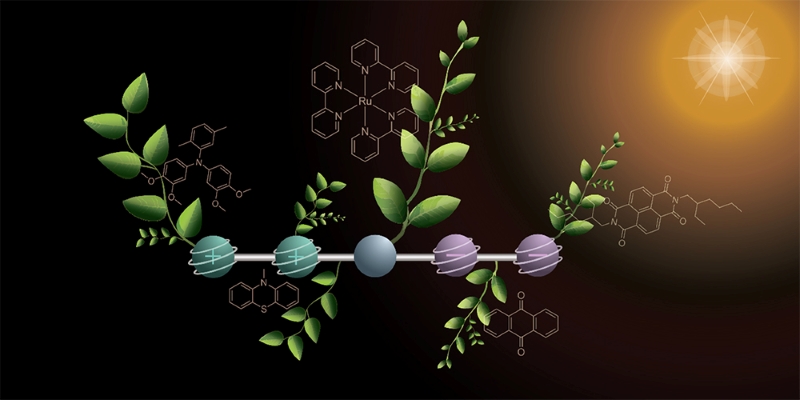
- Artificial photosynthesis aims to provide clean energy by transforming sunlight and carbon dioxide into fuel.
- Scientists have developed a molecule that brings this vision a step closer.
- The molecule can store multiple charges when exposed to light, clearing a major hurdle on the path to solar-powered fuels.
A scientific breakthrough might have brought sun-powered fuels a step closer. Scientists from the University of Basel said on August 25, 2025, they’ve developed a new molecule that can store multiple charges when exposed to light, marking a major step forward in the pursuit of artificial photosynthesis.
Photosynthesis is the backbone of life on Earth. By turning sunlight into carbohydrates, plants unlock our star’s clean, unlimited energy. And artificial photosynthesis could do the same. It would use sunlight and carbon dioxide to produce high-energy fuel that, when burnt, would release the same amount of carbon dioxide it took to produce. In other words, it would be carbon neutral.
The researchers published their findings in the peer-reviewed journal Nature Chemistry on August 25, 2025.
What is artificial photosynthesis?
For decades, artificial photosynthesis has been viewed as a holy grail for clean energy production. Emulating the way that plants convert sunlight, water and carbon dioxide into sugars and oxygen, the technology aims to use sunlight to split carbon dioxide from the atmosphere into useable fuels, like hydrogen, methanol and synthetic gasoline. It would make the essentially unlimited energy of the sun the driving force behind our energy production.
You might wonder: don’t solar panels already do this? Well, solar energy is certainly renewable, and a fantastic means of limiting our use of fossil fuels. But solar panels can only turn sunlight into electricity. It’s very difficult to store this electricity efficiently for later use, and some industries – such as aviation – can’t easily be electrified. Artificial photosynthesis, on the other hand, would create liquid and gas fuels that could be easily stored and transported, and immediately used by planes, ships and heavy industry.
And remember, the creation of these fuels would take carbon dioxide out of the atmosphere. And when they’re used, they would only release the same amount of carbon dioxide that they took to create. So artificial photosynthesis would be a source of carbon-neutral power for these currently fossil-fuel-dependent applications.
It’s a hugely exciting prospect. And scientists have just brought it a step closer.
A groundbreaking new molecule
The new development comes in the form of a molecule that can store two positive charges and two negative charges at once. These charges can drive reactions, such as splitting water into hydrogen and oxygen to form fuels. Successful artificial photosynthesis requires multiple charges, and – until now – that requirement has been a major obstacle.
The specially structured molecule consists of five parts in a series. In the center is a light-sensitive component. When the scientists flash a light at this component, it causes the parts on one side of the molecule to release an electron. Electrons have negative charges, so losing this electron causes that side to gain a positive charge. The components on the opposite side pick up this electron, causing that side of the molecule to become negatively charged.
The scientists then fire off another flash of light, causing the same reaction to happen again. So that leaves the molecule with two negative charges on one side and two positive charges on the other.
Molecules store energy in the difference between positive and negative charges. So after two bursts of light, this molecule is ready to drive chemical reactions.
How does this molecule move artificial photosynthesis forward?
This breakthrough brings artificial photosynthesis closer in two ways. First, this molecule functions under much lower light levels than previous attempts. While earlier experiments have required intense lasers to kickstart the reaction, this new setup is close to working under the intensity of sunlight.
Second, the molecule holds its charge long enough to be used in further reactions, which is a key step toward it being used for fuel creation.
To be clear, these scientists haven’t yet created a functioning artificial photosynthesis system. But, as co-author Oliver Wenger explained:
We have identified and implemented an important piece of the puzzle.
Bottom line: Scientists have developed a new molecule that might bring artificial photosynthesis – and clean, sun-powered fuels – a step closer.
Source: Photoinduced double charge accumulation in a molecular compound
Like what you read?
Subscribe and receive daily news delivered to your inbox.
More from
Will Triggs


Slow solar wind is oddly fast, says Proba-3

Mercury lives on? Strange streaks hint at active world
Milky Way’s central black hole erupted surprisingly recently
Did we just see dark matter? Scientists express skepticism


