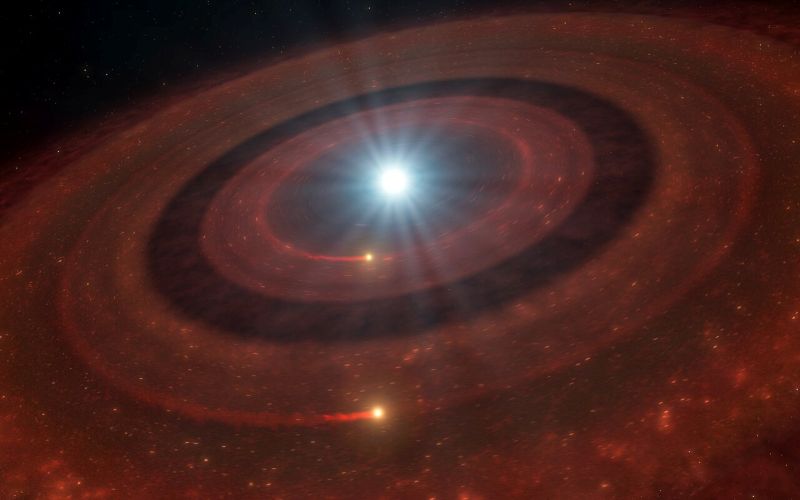
Is this our solar system’s future?
About 5 billion years from now, the sun will near the end of its life when it uses up its supply of hydrogen. Then it will temporarily expand into a red giant for about 1 billion years. Finally, it will blow off its outer layers in a last gasp. All that will be left behind is the sun’s dense, dead core: a white dwarf. But what about the planets circling the sun? What will happen to them? What is our solar system’s future?
Scientists from the European Southern Observatory said on October 27, 2026, that they’ve spotted a white dwarf star with a debris disk circling it. This could be a glimpse at what the solar system’s future holds.
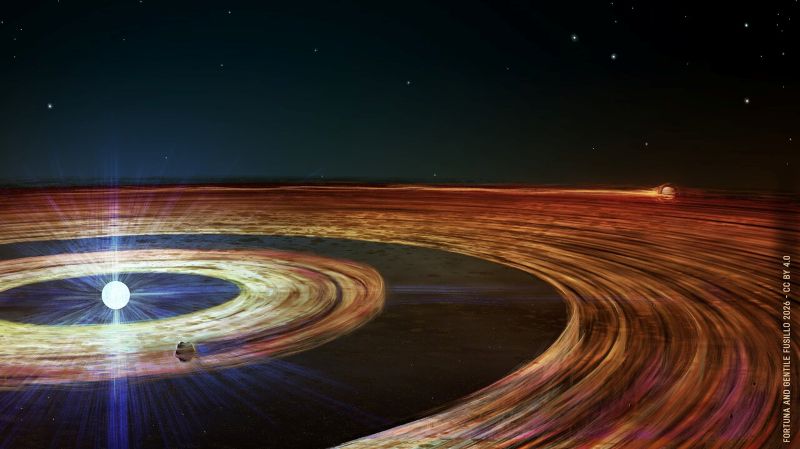
The disk consists of two rings that circle the white dwarf at different speeds. The scientists think the two rings were shaped by two planetary bodies that partially survived the star’s violent transformation. One of the surviving worlds could be as large as Pluto, or even our moon.
The researchers published their peer-reviewed study in the journal Nature Astronomy on October 26, 2026.
A white dwarf star with separate disks
The researchers used the European Southern Observatory’s Very Large Telescope in Chile to study the white dwarf, named J1328-1450. Other studies have found a disk around white dwarf stars before. But this is the first time researchers have spotted a disk with a distinct gap separating it into two parts. Lead author Nicola Gentille Fusillo at the University of Trieste in Italy said:
We have known for some time that planets may survive beyond the transformation of their central star, but this is the first example of a complex system with a double debris disk and potentially two surviving planetesimals.
Co-author Felipe Lagos-Vilches of the University of Warwick in the U.K. and the Universidad Técnica Federico Santa María in Chile added:
The structure we see in this system is particularly intriguing because the two gaseous rings are remarkably stable and remain separated by a gap.
Gentile Fusillo remarked:
The system is a rare glimpse of the violent, chaotic process by which a planetary system meets its end, and it hints that dead stars can have disk structures far more complex than previously realized.
Hence, a foreshadowing of our solar system’s future a few billion years from now.
2 possible surviving planetary remnants
The researchers said the most likely scenario that resulted in the two rings is that they came from two planet-like bodies that partly survived in their separate orbits. They said the inner object could be about the size of an asteroid, approximately a mile or more across. Meanwhile, the outer object could be larger, the size of Pluto or Earth’s moon.
Although they have not spotted the bodies themselves, the researchers have detected elements in the disk, such as calcium, oxygen, magnesium and iron. And the composition of each of those rings is different. The inner ring is rich in magnesium gas while the outer ring has little. This could bolster the idea of the rings being from two planets with different compositions.
However, there is still the possibility that the debris in the rings was from one planet, with one ring getting material from the crust and the other ring fed by the core of a planet.
Science news, night sky events and beautiful photos, all in one place. Click here to subscribe to our free daily newsletter.
Bottom line: Researchers have discovered a dead star — a white dwarf — surrounded by a debris disk with two separate rings. It offers a glimpse at what the solar system’s future might look like.
Source: A double debris disc around a white dwarf sculpted by two planetary bodies
Read more: Ancient water in protoplanetary disk is older than its star
Like what you read?
Subscribe and receive daily news delivered to your inbox.
More from
Kelly Kizer Whitt


Visible planets and night sky guide for October and November

Lake Powell rises more than 10 feet after heavy rains
Lacerta the Lizard, home to a blazar
Why do dolls creep us out? It’s the uncanny valley effect