
Another satellite breakup raises concerns about space junk
This week, a Soviet-era weather satellite broke apart in low-Earth orbit, creating tens of new pieces of debris that could threaten other spacecraft. This information comes from LeoLabs, a company that operates a global network of radars for tracking satellites and space debris. LeoLabs said that it detected the event on October 5, 2026, with the company’s system, LeoLabs Delta. It spotted multiple objects near the inactive Meteor 2-7 satellite after it passed over a radar station in Western Australia. Follow-up observations from other radars confirmed that a debris-generating event occurred.
LeoLabs said the event is the latest in a series of debris-generating events its network has detected over the past six months. The company called it a:
… worrying trend for space safety and security.
A satellite launched in 1981
The satellite that broke up — Meteor 2-7 — was launched by the Soviet Union in May 1981. It was part of the Meteor series of weather satellites. Its purpose was to observe clouds and gather information about Earth’s atmosphere.
But the satellite has now been inactive for decades. Today, it travels around Earth at an altitude of roughly 500 to 560 miles (800 to 900 km), according to orbital data.
That altitude makes the new debris particularly concerning.
NASA says debris at about 500 miles (800 km) can remain in orbit for decades or even centuries, depending on its size and other factors. The atmosphere is simply too thin at that altitude to slow objects down quickly. The Meteor 2-7 debris could therefore remain a hazard to spacecraft for a very long time.
What happened to Meteor 2-7?
There are a couple scenarios that might explain why Meteor 2-7 broke up. First, an internal failure or explosion might have occurred. On the other hand, it might have collided with another object in low-Earth orbit.
Jim Shell, an orbital debris expert, has narrowed down the time of the event to 09:45 UTC +/- 10 minutes on October 5, 2026. Shell speculates the cause might have been a collision but said it will likely remain a mystery. Shell said on X:
Meteor 2-7’s altitude of 855 km is in a dense region for orbital debris. Might we have experienced an impact from one of the numerous untracked debris objects? It is furthermore observed that the event time estimate places the 81 degree inclined satellite near its highest latitude position where the debris spatial density is highest. We will likely never know….
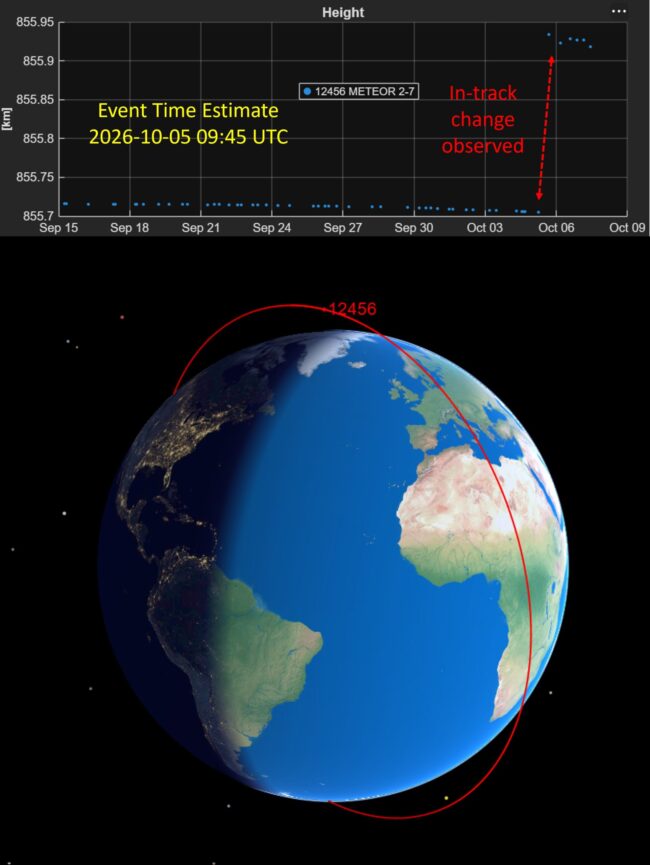
A growing orbital debris problem
This isn’t the first recent fragmentation event to attract attention. In March, LeoLabs detected dozens of objects around the SpaceX Starlink 34343 satellite after it experienced an anomaly. SpaceX said the event was probably due to an internal energetic source rather than a collision. In August, LeoLabs also detected the fragmentation of a Chinese Long March rocket body, producing potentially tens to hundreds of fragments.
Each event adds more material to an already crowded orbital environment. Objects in low-Earth orbit travel at roughly 17,500 mph (28,000 km/h). At those speeds, even a small piece of debris can seriously damage or destroy a spacecraft. NASA estimates that there are hundreds of thousands of pieces of debris at least a centimeter across, along with millions of smaller fragments.
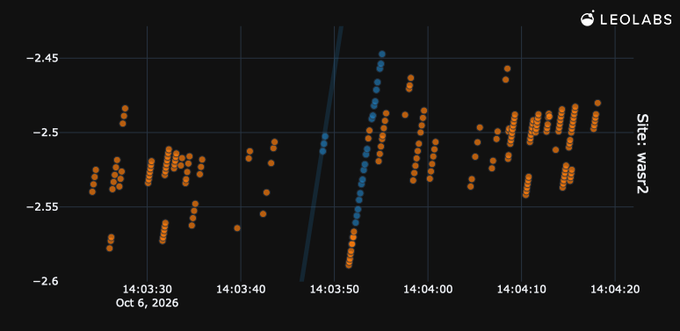
Could this lead to the Kessler Syndrome?
The growing number of objects raises the specter of Kessler Syndrome, a potential chain reaction in which collisions create debris, that debris causes more collisions, and those collisions create still more debris.
NASA scientist Donald Kessler and NASA colleague Burton Cour-Palais proposed the concept in 1978. The concern isn’t that one satellite breakup will suddenly create an impenetrable cloud around Earth. Instead, repeated collisions over many years could gradually make certain orbital regions increasingly hazardous. And each new satellite breakup brings us closer to an unstoppable chain of events.
Read more about the Kessler Syndrome
Bottom line: An inactive Soviet weather satellite has broken apart above Earth. It has added tens of debris fragments to an already crowded low-Earth orbit.
Like what you read?
Subscribe and receive daily news delivered to your inbox.
More from
Kelly Kizer Whitt


Smile mission releases its stunning 1st aurora footage!

Visible planets and night sky guide for October
Hera mission hits the brakes to arrive at asteroid
The ghost of Biela’s Comet: It created a storm and disappeared