Small asteroid hit Earth’s atmosphere on Sunday
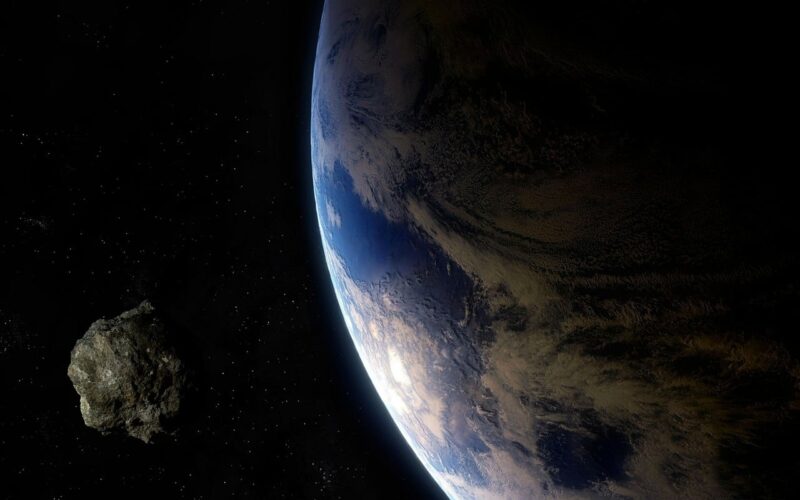
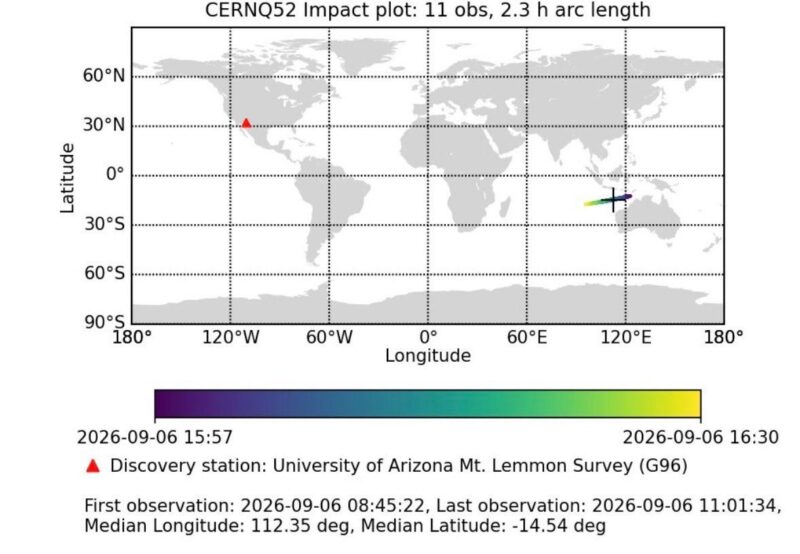
A small asteroid burned up in Earth’s atmosphere over the Indian Ocean on Sunday, September 6, 2026. About 6 hours before the space rock hit our atmosphere, the Mount Lemmon Observatory – as part of the Catalina Sky Survey – spotted it, marking the 13th time scientists have ever discovered an asteroid before impact.
The asteroid turned out to be just about 80 centimeters or 2.6 feet across. Its small size is a testament to how well the space surveys are able to find asteroids in the near-Earth environment.
The impact happened over the Indian Ocean off northwestern Australia. While there were no confirmed sightings of the asteroid as it burned up in our atmosphere, the space rock should have hit around 16:07 UTC (11:07 a.m. CDT).
At first the asteroid was described as CERNQ52. Now it has an official name: 2026 RW1.
Asteroid CERNQ52 entered Earth's atmosphere today over the ocean south of Indonesia. It was discovered by the Mount Lemmon Survey in Arizona only hours before its demise. At 80 cm wide, it would have caused no damage. I had to exaggerate the size here, so you could see it. ? #astro
— Tony Dunn (@tony873004.bsky.social) 2026-09-06T21:58:15.158Z
More about the asteroid 2026 RW1
Adrien Coffinet, a member of the Minor Planet Mailing List, wrote:
If I’m not wrong, this will be the first Aten asteroid (a < 1 AU) detected in space before impact. All the previous impactors detected in space before impact were Apollo asteroids (a > 1 AU).
Aten asteroids are those that have an orbit inside Earth’s, so under 1 astronomical unit (AU). Apollo asteroids are those that are farther from the sun than Earth on average.
Bottom line: A small asteroid impacted Earth’s atmosphere harmlessly on Sunday. Scientists spotted it just 6 hours earlier. It was the 13th asteroid spotted before impact.
Read more: How big are asteroids? Compare sizes in this video
Like what you read?
Subscribe and receive daily news delivered to your inbox.
More from
Kelly Kizer Whitt


Why does anything exist? New theory emerges

Visible planets and night sky guide for October
Euclid was mapping the universe. Then it found a comet
Auriga the Charioteer and bright Capella on October evenings