- Could microbes from Earth survive on the moon? A new study from NASA’s Goddard Space Flight Center says … maybe.
- Microbes that hitch a ride with future Artemis astronauts could potentially survive by hiding in shadowed nooks and crannies on the surface, protected from the sun’s harsh direct sunlight and radiation.
- The microbes would likely only survive, perhaps in a dormant state, rather than thrive and grow.
Can human microbes on the moon survive?
When human astronauts return to the moon’s surface, they won’t be alone. Humans never are. Each of us carries trillions of microorganisms with us wherever we go, including to the moon.
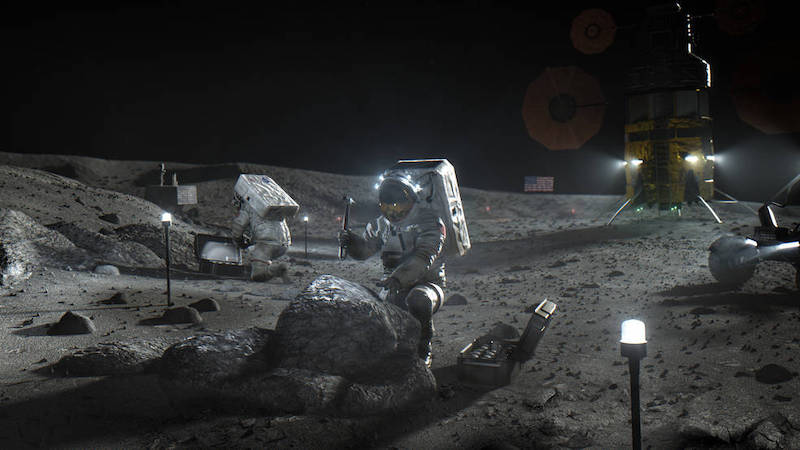
So tiny microbial companions will travel with future astronauts, on their bodies and equipment. But could any of these little critters survive on the moon? A new study from researchers at NASA’s Goddard Space Flight Center suggests some might be able to, in shaded nooks and crannies – even in an astronaut’s bootprint – in and around the moon’s south pole region, where the first Artemis astronauts are scheduled to land.
The researchers said on August 19, 2026, that the microbes could survive. But they would be unlikely to thrive and grow.
The intriguing peer-reviewed results were published in Science Advances on August 19, 2026.
Microbes from Earth may survive on the moon, scientists find www.space.com/astronomy/mo…
Microbes hitching a ride to space with astronauts could survive in the moon’s shady south pole region, according to NASA and #UMD researchers. Their findings have implications for space missions—explorers who discover microbial life on the moon need to know if they carried it there themselves. ?
— UMD Science (@umdscience.bsky.social) 2026-08-20T20:17:38.237Z
Is the moon a harsh place?
Some of the most striking hazards for microbes (and humans) on the moon include:
- Intense ultraviolet radiation from the sun, with no protective atmosphere.
- Cosmic radiation and solar energetic particles.
- Extreme temperatures, from roughly 250°F (120°C) in sunlit areas to about -280°F (-173°C) in darkness.
- Near-vacuum, with essentially no atmospheric pressure.
- Severe dryness, essentially no liquid water at the surface.
- Abrupt temperature swings, especially around sunrise and sunset.
- Abrasive lunar dust, which is chemically reactive and can damage biological structures.
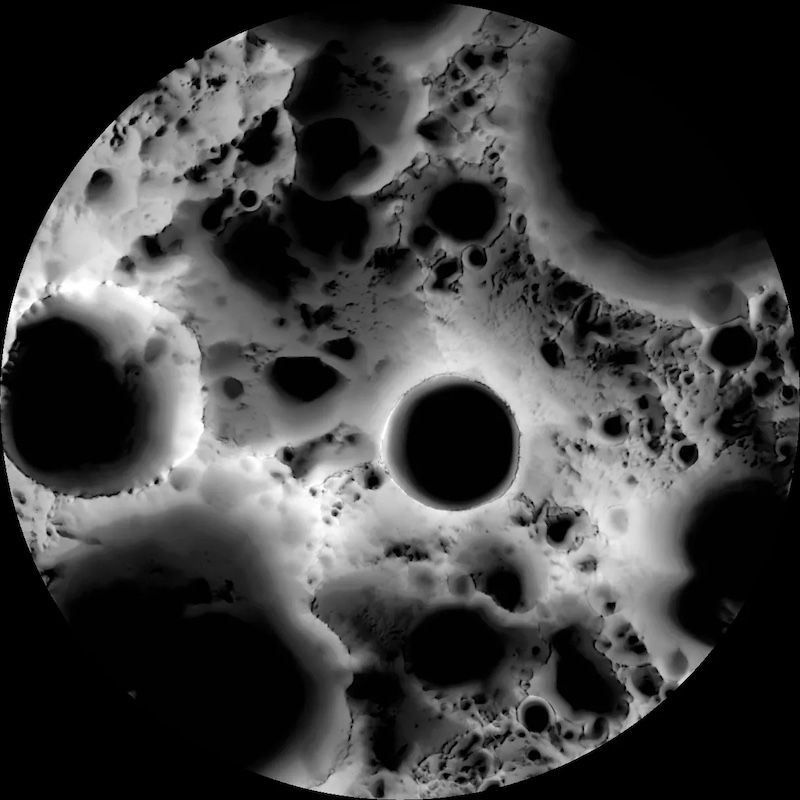
Some microbes are remarkably tough. Spores and certain dormant microorganisms can survive radiation, desiccation (drying), vacuum and temperature extremes for surprisingly long periods. Now bear in mind the shadowed areas at the lunar poles. From the poles, the sun stays just above the lunar horizon, so the sunlight skims the surface like a flashlight skimming a surface. Hence there are many shadowed regions.
The researchers studied microbes that might be able to live in the lunar conditions. This includes organisms commonly found in spaceflight environments and those common on human skin. Besides Aspergillus niger, these included Bacillus subtilis, Staphylococcus aureus, Deinococcus radiodurans and several species of Fusarium.
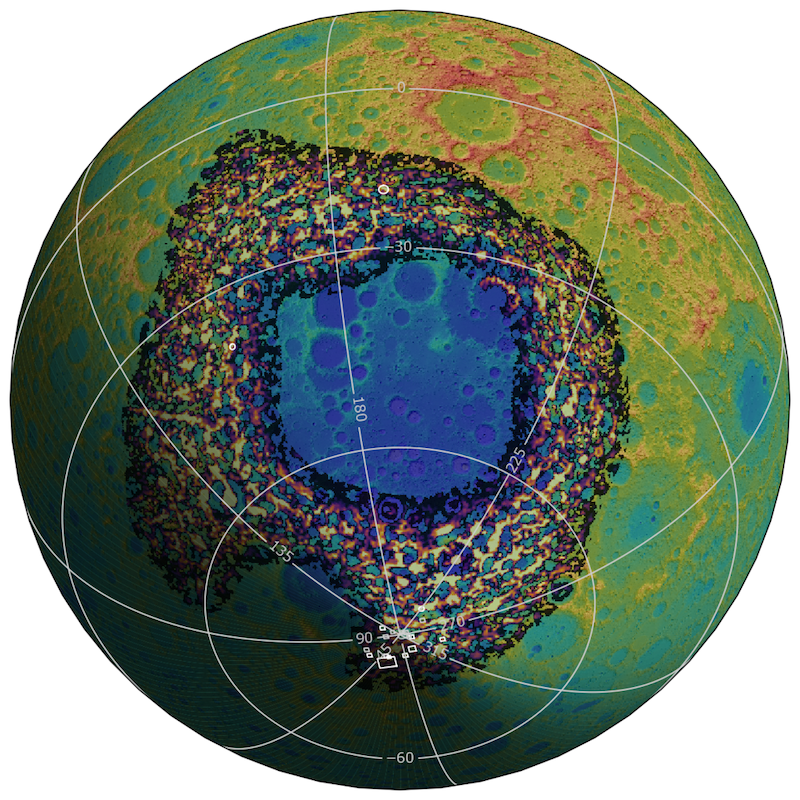
Based on an analysis of previous studies, the scientists noted the maximum amount of heat and ultraviolet (UV) radiation each organism can withstand. And after that, the organisms were tested in simulations of three regions near the lunar south pole: Nobile Rim, Connecting Ridge and De Gerlache Rim.
In addition, those simulations used detailed environmental maps built from elevation and temperature data collected by instruments on NASA’s Lunar Reconnaissance Orbiter. These were then combined with models of how radiation strikes the lunar surface.
The Artemis astronauts’ microbial companions
Even with their protective spacesuits and decontamination procedures, the Artemis astronauts will still bring many microbes with them to the moon. On average, humans have 1 million bacteria living on each patch of skin the size of a pencil eraser. And these bacteria can vent from spacesuits and habitats. So human bacteria will be exposed to the harsh lunar surface environment near the south pole.
As lead author Prabal Saxena at NASA’s Goddard Space Flight Center in Greenbelt, Maryland, said:
Humans are natural explorers, and with them come their voices, their memories … and their microbes. For some scientists, myself included, that reality can be unsettling. But it also creates an opportunity to turn an imperfect situation into a useful experiment.
For those experiments, the moon could be used as a natural lab. Indeed, the unique environment of the moon would allow scientists to test the real-life limits of the microbes in that environment.
All 6 Apollo landing sites – from 1969 to 1972 – are near the lunar equator. In this visualization, the Apollo sites are contrasted with the south pole, where future Artemis astronauts will explore. Time passes as we zoom toward Shackleton crater at the south pole, revealing illumination conditions quite different from those near the equator. Many craters remain in permanent shadow. Video via NASA’s Scientific Visualization Studio/ Ernie Wright.
‘Survivable niches’ for microbes on the moon
These scientists’ models revealed “survivable niches” on the moon. Some were the size of a miles-wide crater floor. But even an astronaut’s footprint could become a habitable zone. Ultimately, Aspergillus niger was the most resilient to UV radiation.
As co-author Heather Graham at Goddard concluded:
When we think of the moon, we don’t typically think of biology. But the moon is a place where a cell can survive, so our first exploration of these sites should pay extra attention to our microbial hitchhikers and work hard to characterize lunar chemistry before our visits change what we will find.
Experiments on Earth indicate some common species of bacteria and fungi could survive for several days on the moon's surface, suggesting missions must take stronger precautions to avoid contamination
— New Scientist (@newscientist.com) 2025-09-28T12:48:31.475Z
Baseline for future science
That testing will be invaluable. But first, scientists need to know what kinds of microbes future astronauts might bring to the moon. And this is especially true for human missions to Mars further in the future. Co-author Andrew Needham at Goddard said:
We need to understand what was there before us, because when we go to Mars to search for signs of life beyond our planet, we will want to make sure it’s not stuff we brought.
Most microbes would have little chance of surviving on the moon or Mars. But others are much tougher and resilient. Scientists call these extremophiles. One example is Aspergillus niger. It’s a fungus that thrives in warm, damp places like household bathrooms and heating, ventilation and air conditioning systems.
That might be the best environment for it, but astronauts also found it surviving on the outside of the International Space Station! And Aspergillus niger isn’t even technically considered to be an extremophile. Co-author Aaron Regberg, a geomicrobiologist at NASA’s Johnson Space Center in Houston, Texas, said:
I would have expected these microbes to have dried out.
Will we infect Mars?
In a thesis reported on earlier this summer, Tommaso Zaccaria at Radboud University in the Netherlands wrote about how some human-based infectious – or pathogenic – organisms could live in the Martian environment.
He found that such microbes might actually become more infectious in the Martian environment. If true, that’s not good news for future astronauts.
Bottom line: Microbes on the moon that hitch a ride on human astronauts could survive by using little nooks and crannies for protection from the harsh environment.
Source: Potential survivable niches for microbial life on the lunar south pole
Read more: Infectious microbes on Mars could become even more deadly
Read more: A lunar quarantine facility to protect from alien microbes?
Like what you read?
Subscribe and receive daily news delivered to your inbox.
More from
Paul Scott Anderson


Lucy mission to Trojan asteroids: 5 years of discoveries

Surprising colors of white dwarf stars revealed for 1st time
Caves on the moon are target of new NASA mission
2nd-generation planet: Was this world born around a dead star?