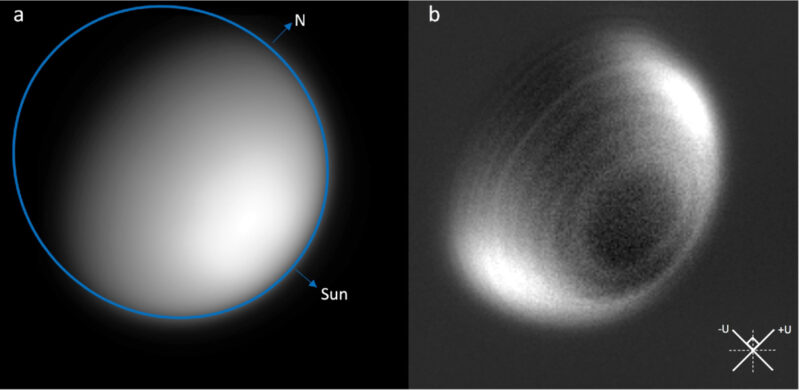
A group of Dutch astrophysicists has discovered a set of giant “rings” on Venus. They’re not solid planetary rings (like Saturn’s). Instead, they are circular bands in Venus’ upper atmosphere that wrap around the planet. And they’re not visible to the eye, but can be seen in polarized light, which blocks some scattered light and enhances subtle patterns.
The rings are actually waves or ripples in Venus’ atmosphere, but very ring-like! The group discovered them while taking a second look at images of Venus captured in 2010 by the William Herschel Telescope.
The rings appear to be the result of differences in gas density above the cloud tops. A simulation of Venus’ atmosphere created for the study shows gravity waves could be driving the phenomenon. The same kind of gravity waves create the broad, expanding rings that spread across a pond after you toss in a stone. And gravity waves help shape weather and climate patterns on Earth.
The researchers published a peer-reviewed paper detailing the discovery on July 9, 2026, in The Planetary Science Journal.
Venus rings found high in its atmosphere
The announcement of rings in Venus’ atmosphere is recent, but the data was collected in 2010. The authors said they captured the images while waiting for the sky to darken enough to continue their hunt for exoplanets:
The Venus images we present here are truly serendipitous. They were captured using the 4.2-meter [14 feet] William Herschel Telescope … during a period of about 36 minutes in which we were waiting for the end of the astronomical evening twilight on May 24, 2010. We were waiting to start observations of circumstellar disks around exoplanets.
The Extreme Polarimeter (ExPo) was an instrument designed to detect circumstellar disks of gas and debris around distant stars. Signs of exoplanets are often hidden within these disks. ExPo has since been decommissioned and disassembled.
The giant rings on Venus are centered on a region downwind of the planet’s subsolar point, the moving spot on the planet where the sun appears directly overhead (at the zenith). This point shifts slowly across Venus’ surface because the planet takes 117 Earth days to complete one rotation.
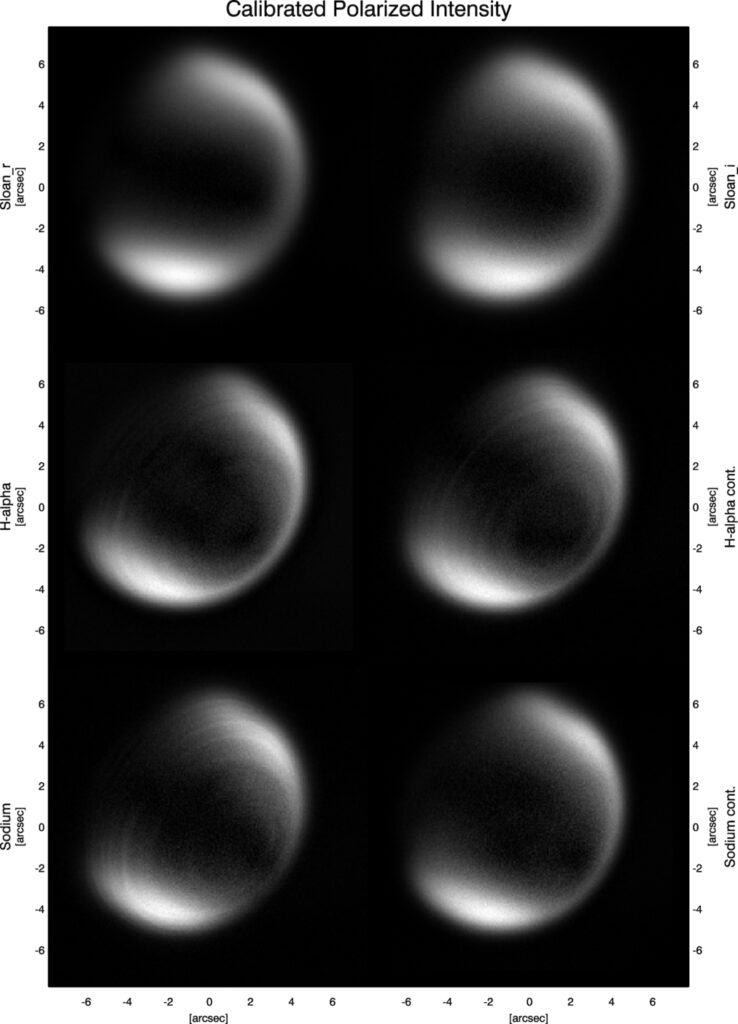
Images of Venus rings are one-of-a-kind
At first, because they’re almost centered on the brightest point on the planet’s disk, the researchers thought the giant rings on Venus might be an artifact of the ExPo detector. But the tool for measuring the polarization of light waves was designed to avoid such errors. Six different kinds of filters were used to create six sets of images, and the rings only showed up in three of them.
The science team had no other explanation: the rings are really there. And these are the only pictures of them ever taken.
The images from ExPo were captured under the extremely dark skies above the Canary Islands during a night of exceptionally clear skies. Unfortunately, no more images of the rings can be taken because the instrument has been dismantled:
We have no other images of Venus with rings, as we did not have other opportunities to observe Venus under such advantageous seeing conditions and, due to the experimental nature of ExPo, the instrument has been taken apart and its optical components reused for other experiments. To the best of our knowledge, there are no other polarimeters available that combine imaging with ExPo’s high polarimetric sensitivity.
Upcoming mission to Venus to help explain ring mystery
The researchers, of course, want more observations to deepen our understanding of how and why these Venus rings form. They want both ground-based imagery, as well as measurements taken by space-based telescopes.
They might get an extremely close look from ESA’s EnVision mission. It includes plans to carry a high-resolution polarimeter into orbit around Venus. Launch is scheduled for 2032.
But who knows? The rings might not be there when the orbiter arrives. No one knows how often this atmospheric ring feature forms or how long it lasts.
And, despite not finding an error in the way ExPo collected the data, it’s still possible the rings are a false signal. While it looks like a newly discovered weather pattern, there isn’t enough information to be sure. The researchers said:
Moreover, ExPo was an experimental instrument that was not later reinstalled in an identical configuration and has since been dismantled. For these reasons, the present observations cannot by themselves establish a definitive detection of a new Venusian atmospheric phenomenon and should instead be viewed as a candidate signal that requires independent confirmation.
Still, what we see in the first ring images is enough to let the team speculate about how the rings came to be:
If the observed pattern is astrophysical rather than instrumental, one plausible explanation is spatial variation in the gas density above the hazes and clouds. Such planet-wide density variations could result from atmospheric waves emanating from the region close to the subsolar point.
Bottom line: New analysis of images taken in 2010 reveals giant Venus rings high in the planet’s atmosphere, hidden from normal view.
Read more: New evidence of lava tube on Venus found in old radar data
Like what you read?
Subscribe and receive daily news delivered to your inbox.
More from
Dave Adalian


Fall hummingbird migration in progress across North America

Save the Frogs Day is today, Tuesday, April 28
Join the worldwide 2026 City Nature Challenge this weekend!
Milky Way and Andromeda held together by dark matter sheet