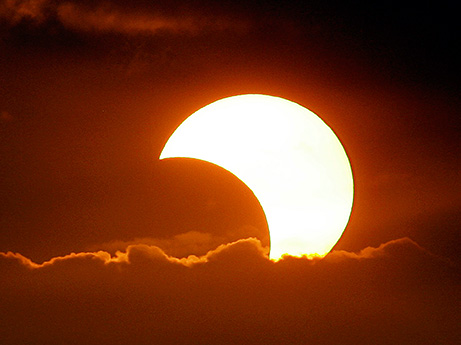
At this particular moment in Earth’s history – although the sun’s diameter is about 400 times larger than that of the moon – the sun is also about 400 times farther away. So the sun and moon appear nearly the same size as seen from Earth. And that’s why we on Earth can sometimes witness that most amazing of spectacles, a total eclipse of the sun.
When is the next solar eclipse?
No one knows the odds, because no one knows how many planets and moons there are in space. Astronomers have discovered 893 planets in distant solar systems so far (as of June 21, 2013), and we don’t know much about their moons.
EarthSky asked Myles Standish about the similarity in the size of Earth’s moon and sun, as seen from Earth. He is a mathematical astronomer and a former professor at Yale University. He worked for CalTech’s Jet Propulsion Laboratory. He has published over 300 articles, mostly in the field of solar system dynamics and celestial mechanics. He said this similarity is unique among the planets and moons that make up our local family in space, our solar system. In other words, it doesn’t occur with any other planets and moons in our immediate neighborhood of space.
But there may be millions or billions of undiscovered solar systems.
So what are the odds of the moon and sun appearing nearly the same size from Earth? No one knows.
By the way, although it’s fascinating that they are so similar, the sun and moon aren’t always the same size as seen from Earth. In fact, the moon and sun are rarely exactly the same size. The moon’s distance from Earth varies slightly over the course of a single month. So the moon’s apparent size in our sky is always changing.
For part of every month, the moon is in a far part of its orbit from Earth. At such times it isn’t big enough to cover the sun completely. If an eclipse happens then, the outer part of the sun’s surface will appear as a ring around the moon. This type of event is called an annular or ring eclipse. It’s essentially a partial eclipse. The sky doesn’t darken. You can’t look at the eclipse without special filters. Still, it’s very beautiful and fascinating to witness any eclipse – and stand in line with the sun and moon!
What’s more, the moon is getting minutely farther from the Earth – by about 4 centimeters – every year. That means that, in past aeons, there were no annular eclipses. All eclipses were total eclipses because the moon in Earth’s sky always appeared bigger than the sun.
Now some eclipses of the sun by the moon are total, and some are annular, as seen from Earth.
But as the aeons pass, and the moon gets ever farther from us, its apparent size in our sky will continue to grow smaller. Eventually, people on Earth won’t see total eclipses. All the solar eclipses will be annular, with the moon not quite big enough to cover the sun completely.
Bottom line: The sun’s diameter is about 400 times larger than that of the moon – and the sun is also about 400 times farther from Earth. So the sun and moon appear nearly the same size as seen from Earth. What are the odds?
Like what you read?
Subscribe and receive daily news delivered to your inbox.
More from
Editors of EarthSky


Meteor shower guide 2026: Up next … the Taurids

Comet Halley is parent of 2 meteor showers
Inferior conjunction — Venus! October 23-24, 2026
We fly between the sun and Saturn on October 4