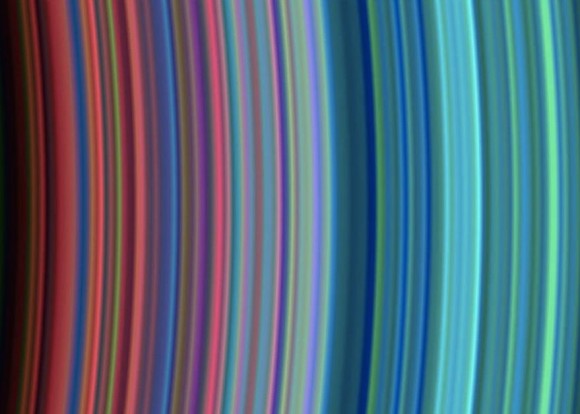
The European Space Agency posted this image on its Flickr page this week (May 5, 2014). It shows a section of Saturn’s beautiful rings, first observed in the year 1610 by early telescopes … and more recently observed close-up by the Cassini spacecraft, which has been orbiting Saturn, weaving in and among its moons, since 2004.
This image shows a portion of Saturn C-ring. The image is closest to Saturn on the left, with the B-ring beginning just right of center.
The variation in the color of the rings arises from the differences in their composition. Turquoise-hued rings contain particles of nearly pure water ice, while reddish rings contain ice particles with more contaminants.
Read more at ESA’s Flickr page.
Via Jennifer Welch (@MicrobeLover on Twitter)

Bottom line: The Cassini spacecraft captured this image of multiple colors within the rings of Saturn. Turquoise-hued rings of Saturn contain particles of nearly pure water ice, while reddish rings contain ice particles with more contaminants.
Like what you read?
Subscribe and receive daily news delivered to your inbox.
More from
Deborah Byrd


NASA’s Perseverance rover on Mars sets off-world driving record

Visible planets and night sky guide for October
Hera mission hits the brakes to arrive at asteroid
Flashing star in autumn? Here are 3 candidates