The North Star, aka Polaris
The North Star, also known as Polaris, appears to stay fixed in our northern sky. It marks the location of the sky’s north pole – the north celestial pole – which is the point around which the whole starry northern sky turns as the Earth rotates. That’s why you can always use Polaris to find the direction north.
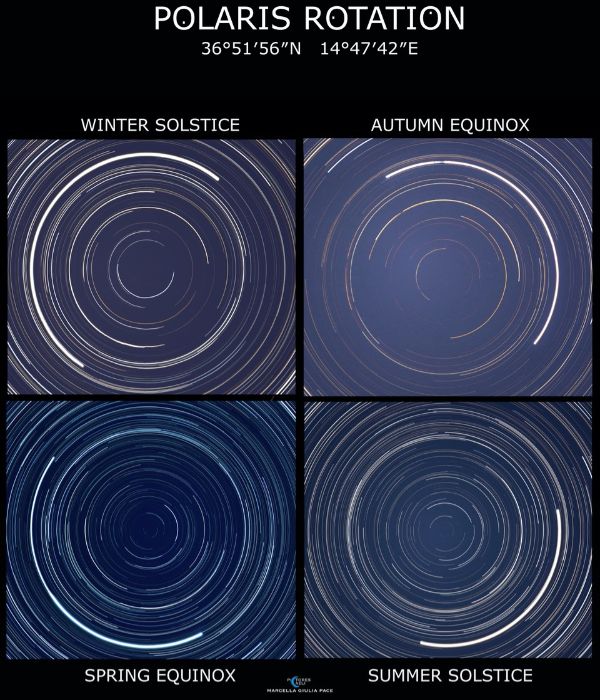
But even though the North Star doesn’t appear to move, a timelapse video reveals that it actually does. It makes its own little circle around the sky’s north pole every day. That’s because the North Star is offset a little – about 0.65 degrees – from celestial north. So Polaris makes a circle that’s 1.3 degrees in diameter each day.
Why do stars move, anyway?
Why does Polaris – and all the other stars in the sky – move at all? The answer is Earth’s spin. Because Earth rotates counter-clockwise when looking from above the North Pole, the sun in the daytime – and most stars at night – appear to rise in the east and set in the west.
Depending on your latitude, certain stars will be close enough to your nearest pole that they never rise or set. Never dipping below the horizon, they instead circle above you constantly. These are called circumpolar stars.
And the North Star is a special example of a circumpolar star. Because it lies almost exactly above Earth’s northern axis, it’s like the hub of a wheel. It doesn’t rise or set, and barely moves in a circle. Instead, it appears – to the eye – to stay put in the northern sky.
How high in your sky?
The North Star not only points toward the north, but its height in the northern sky also matches your latitude on earth. If you are sailing the Caribbean at 16° north latitude, the North Star will be about 16° high in your sky. If you are sailing around Nova Scotia, at 44° north latitude, then the North Star will be about 44° high in your northern sky. Each degree north or south equals 69 miles (111 km), so traveling 690 miles north or south will change your latitude, and the North Star’s elevation, by 10 degrees.
Read more: Polaris is the North Star
Taking turns as the North Star
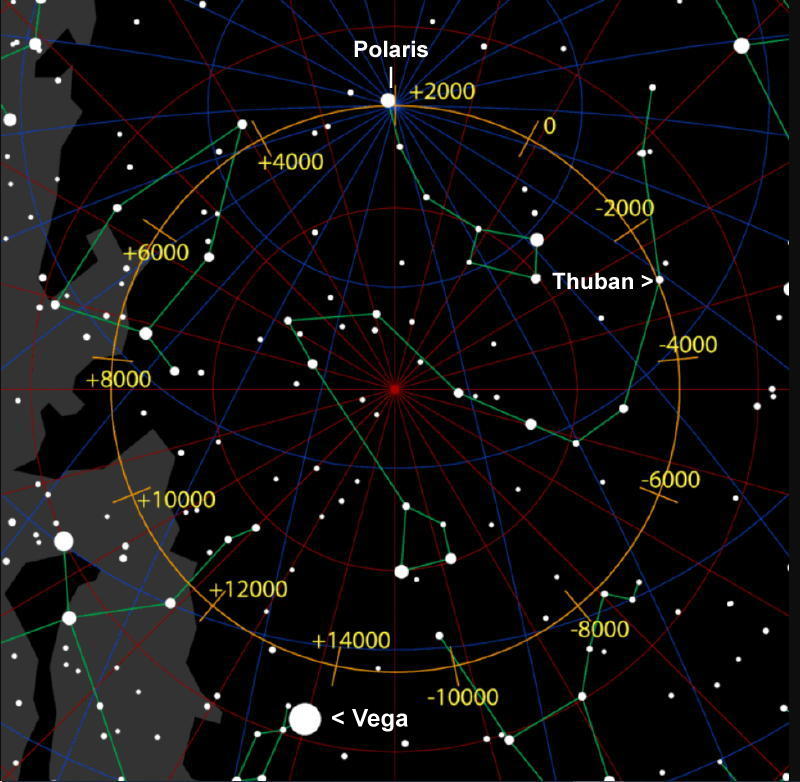
A motion of Earth called precession causes our axis to trace out an imaginary circle on the celestial sphere every 26,000 years. And that means the star closest to the north celestial pole isn’t fixed.
Thousands of years ago, when the pyramids were rising from the sands of ancient Egypt, the North Star was an inconspicuous star called Thuban in the constellation Draco the Dragon.
Twelve thousand years from now, the blue-white star Vega in the constellation Lyra the Harp will be a much brighter North Star than our current Polaris.
Polaris could be a name for any North Star. Our current Polaris used to be called Phoenice. It is the 49th brightest star in the sky. It is not known for its brightness, but for its unique position in the sky.

Proper motion
By the way, Polaris – like all stars – has more than one kind of motion. There’s the movement we see on our sky, caused by the Earth’s rotation. And then there’s each star’s actual motion through space.
The stars we see in our night sky are all members of our Milky Way galaxy. All of these stars are moving through space, but they’re so far away we can’t easily see them move. That’s why the stars appear fixed relative to each other. And it’s why, for the most part, we see the same constellations as our ancestors.
But over time, this movement – called proper motion – rearranges the patterns of stars we see in our sky. For Polaris, that movement is small, about 46 arcseconds in 1,000 years. That is about 1/40th of the diameter of the full moon as seen from Earth. So when you’re talking about stars moving or staying fixed, remember … they are all moving through the vastness of space. It’s just the relatively short time of a human lifespan that prevents us from seeing this grand motion.
Enjoying EarthSky? Sign up for our free daily newsletter today!
Bottom line: The North Star is a symbol for constancy. But a video or star trails image reveals that it makes its own little circle around the sky’s north pole every day.
Like what you read?
Subscribe and receive daily news delivered to your inbox.
More from
Editors of EarthSky


Mercury after sunset and great for Southern Hemisphere!

Meteor shower guide 2026: Up next … the Orionids
We fly between the sun and Saturn. At opposition today
October birthstone: Colorful opal and tourmaline