EarthSky // Interviews // Earth By Jorge Salazar Feb 20, 2012

Chuck Kennicutt: Penetrating miles of Antarctic ice in search of alien-like life

Russian scientists have penetrated miles of Antarctic ice to analyze waters for alien-like life. EarthSky spoke with oceanographer Chuck Kennicutt.

DownloadEmbed
close

Copy the following code to embed this player

Russian scientists have penetrated miles of Antarctic ice as others race to analyze its waters for alien-like life, according to the news agency Reuters.

EarthSky spoke to oceanographer Chuck Kennicutt of Texas A&M heads the Scientific Committee on Antarctic Research, which coordinates research in the area. Kennicutt said:

This is truly a breakthrough event. Our Russian colleagues should be congratulated on an outstanding feat of accomplishment, technologically. This has been a long time in the planning. There’s been great interest for more than a decade, that these are very unusual environments that we know little about, primarily because they’ve never been penetrated.
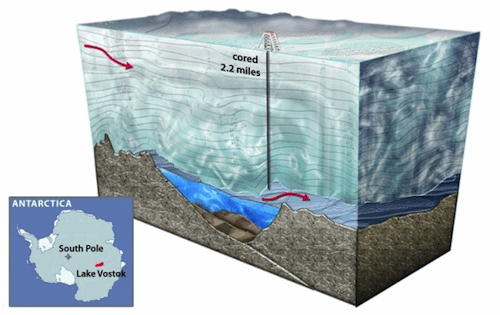
An artist's cross-section of Lake Vostok, the largest known subglacial lake in Antarctica. The depth of the drill core has increased since the diagram was created. Credit: Nicolle Rager-Fuller, NSF

An artist's cross-section of Lake Vostok, the largest known subglacial lake in Antarctica. The depth of the drill core has increased since the diagram was created. Credit: Nicolle Rager-Fuller, NSF

Valery Lukin is head of Russia’s Arctic and Antarctic Research Institute that oversaw the scientific drilling in the sub-glacial lake of Antarctica’s Lake Vostok. He said:

It’s like the first flight to the moon

After 30 years, Russian scientists finally announced on February 8, 2012, that they had penetrated 3769.3 meters of glacial ice to reach the waters of Lake Vostok, which hasn’t seen the light of day in over 15 million years.

Russian researchers at the Vostok station work in a snow bore pit. (Russian Geographical Society)

Russian researchers at the Vostok station work in a snow bore pit. (Russian Geographical Society)

Kennicutt told EarthSky:

This first entry, in and of itself will only be the beginning of providing information about what might be living in the lakes, how have these lakes evolved over time, do these lakes impact the overlying ice sheets, are ice streams associated with accumulations of water, and just a whole range of scientific knowledge will ultimately come from the exploration of these environments.

Russian Vostok station and 5G drill tower. (Russian Geographical Society)

Russian Vostok station and 5G drill tower. (Russian Geographical Society)

Russian scientists call Lake Vostok “the pole of cold,” with average surface temperatures a chilly -56 degrees Celcius (-68.8 degrees Fahrenheit). Scientists worldwide suspect that microbes might be living in the sub-glacial waters of Lake Vostok. The extreme conditions there are similar to what life on other worlds might face. Dr. Kennicutt explained the search for alien-like life at Lake Vostok:

Fundamental to the existence of life as far as we know it is the existence of liquid water. That has always been the touchstone for looking for where life might exist beyond planet Earth. This is particularly true in our own solar system such as the discovery of icy moons like Europa, that we’re convinced now from studies does have liquid water beneath a thick ice sheet; and also the moon of Saturn, Enceladus. We do know that there are places in our solar system that have thick ice sheets over what appears to be liquid water. And that’s the analogy that’s often given.

These lakes in Antarctica are similar, though there are much more severe conditions once you get off of planet Earth. There is at least the analogy that these are locations that organisms could possibly have colonized that are beneath large ice sheets in liquid water. That’s the connection that people make in trying to understand where is the most likely place to look for life beyond Earth.

Jupiter's moon Europa, which scientists also suspect might harbor life beneath miles of ice.

Jupiter's moon Europa, which scientists also suspect might harbor life beneath miles of ice.

Listen to the 90-second EarthSky interview with Chuck Kennicutt on penetrating miles of Antarctic ice on Lake Vastok to analyze water samples for possible alien-like life.

Racing against time to strike liquid water in frozen, ancient Lake Vostok

EarthSky 22: Penetrating Lake Vostok

Share your comments on Facebook

3 Responses to Chuck Kennicutt: Penetrating miles of Antarctic ice in search of alien-like life

  1. [...] scientists won’t be able to study the water until the next Antarctic season, however the possibility of life existing in the ancient lake is being heavily debated.  According to Dr. Robin Bell, of the Lamont-Doherty Earth Observatory at [...]

  2. Joe Losito says:

    Let’s hope there are no micro-organisms in Lake Vostok that are harmful to humans. It’s not beyond the realm of possibility that that are microbes or bacteria down there that humans have developed an immunity to over the millennia but which we will now be defenseless against.

  3. Marc Viola says:

    However exciting, several additional possibilities could await these explorations. Lake Vostok, one of the biggest in the world (with a liquid depth of 500 meters) has had millions of years to let evolution work — even longer a time period than for humans. What’s down there is anybody’s guess. The depths could harbor:

    1) As mentioned earlier, strange, and heretofore never before encountered microorganisms could be waiting. These potential pathogens could be harmful to both human and / or other life forms on the surface. It would be no small irony if 2012 were to witness the unintended release of a new pandemic (even plague) to the world.

    2) To paraphrase the classic film, the “Thing,” the ice might harbor organisms somewhat larger than “micro” in size. What those “things” might be is anybody’s guess. A life form with more time to evolve than even humans? Maybe a super-advanced cephalopod? Or maybe even something intelligent? If communications with the Russian station were to suddenly go silent, we might consider treading more carefully on the lair of something we don’t fully understand. After all, what if they are studying us (and not the other way around)?

    NOTE: It just so happens that Director Guillermo del Toro (“Hellboy” and “Pan’s Labyrinth”) and screenwriter Matthew Robbins wrote a screenplay based on Lovecraft’s 1931 novella, “At the Mountains of Madness.” The story takes place, strangely enough, in Antarctica. In July 2010 it was announced that the film would be made in 3D and that (del Toro’s friend) James Cameron would become producer, and Tom Cruise was attached to the project as a star. The premise of the story is that an Antarctic exploration accidentally discovers the existence of strange imprisoned beings, including Cthulhu. In Lovecraft’s earlier (1928) story, “The Call of Cthulhu,” Cthulhu is described as a monstrous entity who lies “dead but dreaming” in the city of R’lyeh, a place of non-Euclidean madness sunken below the depths. Let us hope that life does not imitate art.

    THE LAST WORD: And by no means least, may humanity’s quest for knowledge (and its best of intentions) refrain from yet again contributing to the untimely extinction of even more precious life forms on this tiny planet…

Share your comments on EarthSky

Your email address will not be published. Required fields are marked *

*

You may use these HTML tags and attributes: <a href="" title=""> <abbr title=""> <acronym title=""> <b> <blockquote cite=""> <cite> <code> <del datetime=""> <em> <i> <q cite=""> <strike> <strong>