The full Beaver Supermoon
The crest of the November 2026 full moon will fall at 8:54 a.m. CT (14:54 UTC) on Tuesday, November 24. So – for the Americas – the fullest moon will come on the morning of November 24. As a bonus, this full moon is near the point in its orbit where it’s closest to Earth. This makes it a supermoon. In fact, it’s the first of three supermoons in a row.
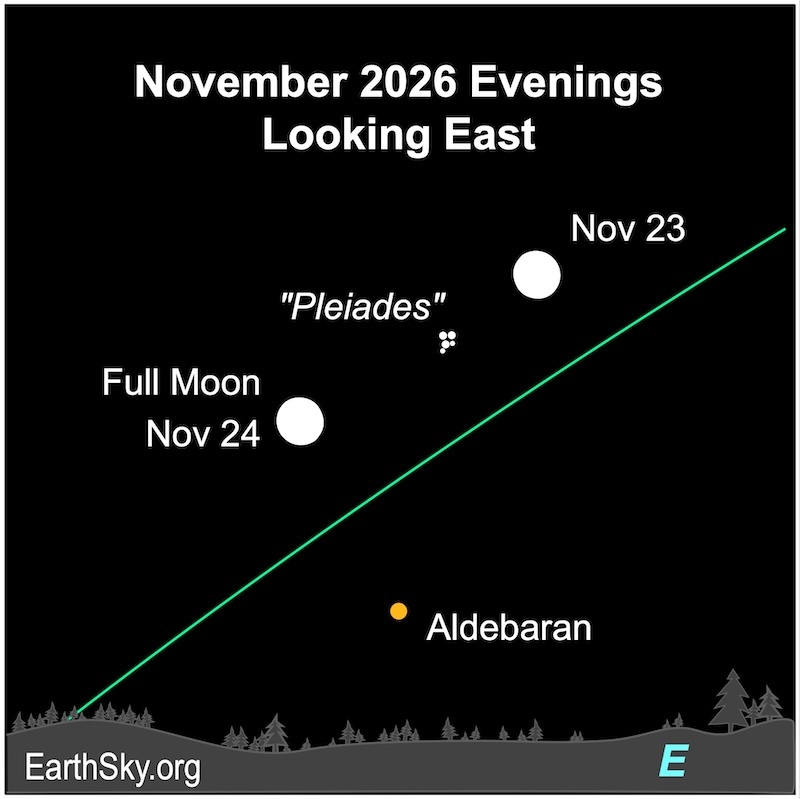
On the night of full moon – November 24 – the bright, round full moon will be climbing in the east, as night falls. And we’ll all find the moon glowing high in the south near midnight and dropping low in the west near sunrise. The moon is roundest on the day that it’s full. But the day before and after, it appears almost, but not quite round and full in our sky.
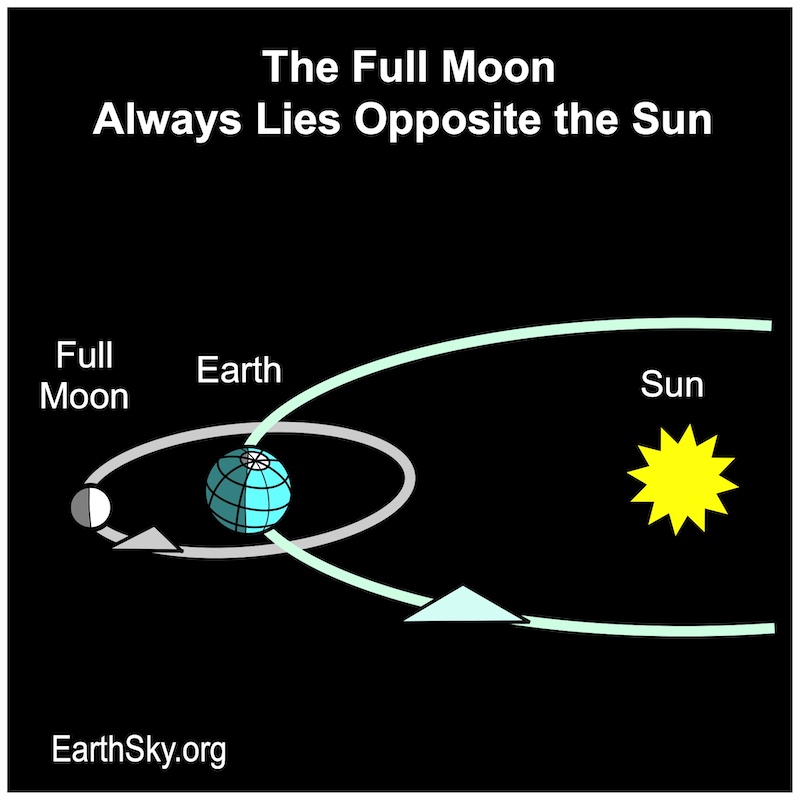
The full moon is a whole-Earth event. And every full moon is opposite the sun, rising when the sun sets and setting when the sun rises. At full moon, the sun, Earth, and moon form a line in space, with Earth in the middle. It’s at this time that the moon’s fully lighted hemisphere – its day side – faces Earth most directly.
November full moon is Beaver or Frosty Moon
All the full moons have popular nicknames. If the full moon in November falls before November 7, it’s called the Hunter’s Moon. Otherwise, as in 2026, you can call November’s full moon the Beaver Moon, or Frosty Moon. That’s because in November, North American beavers are preparing their dens – and stocking up on food – for the coming cold months. We also hear the name Digging Moon for this November full moon, because it’s the last chance for seasonal foraging by forest animals.
The full moon passes near the Pleiades
The bright full moon will lie close to the delicate Pleiades star cluster. Because of the great brightness of the moon, this pretty cluster of stars might be challenging to see. Try blocking the moon out to see if you can spot any of the stars of the Pleiades.
The moon’s path across the sky
In the Northern Hemisphere, the November sun travels across the southern sky each day in a short, low arc. So the full moon, being opposite the sun in the sky, travels in a long, high arc across the November night sky. Now consider the moon’s path six months ago or six months from now. A May full moon travels in a short, low arc, while the May sun moves in a long, high arc. At full moon, the sun and moon are opposite each other in space.

Why is the full moon so bright?
All full moons are bright. And their strong glow lightens the sky enough to blot out all but the bright planets and brightest of stars.
There are two major reasons why the full moon is so bright. First and most obviously, a full moon isn’t a point of light, like a star or a planet. It covers a much-larger area of our sky, and so reflects more of the sun’s intense light. But secondly, and most importantly, the sun is so bright. It’s some 400,000 times that of the moon. And moonlight is just reflected sunlight. So the moon isn’t really bright in and of itself. In fact, the moon’s surface has a relatively low reflectivity, similar to that of asphalt.
If the moon had a reflectivity matching that of snow, the full moon would be over five times brighter!
This month’s full moon is also a supermoon being particularly close to us on Earth. It is almost 15% brighter than a typical full moon.
Read more: What is a supermoon?
November full moon in Taurus
The November full moon can lie in front of one of three constellations of the zodiac. Most years, as it does this year, it falls in Taurus the Bull. But it can also be in Aries the Ram as it was in 2025.
Then, infrequently, November’s full moon can lie in the sprawling constellation just southwest of Taurus, called Cetus the Whale.
Bottom line: The November full moon, frequently called the Full Beaver Moon, will fall in the afternoon of early on November 24, 2026, and will appear full that night. And it’s a supermoon, the first of three supermoons in a row.
Like what you read?
Subscribe and receive daily news delivered to your inbox.
More from
John Jardine Goss


Visible planets and night sky guide for November

The September full Moon is the Harvest Moon near Saturn
The July full moon is the beautiful Buck Moon