How far is a light-year?
Objects in our universe are extremely far away. In fact, they’re so far away that kilometers or miles aren’t a useful measure of their distance. So, with this in mind, we speak of space objects in terms of light-years, the distance light travels in a year. Light is the fastest-moving stuff in our universe. It travels at 186,000 miles per second (300,000 km/sec). So, a light-year is 5.88 trillion miles (9.46 trillion km).
However, stars and nebulae – not to mention distant galaxies – are vastly farther than one light-year away. And, if we try to express a star’s distance in miles or kilometers, we soon end up with impossibly huge numbers. Yet miles and kilometers are what most of us use to comprehend the distance from one place on Earth to another. In the late 20th century astronomer Robert Burnham, Jr. – author of Burnham’s Celestial Handbook – devised an ingenious way to portray the distance of light-years in terms of miles and kilometers.
Keep reading, for a way to comprehend the vastness of the universe, using units of distance we know and use every day.
Let’s start with astronomical units
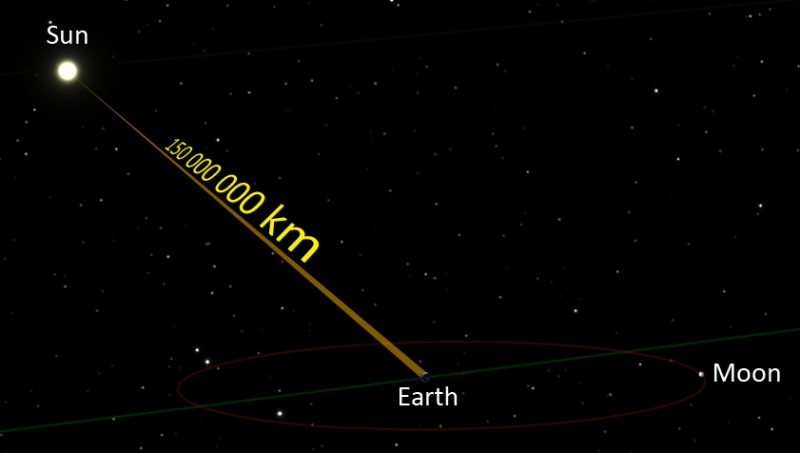
Burnham started by relating the light-year to the astronomical unit – the Earth-sun distance.
One astronomical unit, or AU, equals about 93 million miles (150 million km).
Also, another way of looking at it is this: the astronomical unit is a bit more than 8 light-minutes in distance.
A light-year, pictured as a mile
Robert Burnham noticed that, quite by coincidence, the number of astronomical units in one light-year and the number of inches in one mile are virtually the same.
Generally speaking, there are 63,000 astronomical units in one light-year, and 63,360 inches (160,000 cm) in one mile (1.6 km).
This wonderful coincidence enables us to bring the light-year down to Earth. So, if we scale the astronomical unit – the Earth-sun distance – at one inch, then the light-year on this scale represents one mile (1.6 km).
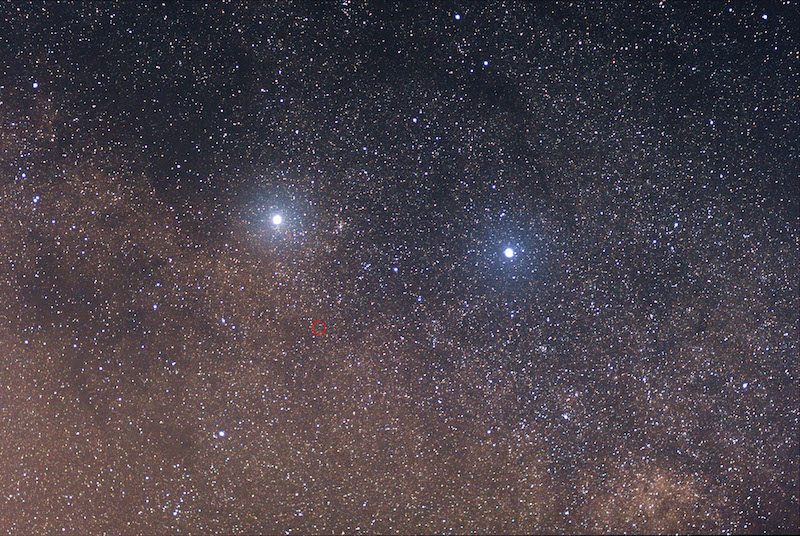
The closest star to Earth, other than the sun, is Alpha Centauri at some 4.4 light-years away. So, scaling the Earth-sun distance at one inch places this star at 4.4 miles (7 km) distant.
See?
Familiar space objects, conceptualized
Scaling the astronomical unit at one inch (2.5 cm), here are distances to various bright stars, star clusters and galaxies:
Alpha Centauri: 4.4 miles (7.0 km)
Sirius: 8.6 miles (14 km)
Vega: 25 miles (40 km)
Pleiades open star cluster: 444 miles (715 km)
Antares: 550 miles (885 km)
Hercules globular star cluster (aka M13): 25,000 miles (40,233 km)
Center of our Milky Way Galaxy: 26,100 miles (42,000 km)
Great Andromeda Galaxy (M31): 2,540,000 miles (4,087,000 km)
Sombrero Galaxy (M104): 28,000,000 miles (45,000,000 km)
Whirlpool Galaxy (M51): 31,000,000 miles (50,000,000 km)
And so on, back to approximately 13 billion+ light-years to the farthest galaxies: 13,000,000,000 miles (21,000,000,000 km)
Okay, the numbers are still pretty big! But hopefully they can help you see that our universe is very vast. And this video helps puts it in perspective.
The fastest-moving stuff in the universe
As mentioned above, light travels at an incredible 186,000 miles per second (300,000 km/sec). That’s very fast, indeed. In fact, if you could travel at the speed of light, you would be able to circle the Earth’s equator about 7.5 times in just one second!
In other words, a light-second is the distance light travels in one second, or 7.5 times the distance around Earth’s equator. So, a light-year is the distance light travels in one year.
How far is that? Multiply the number of seconds in one year by the number of miles or kilometers that light travels in one second, and there you have it: one light-year. It’s about 5.9 trillion miles (9.5 trillion km).
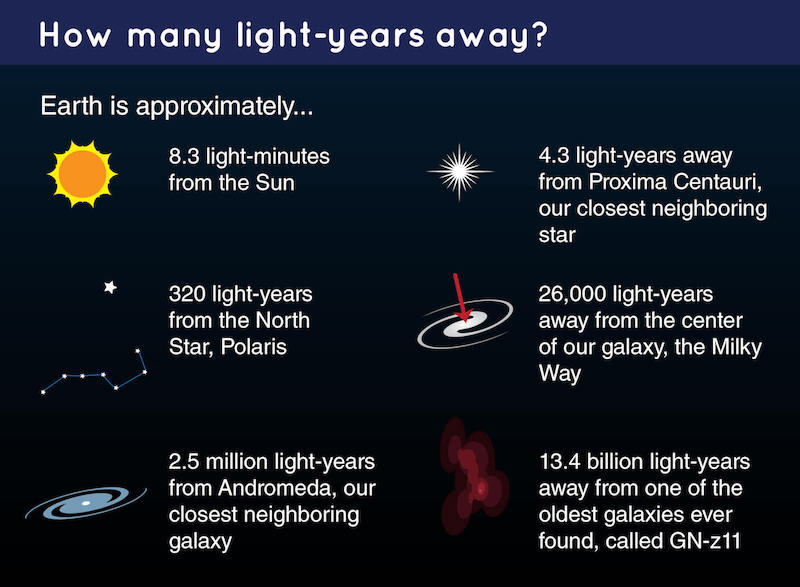
Bottom line: Here’s a way to understand the scale of light-years in miles and kilometers.
Enjoying EarthSky? Sign up for our free daily newsletter today!
Like what you read?
Subscribe and receive daily news delivered to your inbox.
More from
Bruce McClure


Can a single season have only 2 full moons?

Virgo the Maiden represents a harvest goddess