



Northern summer is Summer Triangle time
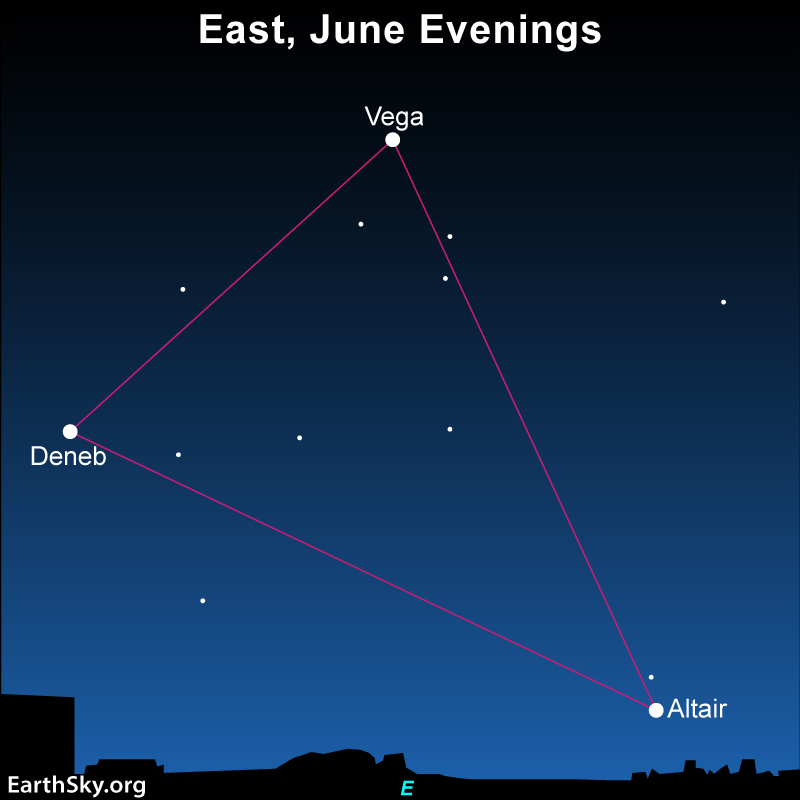
During the summertime in the Northern Hemisphere, the days are long. The sun is high in the midday sky. And our summer sky is with us, too. Watch for the famous Summer Triangle, now ascending in the eastern sky on these late June and July evenings.
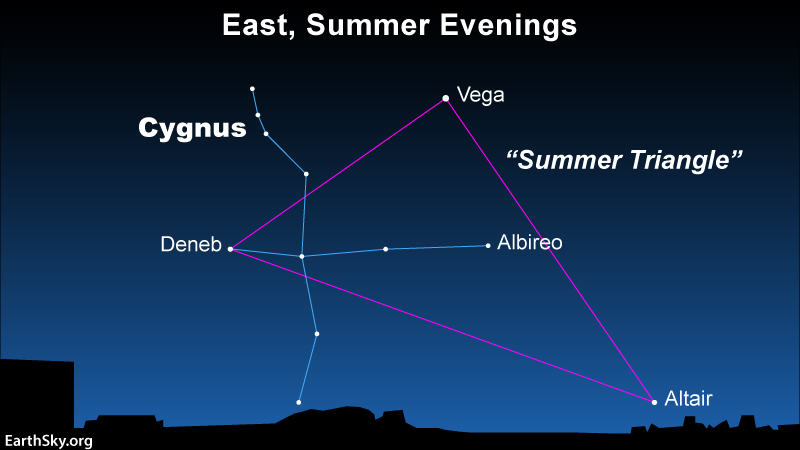
The Summer Triangle isn’t a constellation. It’s an asterism, or noticeable pattern of stars. This pattern consists of three bright stars in three separate constellations: Deneb in the constellation Cygnus the Swan, Vega in the constellation Lyra the Harp, and Altair in the constellation Aquila the Eagle.
Learn to recognize the Summer Triangle asterism now, and you can watch it all summer as it shifts higher in the east, then finally appears high overhead in the late northern summer and early northern autumn sky.
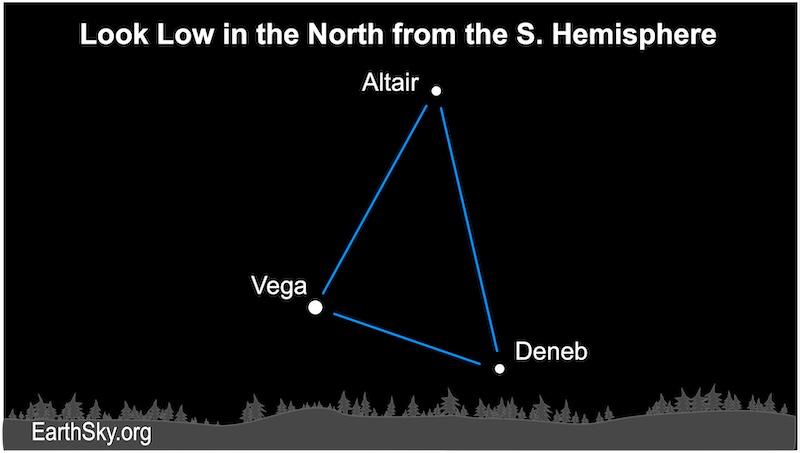
From the Southern Hemisphere, the Summer Triangle appears upside down – as it’s viewed from the Northern Hemisphere – and low above the northern horizon during the southern winter months.
Seeing the Summer Triangle from the Northern Hemisphere
As night falls in June or July, look east for a sparkling blue-white star. That will be Vega, in Lyra the Harp. Reigning at the apex of the celebrated Summer Triangle, Vega is also the brightest of the Summer Triangle’s three stars, which are all bright enough to be seen from many light-polluted cities.
Look to the lower right of Vega to locate the Summer Triangle’s second brightest star. That’s Altair, the brightest star in the constellation Aquila the Eagle. A ruler (12 inches/ 30 cm) held at arm’s length fills the gap between these two stars.
Look to the lower left of Vega for another bright star: Deneb, the brightest in the constellation Cygnus the Swan and the third brightest in the Summer Triangle. An outstretched hand at arm’s length approximates the distance from Vega to Deneb.
It’s difficult to convey the huge size of the Summer Triangle. But you’ll see it. These three bright stars – Vega, Deneb and Altair – will become your summertime favorites.
Summer Triangle in Winter? A View from the South
Via Daniel Gaussen, Founder & Guide – Stargaze Mackenzie – New Zealand
From the Southern Hemisphere, the Summer Triangle appears flipped upside down and rises low into the northern sky. But, for many at populated latitudes across the Southern Hemisphere, Deneb is close to or below the northern horizon rendering the triangle incomplete for many observers. If you are closer to the South Pole than about 45 degrees south latitude, you won’t see Deneb.
So we don’t tend to recognize the triangle as it is seen in the north, and even if we do, it’s only visible, briefly, during our winter season. So the name Summer Triangle is somewhat lost on us. Instead, the sight of Vega and Altair rising to the northeast are a clear sign of winter in the southern hemisphere.
Altair reaches a modest altitude of about 35-40 degrees from latitudes like those in New Zealand and Australia.
But Vega sits very low, between about 5-15 degrees from many places down under. For example:
- Sydney, Australia (approx. 34° S): Vega reaches a maximum altitude of about 17° above the northern horizon.
- Auckland, New Zealand (approx. 37° S): Vega reaches a maximum altitude of about 14° above the northern horizon.
- Christchurch, New Zealand (approx. 43.5° S): Vega reaches a maximum altitude of about 7.5° above the northern horizon.
Still, Vega is the 5th-brightest star as seen from Earth as a whole. So it blazes brightly to those with a clear view of the northern horizon. And both Vega and Altair stars act as luminous markers of the Southern Hemisphere’s winter northern sky.
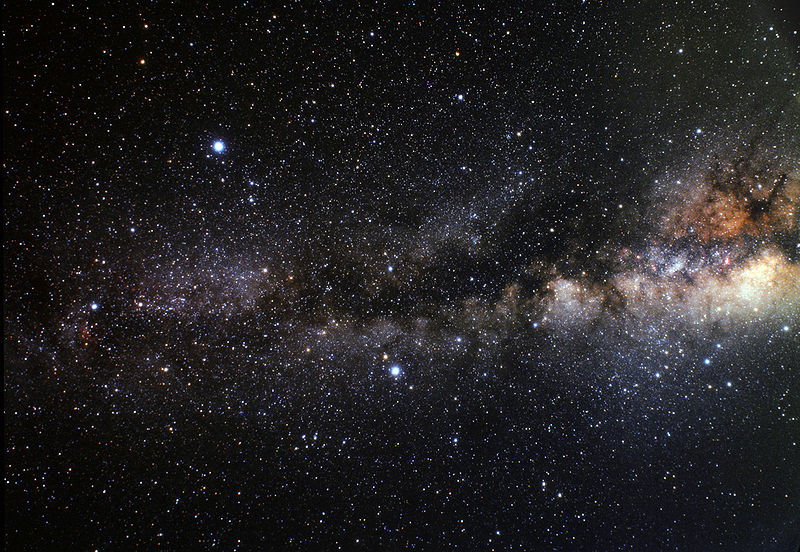
Arching through the sky between these two stars is the glow of the Milky Way, with Vega to the west and Altair to the east. They frame the galaxy as if it were a river flowing between them.
In Japanese tradition, this is celebrated in July during the summer star festival and the story of Tanabata, where Vega and Altair represent two separated lovers, divided by the Milky Way and allowed to meet only once a year.
From the Southern Hemisphere, this cultural imagery remains fitting, as the two stars appear as distant beacons low in the northern sky, divided by the glowing stream of the galaxy.
The Summer Triangle is a northern road map to the Milky Way, too
Likewise, from the Northern Hemisphere, if you’re lucky enough to be under a dark sky on a moonless night, you’ll see the great swath of stars passing between the Summer Triangle’s Vega and Altair. For our latitudes, the star Deneb bobs in the middle of this river of stars, which arcs across dark summer skies. This sky river is, of course, the edgewise view into our own Milky Way galaxy. Every star you see with the unaided eye is a member of the Milky Way. And at this time of year, we can see clearly into the galaxy’s flat disk, where most of the stars congregate. By August and September, we’ll have a good view toward the galaxy’s center.
Once northern observers master the Summer Triangle, they can always locate the Milky Way on a clear, dark night. How about making the most of a dark summer night to explore this band of stars, this starlit boulevard with its celestial delights? Use binoculars to reveal the gossamer beauty of the haunting nebulae and bejeweled star clusters along this starlit trail.
A word about asterisms
As we mentioned above, asterisms aren’t constellations; they’re just patterns on the sky’s dome. Constellations generally come to us from ancient times. In the 1930s, the International Astronomical Union officially drew the boundaries of the 88 constellations we recognize today.
Meanwhile, you can make up and name your own asterisms, in much the same way you can recognize shapes in puffy clouds on a summer day.
Of course, some asterisms are so obvious that they’re acknowledged around the world. And – especially if you can see it from the Northern Hemisphere – the Summer Triangle is one of these.
Bottom line: For those of us in the Northern Hemisphere, the Summer Triangle says “summer” in the sky. Meanwhile, in the Southern Hemisphere, the triangle might be less distinct, but our galaxy is a rather conspicuous river between the asterism stars.
Like what you read?
Subscribe and receive daily news delivered to your inbox.
More from
Deborah Byrd


