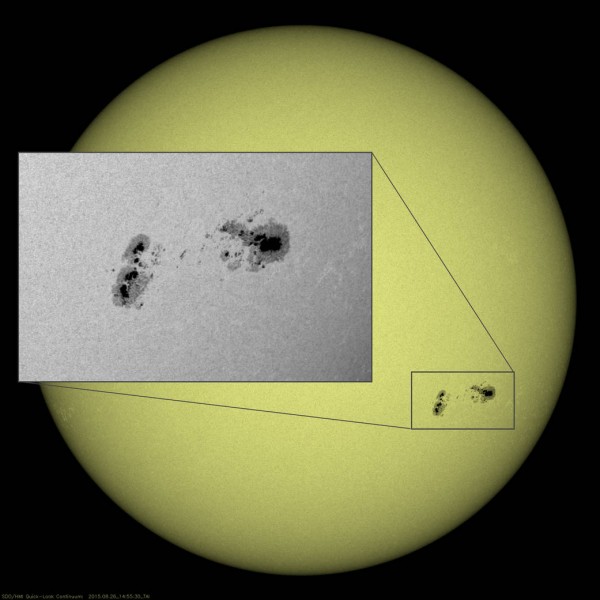
The still image shows AR2403 as the separated group as it appeared on August 26. image via NASA/SDO.
The large group of sunspots known to scientists as AR2403 has now rotated out of view, around the sun’s limb, but it was spectacular when it was visible. As the sun spun on its axis, it appeared to move across the sun’s visible face over six days, from August 21 to 26, 2015, starting out as a single cluster, and gradually separating into distinct groups. According to NASA:
This region produced several medium-sized, or M-class, flares, but only one greater than M5-class. These were the only significant spots on the sun during this period.
We received several photos of the sunspot region from friends on Facebook and G+. Thanks to all who posted!
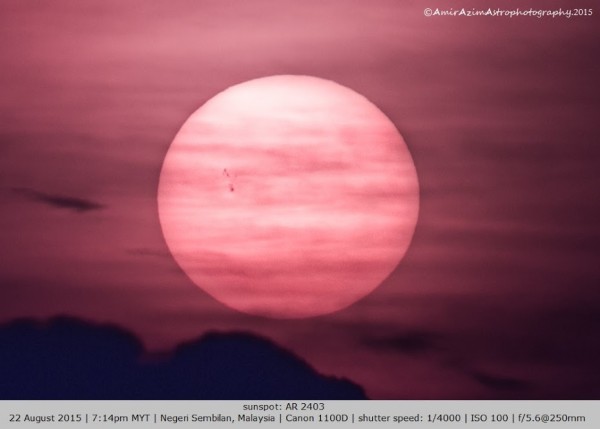
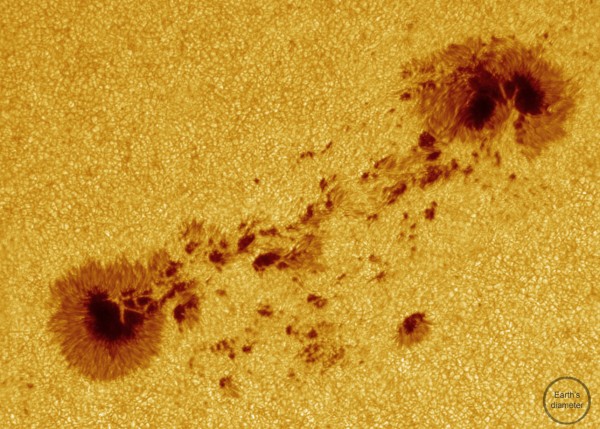
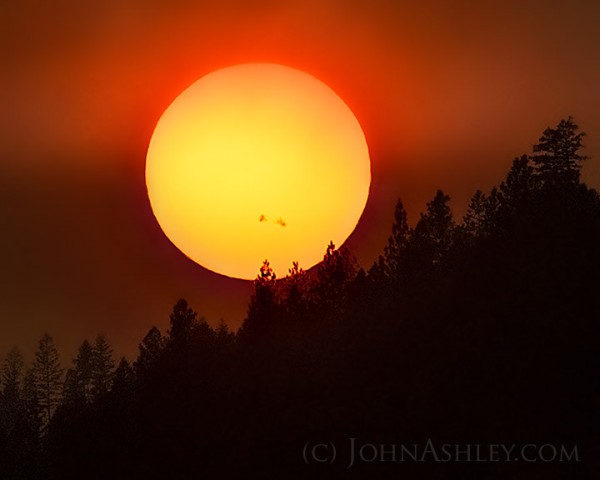
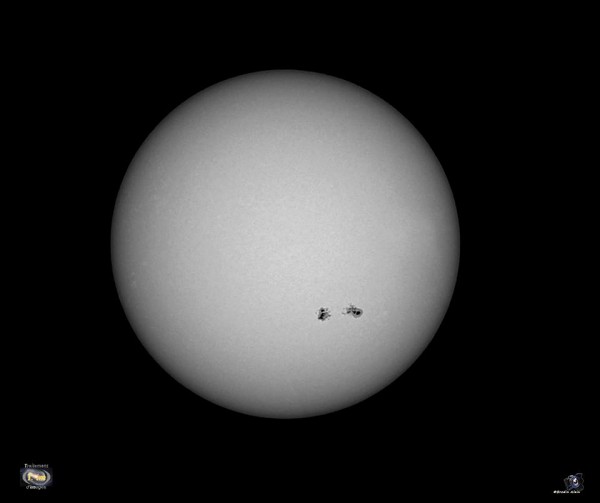
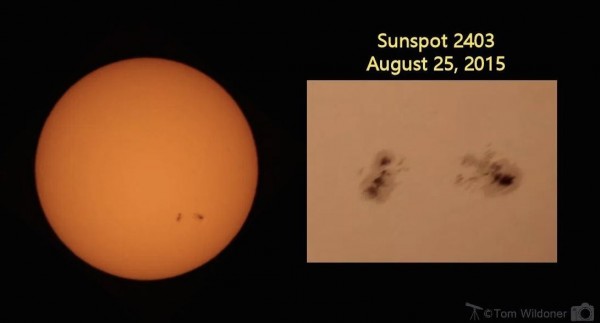
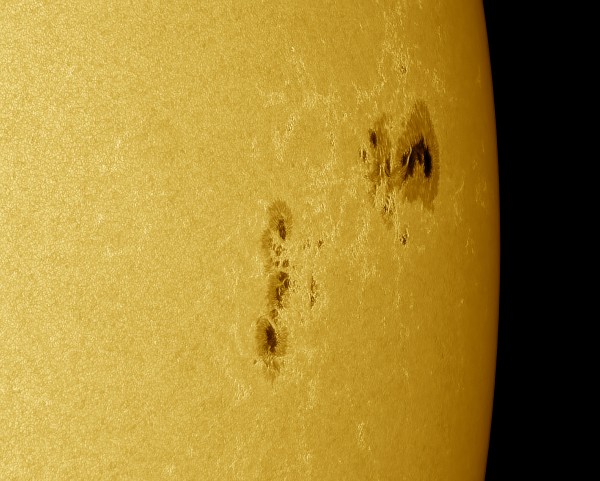
One of our favorite photographers, John Ashley at Rogers Lake, Montana, captured this image of AR2403 on August 20, just as the spot had appeared over the Earth-facing edge of the sun.Amirul Hazim Kamarulzaman in Malaysia caught AR2403 on August 22, in a cloudy sky at sunset.View larger. | Max of Maximus Photography obtained this image on August 23. His equipment was a homemade 200mm F/5 Newtonian working at F/20, with a full aperture Astrosolar filter and the ASI 120MM-S camera with a Baader green filter. He stacked 700 frames to create the image. Notice that he added Earth’s diameter in the lower right … “as a reminder of how small our planet really is in the solar system.”John Ashley captured this image of AR2403 on August 24. Notice the spot’s movement from the previous days!Brodin Alain, an EarthSky friend on Facebook, captured AR2403 on August 25, from France.Tom Wildoner posted this August 25 photo of AR2403 on EarthSky’s G+ community page. View this photo at Tom’s blog LeisurelyScientist.com.Giant sunspot group AR2403 as it was leaving the Earth-facing side of the sun. Photo by Maximus Photography. Read more about this image.
Bottom line: It didn’t produce any X flares, but it was spectacular to view on the sun for six days, from August 21 to 26. See photos from space and from the EarthSky community.
Deborah Byrd (asteroid 3505 Byrd) helps edit EarthSky.org and is a frequent host of EarthSky videos. Deborah created the EarthSky radio series in 1991 and founded EarthSky.org in 1994. Prior to that, she had worked for the University of Texas McDonald Observatory since 1976, and created and produced their Star Date radio series. She has won a galaxy of awards from the broadcasting and science communities, including having an asteroid named in her honor in 1990, a Public Service Award from the National Science Board in 2003, and the Education Prize from the American Astronomical Society in 2020. A science communicator and educator since 1976, Byrd believes in science as a force for good in the world and a vital tool for the 21st century. "Being an EarthSky editor is like hosting a big global party for cool nature-lovers," she says.
Like what you read? Subscribe and receive daily news delivered to your inbox.
Thank you! Your submission has been received!
Oops! Something went wrong while submitting the form.