Dinosaur Tracks

download Help

JB: This is Earth and Sky – on the subject of dinosaur tracks.

DB: Dinosaurs sometimes left behind footprints in soft mud or sand. Most of those prints disappeared, but some were buried. When the sand or mud turned to stone, the prints were preserved.

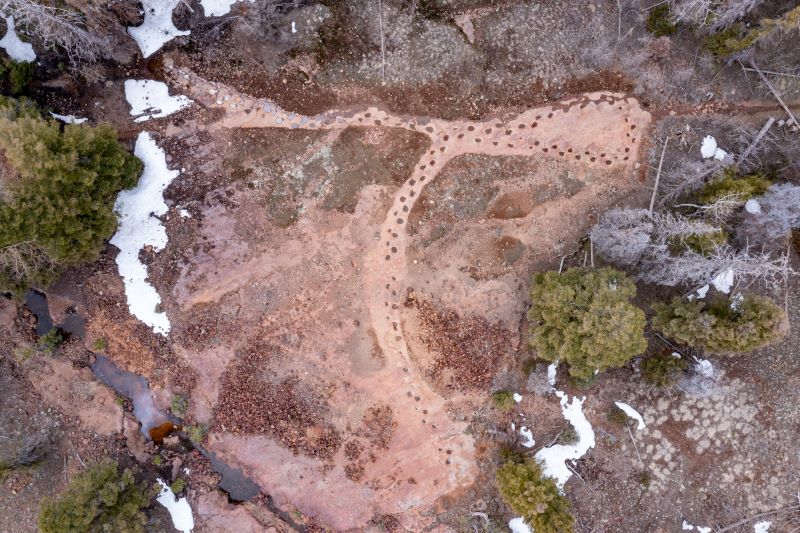
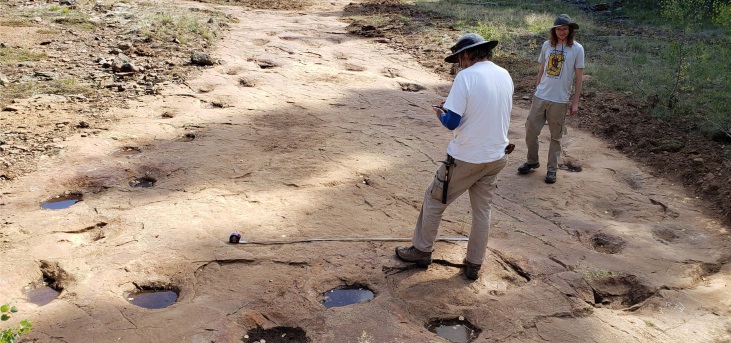
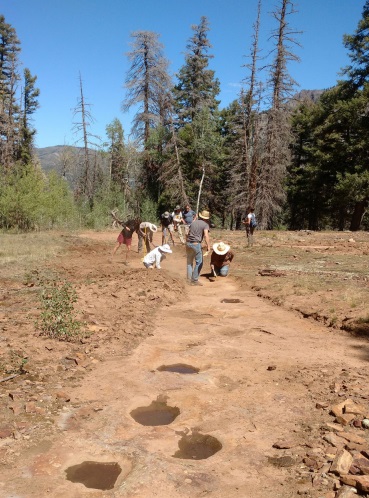
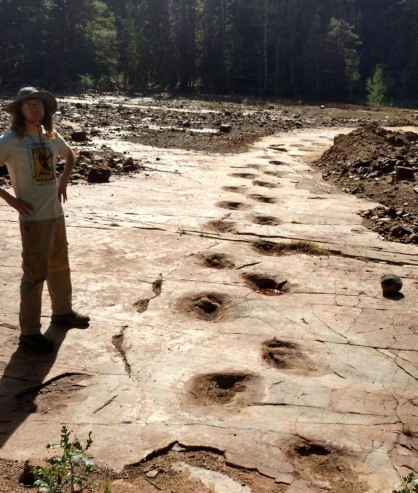
JB: There are sites in the western U.S. where rocks from the time of the dinosaurs lie exposed on the surface. In the Purgatoire River valley in Colorado’s Comanche National Grassland, hundred-million-year-old limestone bakes under the harsh western sun. This limestone is pocked with dinosaur tracks.

DB: And these tracks are the nearest thing we have to photos of dinosaur feet. Bones can be misleading. Take the Sauropod – looking at its foot bones doesn’t give you an accurate picture of the animal’s feet. It’s the imprint of the foot that reveals that Sauropods had feet like elephants – with a lot of fleshy padding to cushion their great weight.

JB: Trackways – what you might call dinosaur paths – are snapshots of how dinosaurs walked, ran, and lived together. Some Sauropod trackways in the Purgatoire River valley were laid down in the same direction, at the same time – they probably represent a herd of sauropods moving together. Lines of three-toed tracks laid over those were probably made by packs of meat-eaters shadowing the herd.

DB: You’ll find more on dinosaur tracks on our website at earthsky.com. We’re Block and Byrd for Earth and Sky.

Our thanks to the following individuals and institutions who assisted in the preparation of this script:

Martin Lockley
University of Colorado
Denver, CO

David Wolf
U.S. Forest Service

Terry Johnson
U.S. Forest Service

The following books, articles and web sites were used in preparing this script:

Dinosaur Tracks and Other Fossil Footprints of the Western United States, Martin Lockley and Adrian P. Hunt, Columbia University Press, 1995.

Tracking Dinosaurs: A New Look at an Ancient World, Martin Lockley, Cambridge University Press, 1991.

Dinosaur Trackers Research Group – University of Colorado Denver

Friends of Dinosaur Ridge Tracksite

Triassic-Jurassic Footprint Project (Columbia University)

Dinosaur State Park, Connecticut (not all U.S. dino tracks are west of the Mississippi)

Author notes:

Dinosaur tracking is a branch of ichnology, the study of trace fossils. Other ichnologists look at things like fossilized worm burrows and termite mounds, coprolites (fossilized body waste), gizzard stones, eggs, and nests.

Dinosaur trackers usually use rather traditional techniques to gather data on the tracks they locate. They use measuring tapes to size up individual tracks, pencil and notebook to record numbers and make drawings, and latex rubber and plaster to make three-dimensional casts. These techniques, which work well, are the old reliable tools in the dino tracker’s tool kit.

Dino trackers have experimented with new tools for their tool kit. In 1996, for example, dino tracker Dr. Martin Lockley of the University of Colorado – Denver, teamed up with stereo photography experts David Wolf and Terry Johnson of the U.S. Forest Service to make three-dimensional photos of tracks in Comanche National Grassland.

Johnson and Wolf set up a camera above an individual track, pointed down. They snapped a photograph of the track, then moved the camera slightly and snapped another photo of the same track. Offsetting the camera re-created the three-dimensional effect we see with our two offset eyes. Placing each pair of photos in a special viewer showed them as a single three-dimensional image.

This is an old technique. In the late 19th century, for example, “stereopticon” viewers were all the rage. In this century, the technique has been used to project 3-D movies. Planetary scientists use stereo photography to explore other worlds. Sometimes they find that the play of light and shadow on alien landscapes can be misleading. For example, features that look like mountains in individual photographs are revealed to be deep pits in stereo.

Wolf and Johnson took the stereo images of dinosaur tracks one step further. Johnson used computer software to digitize the track images. That is, he reduced them to numerical data points precisely recording the depth, height, and width of the individual tracks. When combined, the data points yielded a precise contour map of each individual track.

Again, this is not a new technique. Stereo images have been used to make contour maps of landscapes and archaeological sites for many years. This was, however, the first time it was applied to dinosaur tracks.

Martin Lockley cautions that this technique is no substitute for on-site inspection by a trained dino-tracking scientist. He prefers to work with the old tools, and would take a plaster cast of a track on his desk over a digital map on his computer monitor any time. But he admits that the new technique has its uses.

For example, very large tracks are hard to cast using plaster. It’s difficult to transport a heavy plaster cast back to the lab. The new technique reduces a large track to a computer file that can be carried in one’s pocket on a CD or even emailed over the Internet. Also, the new technique can be applied to entire trackways, which in some rare cases extend for thousands of meters. For trackways, the camera can be mounted on an airplane, which can then fly over the track site. This is potentially more accurate – not to mention, much easier – than the old technique of recording large trackways using a tape measure and notebook.

Dave Wolf points out that the new technique could also yield casts of tracks. Stereolithography, a technique widely used to create solid models of computer designs, could generate plastic casts using the digital data. The resulting cast would resemble a plaster cast, and could be studied in the same way.

If recorded on CD, track data could be preserved indefinitely. A cast could be generated using stereolithography long after a plaster cast would have crumbled. In fact, a CD could serve as a “dinosaur track preserve” long after natural erosion destroyed the original dinosaur track or trackway.

Additional Teacher Resources

USDA Forest Service: Picketwire Canyonlands Dinosaur Tracksite?Life at Dinosaur Lake

This guide compiled by Pike & San Isabel National Forests in collaboration with Cimarron & Comanche National Grasslands, provides a walk through of the Picket Wire dinosaur footprints, aerial images, conservation efforts, erosion damage, maps, and links to more information.

U.S. Bureau of Land Management, Environmental Education Homepage, Feature of the Month: Wyoming’s Red Gultch Dinosaur Tracksite: An Ancient Shoreline Comes to Light

Imagine dinosaurs lumbering along an ocean shoreline 165 million years ago, searching for a bite of lunch from the debris left by the last high tide. The ground is soft mud, probably similar in consistency to cement just starting to harden, and their feet sink down, leaving clear tracks of every step they take. After the mud hardens, the tracks are perfectly preserved; gradually, fine sand fills them. Over eons, erosional processes go to work removing those layers, finally exposing the tracks that were made all those millions of years ago. This site explains the natural processes that have led to what is now the Red Gultch dinosaur tracksite, as well asthe scientific implications.

U.S. Bureau of Land Management: Cultural and Fossil Resources and Tribal consultation of the Public Lands

A list of BLM recommended publications that can be used by teachers as resources when covering the subjects of paleontology, archeology and fossils.

USDA Forest Service: Tour Scenic Picketwire Canyonlands

A virtual tour of Picketwire Canyonlands in the Comanche National Grasslands. Includes history of and information on the dinosaur tracks, as well as on the native inhabitants of the area.

© 1996-2007 EarthSky Communications Inc. All Rights Reserved.

Design © 2006-2007 lucid crew | austin web design