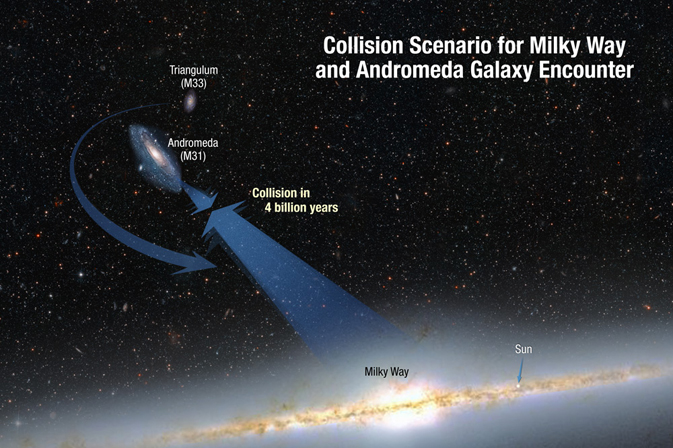
The video above illustrates what NASA scientists announced in 2012 – and what the Cosmos TV series featured in 2014 – that the nearby Andromeda galaxy will collide and merge with our Milky Way galaxy 4 billion years from now. The video (from the Hubble Space Telescope news center) is from a series of photo illustrations, showing the predicted merger between our two titan spiral galaxies, as seen in Earth’s sky.
Will Earth as a planet survive long enough to see this? A word about that at the end of this post.
Milky Way and Andromeda galaxies to collide when? Four billion years
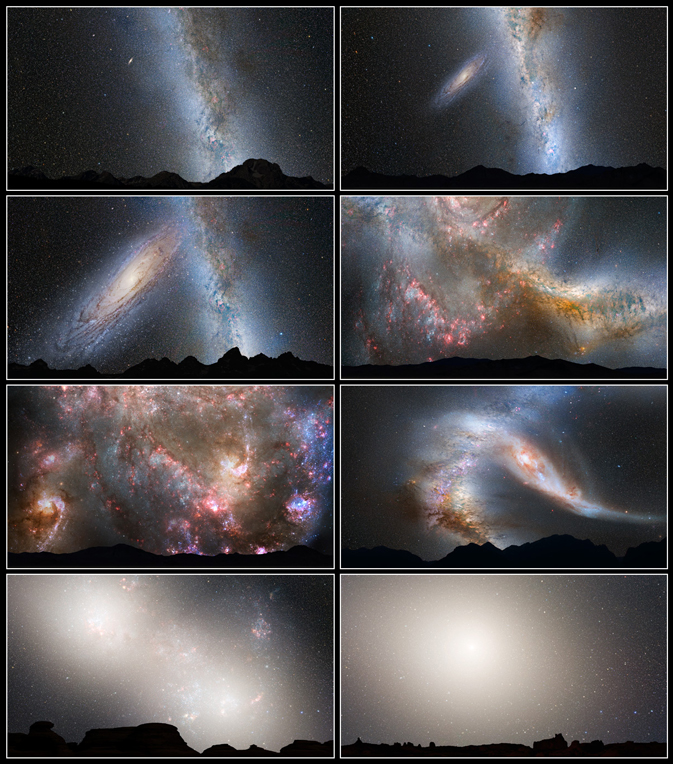
A description of what’s happening in the images above:
First Row, Left: Present day.
First Row, Right: In 2 billion years the disk of the approaching Andromeda galaxy is noticeably larger.
Second Row, Left: In 3.75 billion years Andromeda fills the field of view.
Second Row, Right: In 3.85 billion years the sky is ablaze with new star formation.
Third Row, Left: In 3.9 billion years, star formation continues.
Third Row, Right: In 4 billion years Andromeda is tidally stretched and the Milky Way becomes warped.
Fourth Row, Left: In 5.1 billion years the cores of the Milky Way and Andromeda appear as a pair of bright lobes.
Fourth Row, Right: In 7 billion years the merged galaxies form a huge elliptical galaxy, its bright core dominating the nighttime sky.
The sequence is inspired by dynamical computer modeling of the inevitable future collision between the two galaxies.
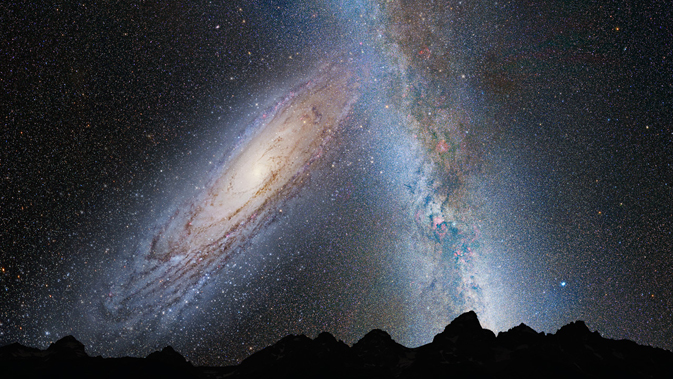
Will Earth survive long enough to see this merger of galaxies, as depicted in the video above? Earth as a planet might, but life on Earth – probably not. Astronomers say that the luminosity, or intrinsic brightness, of our sun will steadily increase over the next 4 billion years. As the sun’s luminosity increases, the amount of solar radiation reaching the Earth will also increase. It’s possible that – around 4 billion years from now – the increase in the Earth’s surface temperature will cause a runaway greenhouse effect, perhaps similar to that going on now on the planet next door, Venus, whose surface is hot enough to melt lead. No one expects to find life on Venus. Likewise, life on Earth will probably not exist 4 billion years from now. What’s more, our sun is expected to become a red giant star eventually. A probable fate of the Earth is absorption by the sun in about 7.5 billion years, after our sun has entered the red giant phase and expanded to cross Earth’s current orbit.
Bottom line: As our Milky Way galaxy and the Andromeda galaxy merge, beings who live in either galaxy will have a spectacular view in our night sky. A NASA video – inspired by dynamical computer modeling of the inevitable future collision between the two galaxies and made from photographic stills – shows the evolution of Earth’s night sky over the next 7 billion years.
Like what you read?
Subscribe and receive daily news delivered to your inbox.
More from
Deborah Byrd


Why do we celebrate Earth Day on April 22?

Why does the moon seem to follow me when I’m in a car?
Kochab and Pherkad: Outer bowl stars of the Little Dipper
Meet Gaia BH3, our galaxy’s most massive stellar black hole