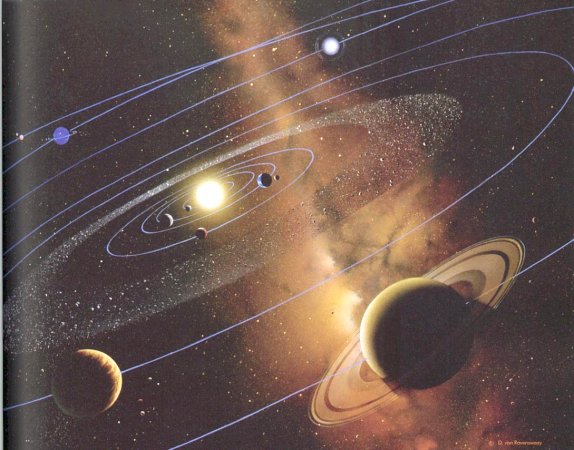
The planets in our solar system orbit around the sun. One orbit of the Earth takes one year. Does the whole solar system orbit around something else?

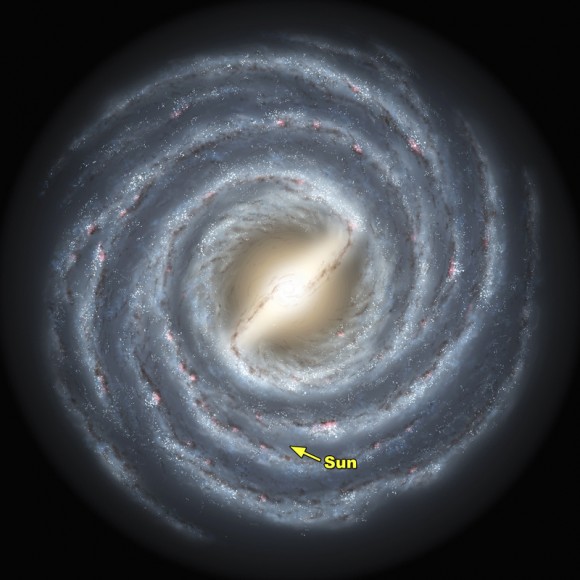
At our sun's distance from the Milky Way galaxy's center, it takes us approximately 200 million years to orbit, or revolve, around the center of the galaxy.
Our sun and its family of planets orbit the center of the Milky Way galaxy. Our sun and solar system move at about 800 thousand kilometers an hour – that’s about 500 thousand miles an hour – in this huge orbit. So in 90 seconds, for example, we all move some 20,000 kilometers – or 12,500 miles – in orbit around the center of the galaxy.
But our Milky Way galaxy is a big place. Even at this blazing speed, it takes the sun approximately 200 million years to complete one journey around the galaxy’s center. This amount of time – the time it takes us to orbit the center of the galaxy – is sometimes called a Cosmic Year.
By the way, there’s discussion in the comments of this post on the difference between the words “rotate” and “revolve.” Revolve means “orbit around another body”. Earth revolves (or orbits) around the sun. The sun revolves around the center of the Milky Way galaxy.
On the other hand, rotate means “to spin on its axis”. The Earth rotates every 24 hours. The sun rotates, but not at a single rate across its surface. The movements of the sunspots indicate that the sun rotates once every 27 days at its equator, but only once in 31 days at its poles.
What about the Milky Way galaxy? Yes, the whole galaxy could be said to rotate, but like the sun it is spinning at different rates as you move outward from its center. At our sun’s distance from the center of the Milky Way, it’s rotating once about every 200 million years – defined by the length of time the sun takes to orbit the center of the galaxy.
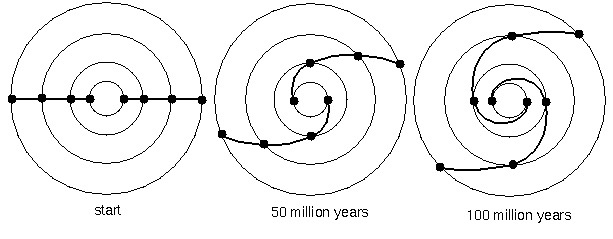
Bottom line: The planets in our solar system orbit (revolve) around the sun, and the sun orbits (revolves) around the center of the Milky Way galaxy. We take about 200 million years to revolve once around the galaxy’s center. This length of time is called a Cosmic Year. Plus an explanation of “rotate” versus “revolve.”


could we collide with any other stars.cheers dod
I asked my science teacher if we orbited anything other than the sun,she couldn’t awnser. Even though she think she knows everything. Well I’m glad I found the awnser to my question. Thank you very much.
I came to this page by wondering if the solar system itself is rotating. I know that the sun, and hence ourselves, orbit the galactic center, but does our system have a rotational period? Can a system of disconnected objects have a single rotational period?
Steve,
The sun revolves one time around the galactic center in an estimated 250 million years.
Bruce
I also came here wondering if the solar system rotated in some way. I think the title of this question should be changed to “revolve”.
If we rotate on our axis, and around the sun and the sun rotates around the Milky Way. Is the Milky Way rotating about something? And if so where is Stationary?
yes it can be possible ,but its beyond our current scientific knoledge, and tools,,,,
our todays science far far behind than the ultimate science, in all aspect. today we dont know the 96% part of universe, so mankind is just start to learn the basic, true scince is far away ,, ….millions of things waiting to discover
If the sun does not move, how can it rotate around the galaxy? How can it orbit anything? I always believed the sun did not move. Thank you.
Dear James. What I could tell you is that, if we need to know we are moving, we need to have a reference point that is not moving or moving slower or faster than us. From earth, we have only some such reference points within our limits such as the sun and the visible stars. When the whole solar system moves all together, we can hardly notice its movement. It is like sitting in a train compartment and though everyone is moving at a certain speed at a certain direction, we can’t differentiate it because, we, along with the others, are moving at the same speed and the same direction. Hope this could clarify your doubt.
The questions above about our solar system revolving around anything but the milky ways center.
the correct way to ask this question is to ask about the rotation of the spiral arm of the milky way galaxy that our solar system resides in!
And unfortunately I do not have an answer to that question.
Hi, I’m doing a report on this article. I have some questions about it. Who wrote this article and have they done any other articles. I’m really interested in this article and the way it was done in a very understandable way. My favorite part is when I read about the solar system and the sun taking about 200 million years two travel to the center of the galaxy. thanks for the aaawwwsssooommmeee/ awsome report on space and alll of the great qualities
Meghan,
Sun does not travel to the center of galaxy, but around center of galaxy in 200 million years. I do have a question however. Since arms of the galaxy are not actual structures , but pressure waves, does the galaxy rotate in the direction arms are pointing, or the oppsite direction. In other words , if you look at the galaxy and the arms are wound in a counterclockwise direction, is the rotation in a clockwise direction?
[...] Does our whole solar system orbit around anything [...]
[...] Does our whole solar system orbit around anything [...]
Hi, does our solar system share orbit with other solar systems around a larger sun? What the name of that larger sun & the other solar systems
Thanks.