EarthSky // Blogs // Space By Larry Sessions Jan 03, 2009

Making sense of astronomical misconceptions

Shortly after posting my last blog, I was abducted by aliens who flew me to Thermoman‘s home planet of Ultron where I was taught secrets of the Universe. Having just returned, I will now enlighten you with a new blog. Now, I know that no one reading this will believe that, but I am amazed…read more »

Shortly after posting my last blog, I was abducted by aliens who flew me to Thermoman‘s home planet of Ultron where I was taught secrets of the Universe. Having just returned, I will now enlighten you with a new blog.

Now, I know that no one reading this will believe that, but I am amazed sometimes at the things people will believe. Some of it is simply unlikely, such as the idea that Earth is being visited by aliens from other worlds. This is certainly not impossible, but for various reasons it is deemed unlikely by most scientists and in any event there is no good physical evidence to support it.

And then there are other beliefs that simply fly in the face of established fact, such as the absurd idea that the Earth is hollow or that the Apollo astronauts never really landed on the Moon.

Leaving TV commercials and all manner of advertising aside, there are many other basic facts and concepts of science that people believe that are flat out wrong.

For example, many people believe that there is no gravity on the Moon. Sometimes they justify this belief by claiming that since there is no gravity in space and the Moon is in space, then there logically must be no gravity on the Moon. Unfortunately, this is an illogical mash-up of misunderstood concepts. Any object with mass has gravity, and missions to the Moon have proved this beyond doubt.

The idea that there is no gravity in space generally is also completely false. Gravity pervades the entire Universe; holds stars, planets and galaxies together; and is impossible to escape. People get the idea that there is no gravity in space when they see astronauts floating in the space station or ISS. By neither the astronauts nor their spacecraft are free of gravity. In fact for near-Earth missions, astronauts are subject a force of gravity 98 to 99 percent as strong as it is on Earth’s surface! The fact that they are falling around the Earth at the same rate as the spacecraft makes them seem weightless relative to things around them.
At this time of year another astronomical misconception arises. When asked what causes the seasons, students often answer that it is because the Earth is farther from the Sun in winter and closer in Summer. At least this bears a little logic, because the Earth does vary slightly in distance to the Sun through the year. It is natural to think that the Earth would be warmer when we are closer to the Sun. This is as logical as a geocentric cosmology (belief that the Earth is the center of the Universe) because we cannot feel the Earth move under us. It seems natural that this big, massive Earth is stationary while those little twinkling lights circle around us. But both ideas are completely wrong.

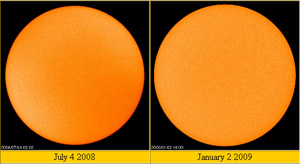
The the Sun-Earth distance variation fueled the seasonal changes, then our winters would be hot and summers cold. In fact, the Earth is about 3 million miles closer to the Sun in early January than in early July! The images at the top of this page show SOHO (Solar & Heliospheric Observatory) MDI (Michelson Doppler Imager) images of the Sun on July 4 2008 (left) and January 2 2009. At first glance you might not notice any difference in size. But if you look very closely, you can see that the January image is very slightly larger. This minor difference does not noticeably affect the amount of sunshine or other energy that the Earth receives, and has virtually no bearing on the seasons.

So what does cause the seasons? The Earth is tilted on its axis, pointing more or less toward Polaris, the North Pole star. As the Earth orbits the Sun, this tilt causes the planet to nod toward the Sun in June, and away from it in December. The upshot to this is that the Sun’s height in the sky varies, which in turn affects the amount of sunshine any given location receives and hence the overall temperatures. The Northern Hemisphere is tilted away from the Sun in winter and receives less sunshine.

My point is that we need to look at everything and ask why we believe what we believe.

I’d be interested in learning of misconceptions you have heard (or perhaps been guilty of), regarding astronomy, space or physical science in general. Comments?

Share your comments on Facebook

18 Responses to Making sense of astronomical misconceptions

  1. Jay says:

    I’ve always thought there’s a possibility the moon is made of cheese. But I’m more confused by people who persist in believing, in the face of facts and/or scientific consensus, that climate change is not happening.

  2. Benjamin Napier says:

    I guess the biggest misconception now is that of anthropogenically caused global warming. That and the idea that CO2 is a pollutant at these levels. Now we are using the term “climate change” to adjust to the fact that the earth has been coolong since about 1997. the facts don’t fit the dogma. It is a political situation masquerading as an impending ecological disaster. It has been working as people are frightened enough to give away their own freedom to totalitarians to “save” the earth.

  3. Jay, as you know, some people believe what they want to believe no matter how strong the evidence is to the contrary. Others show a more realistic outlook and accept evidence-based truth, whatever it is. In my opinion, the Dalai Lama is the most reasonable and straight-thinking religious leader on the planet today. He was once asked how he would react if one day science showed conclusive evidence that Buddhist beliefs, such as reincarnation, are not true. He said, and I paraphrase here, that in that case Buddhists would have to accept the truth and abandon any beliefs that are contradicted by the preponderance of evidence. That’s the kind of thinking we need.

    Benjamin, the question of what is causing global warming (or as you point out, the currently more politically correct term “climate change”) has been debated. But it’s a bit like the rancher and his son who stand around arguing about who left the gate open while all the cattle continue to wander out. I think the answer is a little of both, but the fact is that you can pee in your own swimming pool only so long. If you don’t clean up the water and stop peeing in it, before long you won’t want to swim there any more.

    In our case, it is likely that non-human forces are at working dirtying our swimming pool. So if we want to continuing swimming, we need to counteract whatever the non-human forces there are that are at work, and stop peeing in it ourselves.

    The evidence in favor of climate change (yes, I said “climate change” because although it is repugnantly politically correct, it’s also a better description of what is happening) is staggering. I am not a climatologist and I am not going to start spouting statistics, but there is a very large consensus among working scientists that the climate is changing. The real questions are how much? which way? and why? There are no 100% conclusive answers to any of this, but at the bottom line, does it matter?

    Should we argue about who or what is at fault, or should we close the gate? I for one am in favor of doing what we can, regardless of the cause.

    LS

  4. deborahbyrd says:

    The Internet certainly contributes to many misconceptions. The idea that climate is not changing – or that humans do not play some role in that change – would seem almost laughable to me if it weren’t such a serious issue. I’ve been listening to scientists discuss this oncoming climate change for 30 years! Still, every day, we hear from people who do not believe in human-caused climate change. Why? Often, it’s because they read somewhere on the Internet that human-caused climate change is a myth.

    On the Internet, anyone can say anything!

    I think many people just believe what they want to believe. Whatever reinforces long-held values and conceptions about the world.
    .

  5. Deborah (and all)

    People can get very illogical and irrational when confronted with things they don’t want to believe. (Wow, how well we both know that!) Not everything can be reduced to pure logic, and as a pointy-eared Vulcan is purported to say sometime in the future, “Logic is the beginning of wisdom… not the end.”

    I think of the many stories about people who have had limbs amputated, but can still “feel” them. The human mind just doesn’t want to accept certain traumatic events, and thus alters the perception of reality rather than accepting the evidence and proceeding with that knowledge. That’s not rational, but it certainly is common.

    However, I think we must all make a strong effort to get past our biases and shallow hopes to see reality. I think that logic should prevail in major issues. Placing your hand on a hot stove is not logical. You can feel it and there is no question that it is hot. Unless you are deranged, you won’t touch it. But what about a doorknob? Normally doorknobs are not hot, and can lead to things you really want, such as the food cupboard, the dining room — or the bathroom! So what would you do if that doorknob was strangely glowing red and you could feel heat coming from it? Would you touch it? Logic would dictate caution and a search for reasons that such strange things are happening.

    But the power of human desire can be very strong. Some might ignore the evidence because they desperately want to think that everything is OK. Some would touch it and possibly open the door. We can’t see the future just as we can’t see past the door into the next room. We can imagine what we want to see, or we can assess the evidence and proceed accordingly. If we ignore the evidence, we take a huge chance — unreasonable in my opinion. We can do nothing and hope that there is no blazing inferno on the other side of the door, or we can assess the evidence and call the fire department.

    I am not an alarmist, but I think that ignoring the evidence — and there are prodigious amounts of evidence to support the claim of climate change — is illogical, irrational, and downright foolhardy.

  6. deborahbyrd says:

    I agree, Larry … and I think the Obama administration certainly agrees as well. So our democratic system has worked to give us a government that, hopefully, will begin to rise to the challenge of climate change.

    Democracy in a action!

  7. G. Karst says:

    I have found, that the most common misconception (regarding climate), is that the ice age ended ,some 12,000 yrs ago. I have heard this from even prominent scientists. The facts are that the CURRENT ice age has not ended… yet.

    While it has warmed in the temperate zones, the ice age is not over until all summer ice is gone. This of course, does not refer to ice at altitude (mountain tops). It does require both poles to be mainly ice free during the summer.

    This warm period, of the ice age, could end at anytime, and probably will. The consequences of a re-immersion of the current ice age, are too horrible to contemplate. Unspeakable suffering and death would follow.

    Far more important to man, is to understand, what triggers the return of a frozen world. This is the only scenario which could justify geo-forming.

    It is my fervent wish, that climate change research is concentrated on this very real probability.

  8. G. Karst.
    Well, partly that is based on your definition, but certainly it has been a fairly common viewpoint in the not-so-distant past. About 20 years ago I wrote an article for a national publication on that very subject. The idea that we would be plunged into a new ice age (or perhaps just the continuation of the old one) was not uncommon, but it was all based on data and trends in the geologic record, along with speculations about orbital cycles. It made sense and perhaps is true, but the big differences between the ideas then and now are that today’s concern over climate change is based on directly observed evidence, mostly contemporaneous. It may well be that we are going through a warm interstitial period preceding a new cooling. The fact is,w e don’t know.

    What I think particularly interesting are those people who choose to ignore all the evidence and say nothing is happening. Yet something *is* happening. The Earth *is* warming. What the final outcome will be, no one can say. But the wise choice is to be prepared, control or eliminate whatever human actions that we know beyond a reasonable doubt are affecting the change, and to acknowledge that the Earth is a highly dynamic and changing place. Otherwise we all become like the image of Nero fiddling while Rome burned. True, Nero may not have been fiddling, but Rome did burn and they were not well prepared. Today, our climate is definitely changing in ways that may well become devastating — whether by fire or by ice. Shall we rosen up the bow, or take more prudent and constructive measures?

  9. G. Karst says:

    So Larry, you saying any action, is better than no action. That my friend, is simply not true. Actions to cool the planet, if we are cooling already, would NOT be better. Action without understanding is the definition of panic. Running the wrong way in a fire, will bring certain death. Until we are certain, of exactly, what is going on… let us fiddle. As I tell the technicians, who work for me… Until you know what exactly is going wrong,… KEEP YOUR HANDS IN YOUR POCKETS!!!

    By the way… It is not my definition of “ice age” or age of ice.

  10. No, in fact that is *not* what I said. Certainly completely uninformed action *can* lead to trouble of course, but we already know enough to face the fact that we have to act in some reasonable fashion. Failure to take preventative measures will almost certainly lead to problems. There are many intelligent things that could be done to minimize the affects of climate change regardless of whether it ultimately is a cooling or a warming. I’m not saying that we should take action to cool the planet or warm the planet, but rather to reduce the adverse affects that we know, without doubt, that humans are imposing on the environment.

    Your argument of “keeping your hands in your pockets” is akin to the American intent on staying out of World War II. We “fiddled” while Hitler massed his armies and assaulted the rest of Europe, with eyes on the rest of the world. We entered the war almost too late. We refused to believe, despite the facts, that it was as bad as it was. Shall we do that with global climate change?

    People always want to ignore the 800 pound gorilla in the room. Some people might think, “Maybe he won’t attack if we ignore him, so let’s just wait until he grabs hold and crushes the life out of us. Besides, maybe that’s not a gorilla at all. Maybe it’s just a cardboard cutout or a hallucination! No need to be hasty.” That’s just the old Republican idea of letting a bus load of kids run off the cliff before deciding to put up a guardrail.

    We don’t know all the answers, but failing to take reasonable steps to minimize the high likelihood of continued climatic change is irresponsible, and the type of attitude that has gotten this country into its current woes. I choose intelligent action over sitting on our hands.

    And no, I will not get into a tit for tat argument over this.

  11. Just Me says:

    “We don’t know all the answers, but failing to take reasonable steps to minimize the high likelihood of continued climatic change is irresponsible, and the type of attitude that has gotten this country into its current woes. I choose intelligent action over sitting on our hands.”

    Since by everyone’s admission we don’t know what is happening, how can you say *any action* is better than none. You use a suspect example of how republicans are slow to act in a bus accident, but I’ll use a republican folly of acting too quickly (in sending troops to Iraq) as a counter-argument so as not to ignite a rep vs dem political debate. The reps believed they knew enough (WMDs) to act in some fashion. They believed it so much the soldiers were equipped to handle checmical attacks from Hussein in 2003. That obviously never materialized once we obtained more evidence. The preponderance of the evidence was that there were WMDs in Iraq at the time, and was later proved wrong. Do we still want to mess with things until we know what is actually transpiring?

  12. Larry Sessions says:

    Dear “Just me” — excuse me, but are you reading what I actually wrote? Or are you just reading into it what you want to read? Don’t let your personal biases get in the way of the best for all. You have distorted what I said.

    I never said “any action.” I said “reasonable steps.” Your analogy with WMD is faulty, because the so-called evidence for WMD is sparse, short-term, largely hearsay, not subject to rigorous scientific analysis, and certainly manipulated (and likely largely imagined if not downright fabricated) for the political purposes of the sitting US administration. On the other hand, the evidence of global climate change, whatever the predominant cause, is long term, supported by massive amounts of data both climatic and otherwise, and advocated by tens of thousands (at a minimum) of scientists around the world with no political advantage to gain.

    It is absolutely true that we do not have 100 percent knowledge about this subject, but we have a lot. To sit on our hands as Nevil Chamberlain advised just prior to WWII, is foolish in the extreme. How many British, American, Canadian and other Allied soldiers and non-combatants ultimately died because we waited so long to do anything? Yet climate change is potentially a vastly greater enemy than Hitler.

    If you were stuck on a railroad track late some night and saw a bright light in the distance steadily getting brighter and brighter, what would be your best course of action? Taking action to protect yourself, or brainlessly staring at the light like a deer about to be run down? I have to admit that a lot of people would actually just sit and stare rather than accept a possibility they don’t want to imagine. Personally, if I could not immediately start the car, I’d get out of the way.

    Ignoring strong and abundant evidence just because there are no ultimate answers is just flat dangerous. There is potentially far more to gain than to lose. That is why I choose reasonable action over. I will take Pascal’s wager as the more intelligent approach.

    Larry Sessions

    • MekhongKurt says:

      Larry, you do realize that you’re likely whistling in the wind, don’t you? And now there’s that story going around that the UN folks deliberately falsified the information and suppressed contradictory information — but I’m *deeply* suspicious of this allegation. I’ve checked government lab websites belonging to many countries, and it’s difficult to believe that tens of thousands of scientists the world over would to the last one be involved in some giant global hoax — like would have had to have been the case if the Moon landings were filmed in Hollywood, or wherever.

      And people like to take a single data point — when it supports their position. For instance, using that “methodology,” I could argue that since Moscow was unusually warm today (about 53-54 degrees), that’s “proof” the climate change *is* towards warming. But that ignores that London was only about 43 degrees today.

      I’m not a scientist, but I take it you are. (I’ve been reading here for hours on end and recognize your name.)

  13. Larry Sessions says:

    Mekhongkurt,
    Sometimes it seems that \”whistling in the wind\” is all we *can* do. It would be irresponsible, in my opionion, to see a train speeding down the track and not to try to rouse the homeless guy sleeping on the track — especially when the homeless guy is my brother — or my child — or me!

    The truth is, we do not know the future. The train could be an illusion. Or it could stop in time. But if it was my brother on the tracks, or my child, or myself, you better believe that I think the intelligent action is to get off the tracks. I would stop or slow down the train if possible, but in any event I would endeavor to get anyone on the track off it, and to do whatever necessary to minimize the effect.

    There are many, who for political or economic reasons just don\’t want to see the train, or even admit to its possibility. There are idiots out there — some big time ones on radio and TV — who would rather see civilization destroyed in the long run than to admit that they were wrong — or worse yet — to reduce their inflated incomes. There is too much money involved at the moment for them to see reality. They do not mind inventing disasters or denying others — just flat out distorting reality or lying — as long as it means more publicity and more promotion and more money for them. Think of the major blowhards on radio and you will know who I mean. There are those who are too busy with everyday life to care. And there are those who feel that the future of America and the world deserves to survive and thrive. The real question for all of us is to which group we belong:

    1) The \”there is no problem\” and the \”what, me worry?\” group, or the
    2) \”I don\’t know\” and \”I don\’t have time to be concerned group,\” or the
    3) \”Joe Blow on radio told me this and I am too stupid to think for myself\” group, or the
    4) \”I\’m not sure but reasonable action is the more intelligent choice\” group.

    As for me, I ascribe to the ideas and ideals of group 4.

    As for scientists, I have to ask why anyone would think that scientists would be inflating or distorting the potential problems of climate or other environmental change. Unlike most radio \”commentators\” and \”maintain the status quo\” advocates, scientists in general have no significant monetary gain by warning of major environmental changes. Perhaps ther are exceptions, but in fact it is probably the opposite. Some people (on both sides of the issue) are so wrapped up in their own political viewpoints, that they cannot see the reality. They cannot see the train down the tracks. This includes my own family and friends. Frankly, I hope they are right, but the evidence shows otherwise.

  14. Allen Lipke says:

    I am always surprised when people are not aware that the night sky is always changing and that stars and planets move during the night. They are quite aware of tha moon moving but somehow think the stars will stay where the are? They will ask a question like “Why can’t I see Orion in the summer”? or “Why is that constellation in a different place than what it was earlier”.
    Another concept that somewhat surprised me is that on the 21st of June the angle of the suns rays here at 47 degrees north latitude is about the same as if I were standing on the equator.

  15. Allen, I think it points to woefully inadequate science education in our public schools, and the overall move away from nature and toward electronic entertainment and so on. TO many students, nature and science are not “cool” and they avoid them like the plague. Only when adults start to instill a love of science and nature into their kids will things change. But for now there is this vicious circle of unaware parents not promoting nature and science, and their kids growing up to be the same way.

  16. dan reed says:

    Primary math and science exercise: take the temperatures and volumes of the earth’s components – crust, mantel and core; multiply them out and take an average. It is possible to see through this exercise that the ‘average’ temperature of the Earth is over 8000deg F already. To participate in any sort of meaningful discussion, the individual should know this average temperature fact and be able to understand, and explain in their own words, how it is possible for the organic ‘temperate zone’ to exist in the first place. The relative thickness of this zone can be demonstrated by licking your thumb and putting a wet print on a basket ball – this is the relative scale of the earth and the life forms thereon. It took millions of years for enough of the carbon in the atmosphere to be removed from the Earth’s climate and safely stowed away,(for ever?), under thousands of feet of rock before an environment existed where animals could live on the surface. The genuine concern then becomes – will the addition of this man made co2 blanket to the Earth render the weather patterns too hostile for agriculture?

Share your comments on EarthSky

Your email address will not be published. Required fields are marked *

*

You may use these HTML tags and attributes: <a href="" title=""> <abbr title=""> <acronym title=""> <b> <blockquote cite=""> <cite> <code> <del datetime=""> <em> <i> <q cite=""> <strike> <strong>