



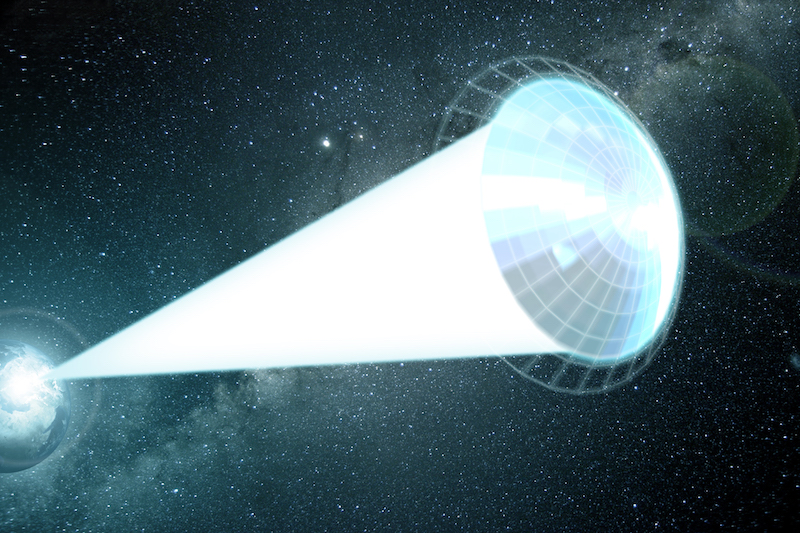
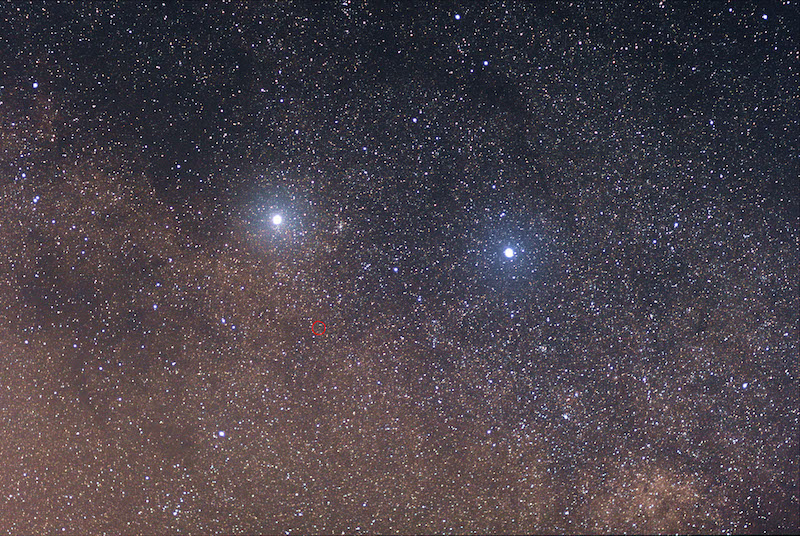
Outer space is big. Really, really, really big. And that’s why NASA has no plans at present to send a spacecraft to any of the several thousand known planets beyond our solar system. But, if we were to plan a trip, Alpha Centauri is an obvious target. It’s the nearest star system to our sun at 4.3 light-years away. How soon could we reach Alpha Centauri? Could we reach any of the nearest stars, in a reasonable amount of time? A new and more durable solar sail spacecraft might be part of the answer.
A new way to travel to Alpha Centauri?
Ordinary rockets won’t work for star travel. They are much too slow. But in February 2022, researchers at Penn Engineering and the Breakthrough Starshot initiative said they’re working on a new method of traveling to the nearest star system.
Their new concept uses a new, more durable solar sail. If it works, it could reach Alpha Centauri in as little as 20 years.
The researchers have published two new peer-reviewed papers outlining the concept. Both papers can be found in ACS Publications, published on December 23, 2021 and January 11, 2022, respectively.
The aim of Breakthrough Starshot
The concept stems from an announcement in April 2016, by Russian high-tech billionaire Yuri Milner. He founded a new and ambitious initiative called Breakthrough Starshot, with the intention to pour $100 million into proof-of-concept studies for an entirely new technology for star travel. It aimed for a speed of 20% of the speed of light, with the goal of reaching the Alpha Centauri system – and, presumably, its newly discovered planets Proxima b and Proxima c – within 20 years.
But is it possible? Researchers have been trying to answer that question.
A new, more durable solar sail
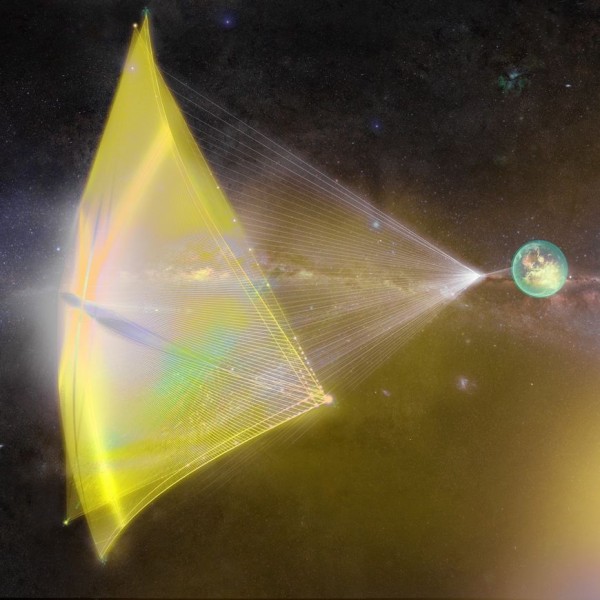
In theory, a solar sail spacecraft should work for star travel. But, in practice, the sail needs to survive the long journey to Alpha Centauri. The new studies focus on a stronger, more durable solar sail. Igor Bargatin at Penn Engineering explained:
Reaching another star within our lifetimes is going to require relativistic speed, or something approaching the speed of light. The idea of a light sail has been around for some time, but we’re just now figuring out how to make sure those designs survive the trip.
The newly planned probe is really tiny. It’s about the size of a microchip. The sail, about 10 feet (3 meters) wide, is incredibly thin: 1,000 times thinner than a sheet of paper. It is composed of ultrathin sheets of aluminum oxide and molybdenum disulfide.
With the use of lasers, these researchers say, this tiny probe from Earth could travel up to 1/5 the speed of light. That’s fast enough to reach Alpha Centauri in 20 years.
Tearing and melting
Earlier versions of solar sails relied on sunlight alone to power them. But Starshot’s new design would use ground-based lasers to help push the sail to faster speeds. The light intensity would be millions of times greater than using only sunlight.
To achieve this, however, the sail must be able to withstand the danger of tearing or melting.
One solution, the subject of the first paper, is to have the sail billow out like a parachute instead of just remaining flat. It would be about as deep as it is wide. Such a sail could withstand the strain of hyper-acceleration, a pull thousands of times that of Earth’s gravity.
Bargatin said:
The intuition here is that a very tight sail, whether it’s on a sailboat or in space, is much more prone to tears. It’s a relatively easy concept to grasp, but we needed to do some very complex math to actually show how these materials would behave at this scale.
Matthew Campbell, lead author on the first paper, said:
Laser photons will fill the sail much like air inflates a beach ball. And we know that lightweight, pressurized containers should be spherical or cylindrical to avoid tears and cracks. Think of propane tanks or even fuel tanks on rockets.
Nanoscale patterning
The second paper focuses on how to dissipate the heat from the laser. The answer, the researchers say, is nanoscale patterning (nanolithography). Nanolithography is a branch of nanotechnology and the name of the process for imprinting, writing or etching patterns in a microscopic level in order to create incredibly small structures. According to Aaswath Raman at UCLA:
If the sails absorb even a tiny fraction of the incident laser light, they’ll heat up to very high temperatures. To make sure they don’t just disintegrate, we need to maximize their ability to radiate their heat away, which is the only mode of heat transfer available in space.
So, how do you maximize the thermal radiation of the sail? Previous versions used a photonic crystal design, where regularly-spaced holes were added to the material of the sail. Now, the new study suggests an additional means of protection: lashing swatches of the sail fabric into a grid.
This doubles the effectiveness of the sail to withstand tearing and melting. The spacing of the holes matches the wavelength of light, and the spacing of the swatches matches the wavelength of thermal emission. By doing this, the sail can withstand a stronger initial push by the lasers. This, in turn, reduces the amount of time the lasers need to be focused on the target on the solar sail.

Why conventional rockets won’t work
This all sounds great, but why can’t we just use regular rockets?
Consider the Space Shuttles that traveled only a few hundred kilometers above Earth’s surface into Earth orbit. If Earth were the size of a sand grain, this distance would be about the width of a hair in contrast to the corresponding 6-mile (10-km) distance to Alpha Centauri in the same scale.
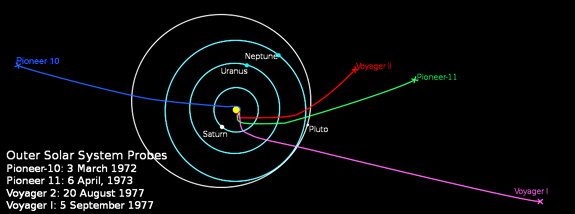
The space shuttles weren’t starships, but we have built starships. Five craft from Earth are currently on their way out of the solar system, headed into interstellar space. They are the two Pioneer spacecraft, the two Voyager spacecraft and the New Horizons spacecraft. All are moving extremely slowly relative to the speed needed to travel among the stars.
So … consider the two Voyagers – Voyager 1 and Voyager 2 – launched in 1977. Neither Voyager is aimed toward Alpha Centauri, but if one of them were – assuming it maintained its current rate of speed – it would take tens of thousands of years to get to get there. Eventually, the Voyagers will pass other stars. In about 40,000 years, Voyager 1 will drift within 1.6 light-years (9.3 trillion miles) of AC+79 3888, a star in the constellation Camelopardalis. In some 296,000 years, Voyager 2 will pass 4.3 light-years from Sirius, the brightest star in the sky. Hmm, 4.3 light-years. That’s the distance between us and Alpha Centauri.
What about the New Horizons spacecraft, the first spacecraft ever to visit Pluto and its moons? New Horizons travels at 36,373 miles per hour (58,536 kph). Launched from Earth in mid-January 2006, it reached Pluto in mid-July 2015 … 9 1/2 years later. If New Horizons were aimed toward the Alpha Centauri system, which it isn’t, it would take this spacecraft about 78,000 years to get there.
So, conventional rockets won’t work because they are simply too slow.
What about a warp drive?
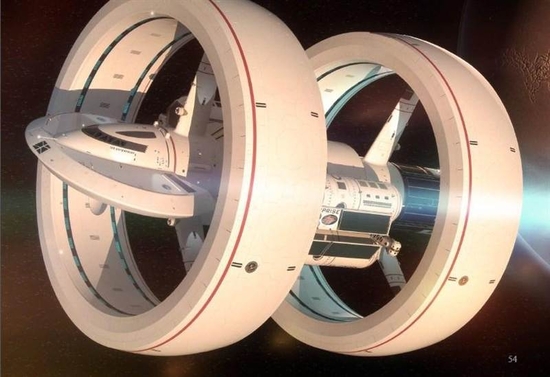
What if we could travel faster than light? Countless sci-fi books and movies are built around the concept, which brings with it challenges to physicists’ understanding of how space and time actually work. Still, a few years ago, Harold “Sonny” White – who leads NASA’s Advanced Propulsion Team at Johnson Space Center – claimed to have made a discovery that made plausible the idea of faster-than-light travel, via a concept known as the Alcubierre warp drive.
This concept is based on ideas put forward by Mexican physicist Miguel Alcubierre in 1994. He suggested that faster-than-light travel might be achieved by distorting spacetime.
White has been working to investigate these ideas further. They are highly speculative, but very cool. See the 2014 faster-than-light spacecraft designs on this Flickr page.
Future plans for the solar sail
The researchers will continue their testing of their new solar sail design. Deep Jariwala at Penn Engineering said:
A few years ago, even thinking or doing theoretical work on this type of concept was considered far-fetched. Now, we not only have a design, but the design is grounded in real materials available in our labs. Our plan for the future would be to make such structures at small scales and test them with high-power lasers.
Bottom line: The distances between stars are vast, which is why star travel is so far. But now, a new solar sail may be able to travel to Alpha Centauri in 20 years.
Source: Relativistic Light Sails Need to Billow
Source: Multiscale Photonic Emissivity Engineering for Relativistic Lightsail Thermal Regulation
Like what you read?
Subscribe and receive daily news delivered to your inbox.
More from
Deborah Byrd


Summer Triangle: Star pattern of the season


