EarthSky // Tonight // Moon Phases By Deborah Byrd May 24, 2012

Understanding moon phases

Why does the moon seem to change its shape every night? Remember that the moon is a world in space – with a day side and a night side.

Why does the moon seem to change its shape every night?

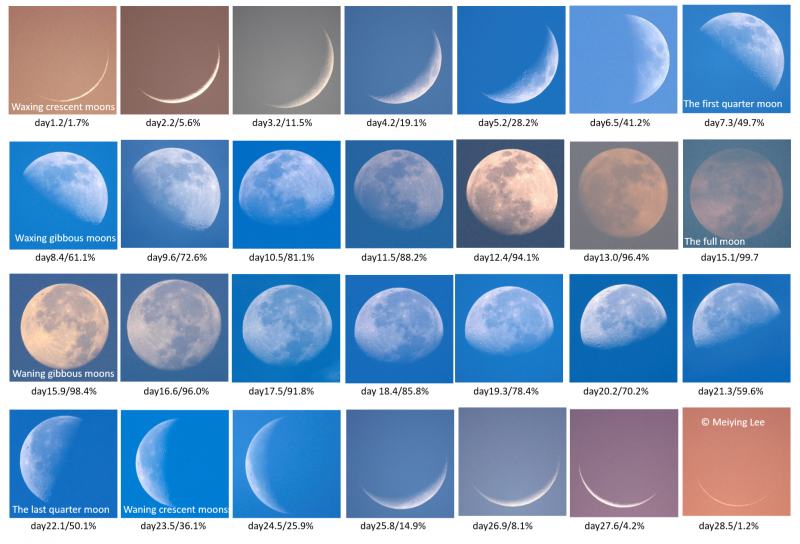
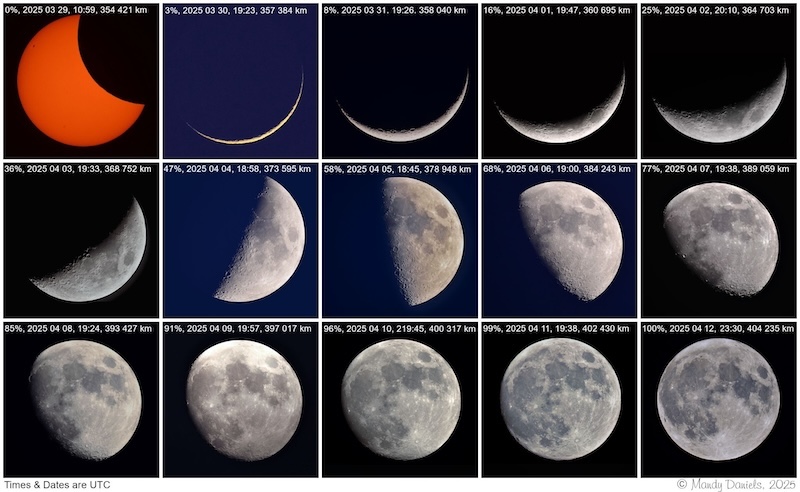
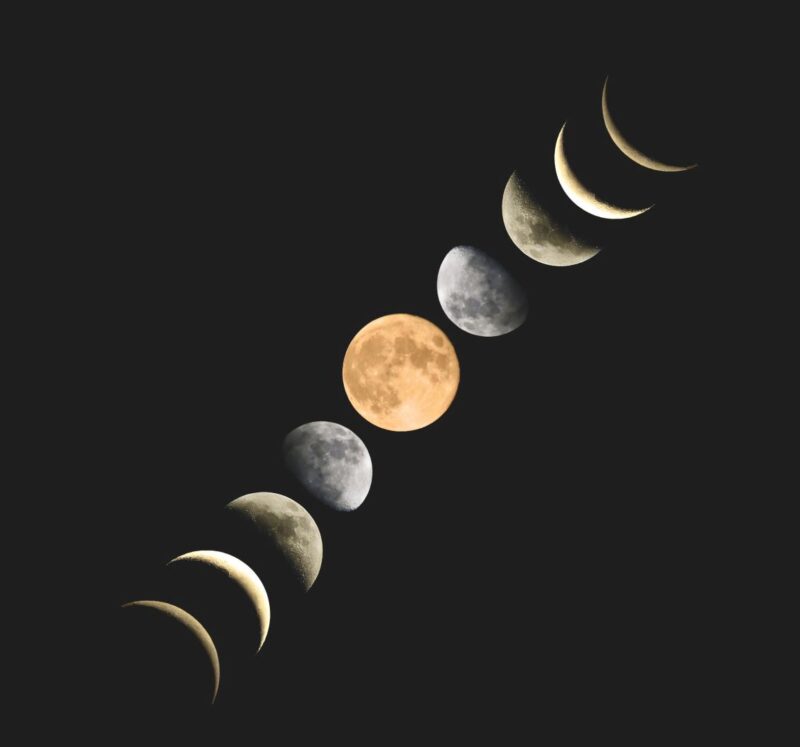
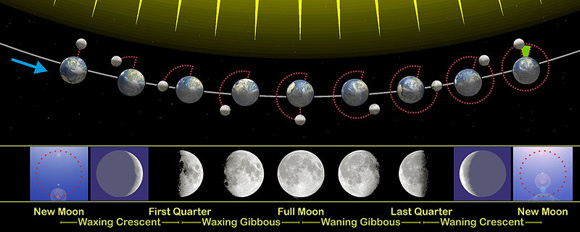
The answer is the moon is a world in space, just as Earth is. Like Earth, it’s always half illuminated by the sun. In other words, the round globe of the moon has a day side and a night side. From our earthly vantage point, as the moon orbits around Earth, we see varying fractions of its day and night sides. These are the changing phases of the moon.

As the moon orbits Earth, it changes phase in an orderly way. Follow these links to understand the various phases of the moon.

Photo credit: Glass House

Waxing Crescent
First Quarter
Waxing Gibbous
Full Moon
Waning Gibbous
Last Quarter
Waning Crescent
New Moon

… and here are the names of all the full moons.

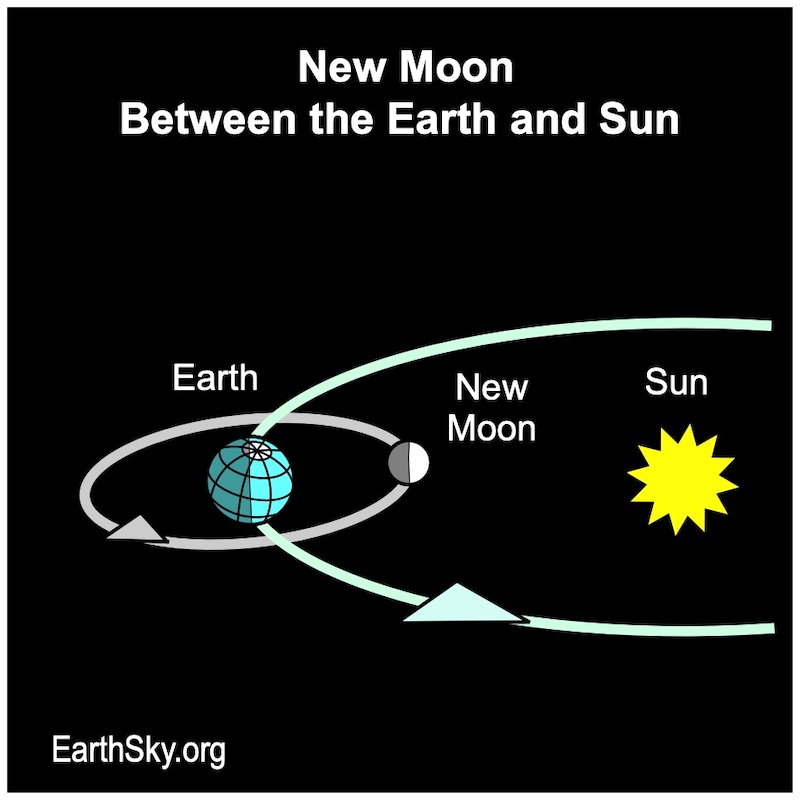
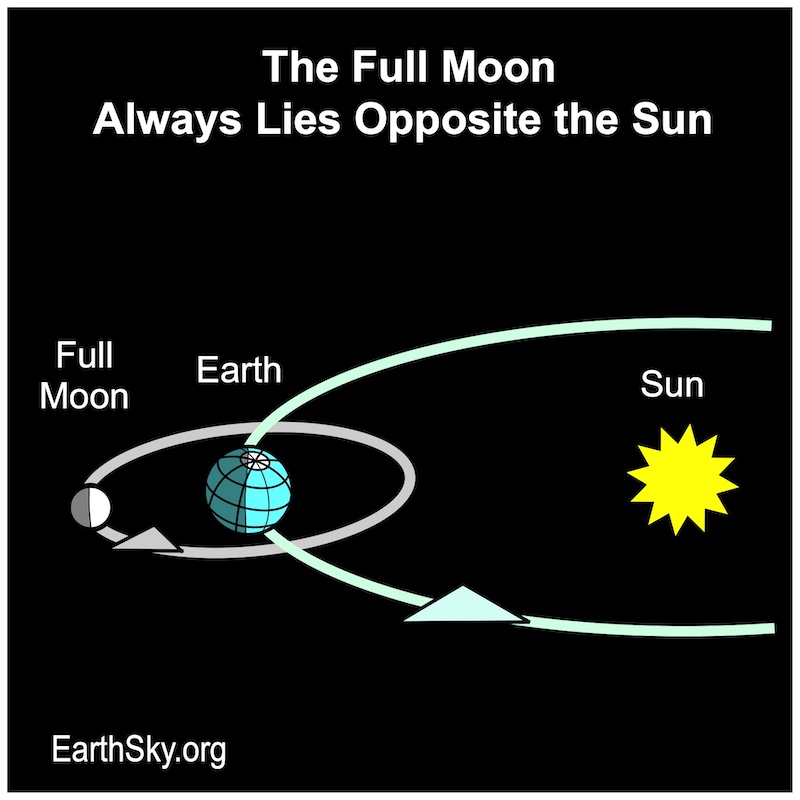
One key to understanding moon phases is to think about the whereabouts of the sun. After all, it’s the sun that’s illuminating and creating the day side of the moon. Moon phases depend on the sun. They depend on where the moon is with respect to the sun in space.

Another key to understanding moon phases is to remember that, like the sun and all the planets and stars, the moon rises in the east and sets in the west each and every day. It has to. The rising and setting of all celestial objects is due to Earth’s continuous spin beneath the sky.

Also, remember that the moon takes about a month (one “month”) to orbit the Earth. Although the moon rises in the east and sets in the west each day (due to Earth’s spin), it’s also moving on the sky’s dome each day due to its own motion in orbit around Earth. The moon’s orbital motion can be detected in front of the stars from one night to the next. It’s as though the moon is moving on the inside of a circle of 360 degrees. Thus the moon moves about 12 degrees each day.

The moon’s orbital motion is toward the east. Each day, as the moon moves another 12 degrees toward the east on the sky’s dome, Earth has to rotate a little longer to bring you around to where the moon is in space. Thus the moon rises, on average, about 50 minutes later each day. The later and later rising time of the moon causes our companion world to appear in a different part of the sky at each nightfall for about two weeks. Then, in the couple of weeks after full moon, you’ll find the moon rising later and later at night.
Share your comments on Facebook

33 Responses to Understanding moon phases

  1. ashley mitchell says:

    it’s fun

  2. Celeste Cook says:

    This is a very informative website. I am finding it very useful as I review for an important exam.

  3. Bob Suri says:

    Pretty good website- Loved It
    :)

  4. erica says:

    very nice website. it helped me with my report :D

  5. brad morrit says:

    :P ;) :) :D :( :’( :O lol

  6. Bill Baumgardner Sr. says:

    It is so good to read that someone else knows that the moon is an earth also. Many people do not know this. I also know that each & every star is a planet also, just like ours, only in a different phase of existance. Our earth will one day be celestialized & moved closer to the planet Kolab, which is close to where Heavenly Father dwells. Just a little Gospel Truth for thought. :)

    • Andy says:

      Bill, you’ve missed the point. The stars are not planets. Stars and planets are mutually exclusive objects. An object in the sky can be a planet, or a star, but not both – although Jupiter, for example, does emit its own light in certain spectrums, giving off more energy than it receives from the sun. This does not make it a star, however. It would have to be many, many dozens of times more massive to shine by its own light.

      What do you mean by “celestialized?” We’re floating – read: hurling – through space right now. We could hardly be more celestialized as it is.

      And ‘Kolob’ is not a planet. I’m sorry, but you’re dead wrong about these “truths.” Everyone is entitled to their own opinions, but not their own facts.

      • Paula says:

        Thank you Andy… That was almost painful to read. But hey, to each their own… Maybe these facts will challenge Bill’s notions enough to broden his research ;-)

      • J says:

        I don’t know how you respond to bill with such clarity. I just get all confused about how such numb brains remain alive… Who makes that kind of stuff up? But yes, thank you Andy for such a mature response to Bill.

  7. julian says:

    cool web sight ms.klatt

  8. manjunath says:

    its my question …

    when moon is covered by earth(full moon phase)means sun raysdirecttly will not fall on moon so moon should not visible why it looks full moon?

    • Rose says:

      You are describing a lunar eclipse, when the earth is exactly in line between the sun and the moon. Most of the time, they are not exactly in line and we can see the lit surface of the moon.

    • EarthSky says:

      Manjunath,

      Rose is right – sounds like you’re describing a lunar eclipse, when the Earth, sun and moon are lined up in space – with Earth in the middle – so that Earth’s shadow falls on the moon. At such a time, some light filters through Earth’s atmosphere onto the shadow on the moon’s darkened surface – so you can still see the moon – and the filtered sunlight makes it look reddish.

      As Rose says, eclipses don’t occur every month. Most of the time, the alignment is not exact, and Earth’s shadow sweeps past above or below the full moon.

      - ES

  9. LKT says:

    You should note that stargazing is best during the new moon, when the moon is invisable in the sky. This happens about once a month. About two weeks later it’s the worst time for stargazing as it will be a full moon which will drown out the sky with light.

  10. [...] from EarthSky.com on the moon’s phases.  To start the month—a nice, concise, relatively clear explanation of the changing phases of our moon: Why does the moon seem to change its shape every [...]

  11. Sean Adams says:

    there is only 1 thing to know about full moons………….it is when werewolves come out

  12. Rieman says:

    How can I build an instrument to find out how the moon’s coordinates changes through observing the moon . As we know it rise and set like the Sun, and every night it appears 50 minutes later in the sky.I know the my instrument must have some reference for my eyes and for the Moon.Let me know how to build such an instrument, please.

  13. [...] conjuction with tomorrow’s New Moon, we begin with a nice, concise, relatively clear explanation of the changing phases of our moon: Why does the moon seem to change its shape every [...]

  14. Cat says:

    Is it just something I’ve never noticed…..but has the moon, in it’s phases, always been lit by the sun on it’s bottom half? Doesn’t the phases of the moon go from left to right in our view on earth? Am I just seeing an eclipse at those times the moon is lit from below?

  15. Sandeep says:

    Why moon rises 50 minutes late everyday? Here is the answer http://www.parkhi.net/2011/11/why-moon-rises-50-minutes-later.html

  16. david lang says:

    Thank you for thr great information presented on this site! Last night I was able to capture great photos of Mars and it’s two moons to add to my night photography collection (which includes hundreds of phetos of Jupiter and the four Galialean moon cams). With the help of this site now I am ready to capture Saturn! By the way, fancy equipiment isn’t needed to get these shots, the camera I use is a Kodak Z981 with it’s 26X power optical zoom – the camera costs $250-$300.

  17. Gen Montoya says:

    Feb 3, 2012
    Love all info regarding our Universe; I read many books on our solar system plus anything on the Milky Way and much more, never get tired of reading or watching this great stuff & makes me wonder much more about our existence and God.

  18. [...] off dust particles that move in the same plane as Earth and the other planets orbiting our sun. Understanding moon phases  Share [...]

  19. colton says:

    awesome picks

  20. [...] Drawing Down the Moon (PBP – Week 7)Trip to the MoonTwitter Weekly Updates for 2012-02-11Understanding moon phases [...]

  21. siti khadijah says:

    The orion’s belt is very clear to see tonight, I’m looking it in the front of my house. The sky looks very beautifull.

  22. Rua Lupa says:

    I’ve been wondering, especially since watching Carl Sagan’s Cosmos series sometime back, why hasn’t been the terms “sunrise” and “sunset” been renamed to be accurate? Ever since the discovery that not everything revolves around the earth, the scientific community should have come up with something by now. Like “turn to sun” and “turn from sun” for example (possibly using Latin instead – Avertosol, Revertosol) Its just plainly confusing otherwise.

  23. khalid says:

    Hello

    I did noticed a very strange and un normal movement of the moon tonight,it changed the direction of its movement and it did moved very very slowly,I did see a very strong light like a house bulbs bur very powreful one just above of it .

Share your comments on EarthSky

Your email address will not be published. Required fields are marked *

*

You may use these HTML tags and attributes: <a href="" title=""> <abbr title=""> <acronym title=""> <b> <blockquote cite=""> <cite> <code> <del datetime=""> <em> <i> <q cite=""> <strike> <strong>