
EarthSky // Blogs // Human World By Larry Sessions Sep 09, 2008

The real danger of the Large Hadron Collider

There is a sobering fact, well known to science but little known in public. It is a fact related to Einstein’s famous equation, E=mc2, and one that is frightening in its scale. The average 75 kg person (about 165 pounds), has lurking in his or her genes — or more specifically, in his or her…read more »

There is a sobering fact, well known to science but little known in public. It is a fact related to Einstein’s famous equation, E=mc2, and one that is frightening in its scale.

The average 75 kg person (about 165 pounds), has lurking in his or her genes — or more specifically, in his or her atoms — an amount of energy equivalent to about 1.6 gigatons of TNT, some 28 times greater than the largest nuclear bomb ever exploded (Tsar bomba, Soviet Arctic, 1960, 57 megaton yield).

Should your nucleons suddenly ignite in 100 percent conversion of matter to energy, the resulting release of energy would be the equialvent of an asteroid several hundred meters across (about a quarter mile) colliding with the Earth at 17 km (nearly 11 miles) per second. The impact would be sufficient to completely obliterate a large metropolitan area, gouge a crater about 5 km across and 300 meters deep. (That’s about 3 miles across and 1000 feet deep). This is several times larger than the Barringer Meteor Crater in Arizona. The surface effects including an atmospheric shockwave would decimate everything for many kilometers around, and would send a blast of heat to incinerate everything in its path. The resulting earthquake would be severe over a wide area, and the dust and debris thrown up by this event would gradually encircle the Earth, possibly even triggering a kind of “nuclear winter” sufficient to cool the temperature of the planet for months or years, killing vegetation and then the animals and people who depend on them thousands of kilometers away.

Given the amount of energy that Nature has stored in the matter of your body, your detonation would change the course of history and kill millions, leaving no trace of you except in the photons of energy that escape into space and the vibrations and heat captured by the planet.

Based on the laws of quantum physics, everything here is true. You do embody the awesome force of nature. However, how likely is it that you will suddenly explode in a nuclear holocaust? Quantum physics is probably the most studied and confirmed theory of nature in history. As with everything, there are problems and things we don’t yet understand about it, but the energy stored in particles is not one of these. This has been proved far beyond doubt. Witness the nuclear bomb, for instance.

Another thing, less widely known, is that quantum physics is a statistical study, and based on its laws, we can express the probability of almost anything happening. It is not absolutely impossible for all the mass in your body to suddenly transform into nuclear energy. But on the other hand, it isn’t likely. Not likely at all. There is an equation to calculate such probabilities, but I would not be so rash as to try and apply it here. However, suffice it to say that you and your immediate descendants are more likely to win first in every single lottery and contest on the planet Earth, every day of every year for the next million years, than you are to spontaneously transform into nuclear energy. It is not exactly impossible, but it is about as close to impossible as it is possible for anyone to imagine. There are better things to worry about.
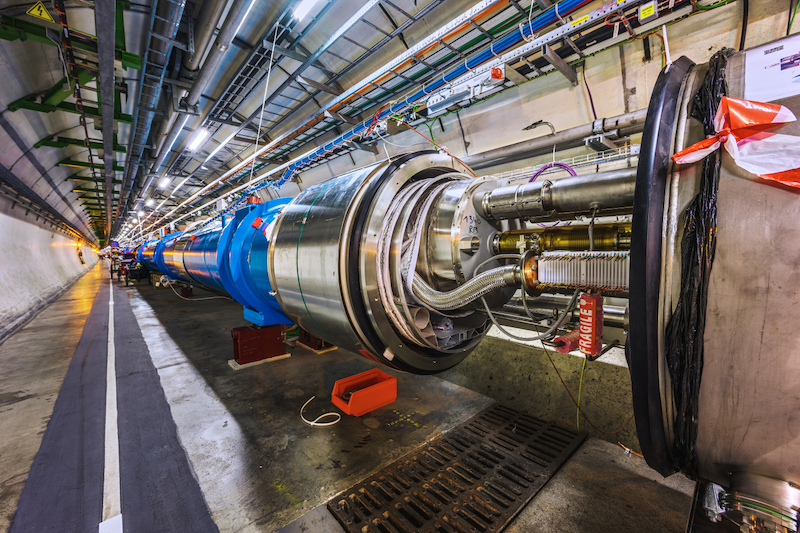
This brings me to the CERN’s Large Hadron Collider (LHC), the latest “atom smasher” scheduled to open on September 10. This enormous new scientific instrument, and many associated instruments, can and will change our conception of the Universe, its inner workings and its origin. But, just as with you and your incredible store of nuclear energy, there is a chance that this collider could produce “mini” blackholes that in the bizarrest and indescribably unlikely of scenarios, could damage the Earth. And as with the chances of you suddenly detonating, the chances of any planetary harm due to the LHC, is frankly unimaginably small.

It is not so unimaginable that the LHC could produce “mini” blackholes, but these are not anything like the popular conceptions of a black hole, fueled by often highly inaccurate movies and over-anxious imaginations. The “mini” black holes that the LHC could produce — although still unlikely — would be microscopic at best, and unstable, which in this case just means that the could last only a tiny fraction of a second at most. Any that are produced — and again this is unlikely in the first place — will “evaporate” long before they would have any chance of pulling in any other matter. In any event, their mass would be far too small to produce enough gravity to pull in matter even as large as a microbe.

The real and dangerous thing about the LHC is not any imagined threat that it poses, but rather the unbridled, unschooled and utterly absurd fears promulgated by uninformed people. Of course such things have always occurred such as in the with hunts of the middle ages, but today absurdities spread with the speed of light through the Internet, and can have potentially deleterious affects on genuine and well-founded research. Too bad that human reasoning and the intelligence of the average public (which of course my dear reader, does not include you) has not kept up with the pace of technological development.

There is far, far, far more potential harm in the outcome of the current election season than there is of even the smallest hair on your head igniting in a bizarre nuclear transformation.

Keep in mind that physicists are people, too, not the “mad scientists” of moviedom. They have families. They love life as much as anyone else, and would not pursue the LHC and related technologies if they felt that there was any reasonable concern about safety. Also keep in mind that Physics is the most basic study of Nature. They are looking for truth. Yes. physicists developed the atomic and nuclear bombs, but that was under order from politicians. If you trust anyone, trust physicists, not politicians. Politicians sometime have to make the decision to go to war, and sometimes that is justified and should not be criticized (although sometimes if should be). Mark Twain once said something like “Be faithful to your country always, and to your government when it deserves it.”

In general, physics is a search for truth. The same is true for other sciences. Politics is a search for votes and power. Trust physics.

Spread the truth, and please don’t forward on emails with absurd claims, conspiracy theories or any of a host of other claims by people who know naught of which they speak.
(As clarification, the transformation of energy in a nuclear (fusion) bomb and in the Sun is not 100 conversion of all matter involved into energy. In fact it is on the order of 1 to 2 percent. The only process that we know of that reliably converts 100 percent of mass into energy is a matter-antimatter interaction — and yes, that is what they talk about in Star Trek and in fact has been demonstrated many times on a very small scale.)

Special thanks to the Dr. David Morrison and the Asteroid and Comet Impact Hazards (NASA) website.

Image Credit: Don Davis

Share your comments on Facebook

61 Responses to The real danger of the Large Hadron Collider

  1. Poe,
    Thank you for your comments and kind words. Fact is, I’ve not gone anywhere, but I ahve been very busy. This semester I have had 6 sections of 4 courses for 3 different schools, and dealing with more than 200 students takes a lot of time. But I have been here and will be here and I enjoy answering questions (if I don’t know the answer, I’ve gotten good at faking it — just kidding! (:^/)

    LS

  2. Hello, its Travis

    I have something 2 say.

    I am worried about the LHC. I need some reasuring info about the LHC. please.
    :(

    TRAVIS TRIANGLE >

  3. Travis, I am afraid that you have missed the point of this blog. The “real” danger of the LHC is not what might happen there, but what happens in the minds of people who hear highly distorted media reports and don’t know enough of the background physics to recognize it for the garbage it is. The fact is that there is nothing to worry about, except an irrational fear of the unknown. The LHC will not spawn black holes that will gobble up Earth, or cause anything of danger. Widespread danger and destruction from the LHC is less likely than you suddenly sprouting antlers and a glowing red nose, and flying away with Santa on Christmas Eve. The bottom line is, it ain’t gonna happen.

    If you feel the need to worry about something, pick something with a higher chance of actually happening. Like the polar ice caps melting, or being attacked by killer bees, or a blizzard in Los Angeles. Heck, it’s much more likely that sharks will sprout legs and crawl up out of the oceans to take control of the world than something terrible happening with the LHC. So find something scarier to worry about.

    And, by the way, you might want to stock up on extra heavy duty shark repellent.

    LS

  4. Keir says:

    A very interesting read for a very interesting project, I must say though I was a tad alarmed when I first heard about this instrument. Not because of the creation on “blackholes” and scare mongerers touting the end of the world, but due to the fact that the scientists were attempting to recreate the “Big Bang” a much larger event than that of a “blackhole”. I’m sure the people coordinating these experiments have crunched the numbers and taken everything into account, but just for a brief second, think about the implications of recreating the creation of our universe.. Thats a pretty monumental event, what does that mean for the current universe, will there BE any way to contain an event with such a massive amount of energy. All things aside this is a very exciting time for science and discovery, I’m excited to be alive during this time

  5. Keir,
    Thanks for your comment, but you are very far off if you think that the scientists with the LHC are trying to recreate the Big Bang! No way. All they are trying to do is to create the conditions — on a very small scale — that predominated at a time very near the time of the Big Bang. The closer we can get to those conditions, the better we can understand the Big Bang (or whatever created the Universe). We certainly are not now capable of creating the conditions at the precise moment of the Big Bang, and may never be due to the phenomenal temperature and pressures. But we can get close.

    However, what you may be misunderstanding is the energy involved. The energy needed to create the Big Bang was more than ALL the energy in the Universe today. (Some of the energy at the time of the Big Bang was converted into matter, so the energy left over today is a bit less). So in order to recreate the Big Bang in a lab, we would need more than all the energy in the Sun, more than all the energy in the 200 billion or so stars in the Milky Way, more than all the energy in all the hundreds of billions of galaxies in the Universe. That’s not just difficult, it is impossible.

    Granted, much smaller amounts of energy could do great damage, but even if the LHC could produce energies capable of destroying anything, it would be the lab or maybe the building, certainly not the Earth. Physicists, astronomers and other scientists have families and lives and they loving living as much as anyone else. They are not the nutjobs so often depicted on TV and in the movies. They would not pursue this project if they thought that there was any reasonable chance that a catastrophe would occur.

  6. Ron Ellis says:

    The scientific method of experimentation has no appeal to authority. It seems quite a few science writers don’t understand this point; preferring to label skeptics as unschooled and uninformed.

    Your analogy about the statistical chance of spontaneous combustion of a human form just doesn’t work. The LHC is about recreating conditions which do not occur precisely this way in nature near our biosphere. I know there’s some evidence that they might but note that a) this is not certain; and b) note how the safety of this experiment hinges on this assertion. But even they do, why not study these natural phenomena a little bit longer as theoretical work advances?

    As to chances, we know there’s a chance of blackhole formation. In the case of this experiment, it is not a random chance (at least we can say that). We also have a theory about black hole radiation which has less of a basis in observation than the formation of black holes. So there’s a chance any such construct would decay immediately. We’re not sure what that chance is either.

    Now balance these unknown chances (which could be small or large) against the destruction of everything. Do a thought experiment on a 44 month collapse of our biosphere. How much of us would survive. You know enough about our space to technology to know that not even Nixon’s signature would escape. That’s the stakes. We don’t know the risk; we do know the stakes.

    Einstein’s theory was developed long before it was observed. We can afford to have much more theoretical work done before we smash particles together at abnormal speeds to merely see what happens.

    The whole enterprise reminds me of the credit default swap idea. Look how that turned out.

  7. It is good that science has “no appeal to authority.” But it does appeal to experience, observation, experimentation and logic. In my opinion, the physicists and other scientists working on a project such as the LHC certainly have more experience, have made more observations, performed more experiements and are in more of a position to make logical decisions on this than is the lay public.

    There needs to be oversight and public input into scientific work, but we also in reason must leave the major decisions to those who are most likely to understand the possible and likely outcomes. Physicians needs to be properly trained and highly experienced before cutting open a heart. Physicists must be properly trained and highly experienced before being allowed to experiment with an enormously expensive project such as the LHC. Now, we would not expect the heart surgeon to not stop in the middle of a bypass operation to call up his high school English teacher to ask which artery to cut, and where. Why then should we expect physicists to stop, delay or modify their research based on the input of bankers, journalists, outdoors men, cab drivers — whoever — who have no significant training in science. This is not an issue of arrogance or “appeals to authority” but just plain common sense.

    The concern over the so-called “mini black holes” shows just how poorly the general public understands the topic, not to mention science in general, and how thoroughly they are influenced by bad (uninformed and sensationalist) journalism. In this sense the Internet has made things worse by allowing the spread of rumors, half-truths and often utter fabrications around the world in a matter of seconds.

    Here is where the “appeal to authority” comes in. We should question the authority of everything we read, especially on the Internet and in supermarket tabloids. But we must apply reason and common sense as well. We cannot reject all authority because that would mean that we would have to start back at the beginning of everything to learn everything through our own experience. We must reject or at least question the authority of anything that comes from unreliable or unknown sources. At the same time, it is intelligent to cautiously accept the authority of those who have earned it through academic preparation, experience and peer review. (Note that I said “cautiously” not “blindly”). Generally speaking, the greater authority, the more likely it to be genuine. To pose a rhetorical question, I have to ask, which would give you the most confidence, a thousand scientists saying that the Sun will rise in the morning, or 100 scientifically untrained lay people saying that it will not? Who would you believe?

    The idea that science does not appeal to authority — that is, accepting something as true based on the authority of whoever is saying it — doesn’t mean that you throw away all knowledge up to that point and start from the beginning again. Instead, you proceed cautiously and build on the foundation of the many scientists who have gone before. If just one physicist was saying there is no danger in the LHC, and thousands of others were convinced that the “mini black holes” would destroy the Earth, then there would be cause for concern. But the fact is that the scientists working on this project — all of them as far as I am aware, but the vast majority in any event — understand the physics and realize that there is no reason whatsoever to worry about it. I’ve gone through this before, so I won’t explain it again, but the energies and time scales just don’t allow it.

    If we want to worry about something, let’s worry about real threats, such as hunger, the spread of disease, terrorism, and global climate change. We should have done something about global warming years ago — certainly scientists called for it — but conservative politicians and oil execs said no, the evidence isn’t conclusive, we must wait. You know, it’s funny, or maybe sad, that the public worries when science says that there is no reason for concern, and ignores them when they give a well-studied and researched warning.

    In any event, what needs to have been said has already been said and I do not intend to further repeat myself here.

    Believe what you choose to believe, but be prepared to accept the consequences. I choose to form my beliefs as far as possible on evidence and logic rather than yellow journalism, paranoia and hysteria.

  8. [...] Solar Power Station as seen on Something for the Weekend | I Saw It On The Box.comHow many nuclear power plants to reduce atmospheric GHG levels by 1 ppm? « A Musing Environment Lifeboat News: The Blog » Poll: Top 10 Existential RisksNintendo NES Complete Game List |eNewsAutoCar.com » Auto Industry Hybrid Cars Shows » Geneva 2008, Honda has a triple debut Green Acre: Let’s Make Papercrete! at Ryan Is HungryAstroprof’s Page » Artificial Gravity The real danger of the LHC at Larry Sessions [...]

  9. Jon says:

    Pseudoscientists also thought that Thalidomide would not harm at all human fetuses, because they had done the absurd “scientific” experiments with non human animals to avoid the teratogenic malformations in our species. However, 10.000 children were born without legs or with serious malformations. So if I the LHC scientists are of the same kind (and nowadays some pseudoscientists are doing the same experiments with animals, though they are not predictive) we must keep this project under suspicion. If 10.000 human beings are born with malformations or if the world is destroyed by the LHC, well anyone can make a mistake, even “scientists”.

  10. The old saying that people “fear what they do not understand” is certainly at work here. The scientists who understand the underlying physics of the LHC and its goals know that the dangers of any large-scale catastrophe are imaginary. That is not to say that nothing at all can go wrong, but any problems would be localized to the facility or at most, the immediate area. It is the uninformed, the ill-informed and the mis-informed — those who do not understand the underlying physics — who raise the fear of catastrophe.

    Equating LHC physicists with “pseudoscientists” is simply wrong, insulting and exposes a lack of understanding of how physics, as a profession, works. Physics is the science least tolerant of pseudoscience, and given the enormous cost of some experimentation at the LHC level, ill-conceived experimental programs and ideas are vetted out of the process long before they have any chance of being performed. I cannot speak to the biological experiments on thalidomide to which you refer, but I can say with some confidence that those programs were not anywhere near the cost of LHC programs, and were no doubt sponsored by the very drug companies who stood to profit from its use.

    There are many, many things of vastly greater danger than the LHC. Ignorance is one of them. Some things we can’t do anything about (at least for now), such as earthquakes, volcanic eruptions and worse yet — asteroid impact. But the LHC and legitimate scientists around the world are doing something about the ignorance. Let them do their jobs.

    LS

  11. Bill Housley says:

    Larry,

    Thank you for this enlightening article.

    Knowledge is power, and the only danger that this machine possesses is the likelihood that we’ll learn something dangerous from it. However, that is a political problem, not a scientific one.

    I also want to say a word to the folks who have posted here saying that life is meaningless. They should go out and make their life meaningful by serving others. Even if someone doesn’t believe in God, the afterlife, and an eternal purpose, they can still believe in and serve people, life, and the next generation.
